


Lactose intolerance shows up as five symptoms: wind, bloating, abdominal pain and cramps, nausea, and diarrhoea or needing the toilet urgently (healthdirect). They start when the small intestine makes too little lactase, the enzyme that breaks down milk sugar, so undigested lactose is fermented by bacteria in the large intestine.
Something sits badly after a latte or a bowl of ice cream, and you cannot tell whether it is lactose or something else. Other conditions cause the same symptoms, and cutting out dairy on a guess can cost you protein and calcium. So this page sticks to healthdirect, Better Health Channel, Dietitians Australia, the United States National Institute of Diabetes and Digestive and Kidney Diseases (NIDDK) and measured food figures.
Below: symptoms, causes, testing, when to see a doctor, how much dairy most people keep, and how to keep protein and calcium in without it.
What are the symptoms of lactose intolerance?
Healthdirect says the symptoms usually happen soon after you eat or drink products containing lactose, that drinking just 1 cup of milk can cause them, and that the more dairy you have the worse they get (reviewed December 2024). NIDDK says symptoms may begin within a few hours and can be mild or severe depending on how much lactose you have (NIDDK). The three sources do not list exactly the same symptoms.
| Symptom | healthdirect | Better Health Channel | NIDDK |
|---|---|---|---|
| Wind (gas, flatulence) | Listed | Listed | Listed |
| Bloating | Listed | Listed | Listed |
| Abdominal pain | Listed | Listed | Listed |
| Diarrhoea | Listed | Listed | Listed |
| Nausea | Listed | Not listed | Listed |
| Vomiting | Not listed | Not listed | Listed |
Healthdirect adds that these effects are short-term, that they do not damage the bowel, and that lactose intolerance has no long-term complications. Better Health Channel says to talk to your doctor if you are concerned. If a protein powder is the suspect, does whey protein have lactose sorts concentrate, isolate and plain whey by lactose content.
What causes lactose intolerance, and can it start in adulthood?
Lactase is made in the lining of the small intestine and splits lactose into glucose and galactose. Without enough of it, lactose travels on to the large intestine, where bacteria break it down into acids and gases, and the undigested lactose attracts water, which is why diarrhoea can follow (Better Health Channel). Yes, it can start in adulthood: NIDDK says that in lactase nonpersistence, the most common cause of low lactase, the small intestine makes less lactase after infancy, and symptoms may not begin until later childhood, the teen years or early adulthood.
Healthdirect says it is normal to make less lactase as you age. The sources name two other routes to low lactase:
- Injury to the small intestine (secondary): healthdirect lists gastroenteritis (which strips lactase for a week or two), a parasitic infection, coeliac disease and Crohn's disease. NIDDK says that once the cause of the injury is resolved, you may be able to tolerate lactose again.
- Congenital lactase deficiency: a rare condition in which the small intestine makes little or no lactase from birth (NIDDK).
Family background matters. Dietitians Australia says people with East Asian, West African, Middle Eastern, Greek, Italian, and Aboriginal and Torres Strait Islander backgrounds often produce less lactase and have a 70 to 95% chance of being lactose intolerant. A widely quoted worldwide estimate comes from a 2017 review the journal retracted in January 2025 (retraction notice, PubMed), so no global figure is printed here.
Is lactose intolerance the same as a milk allergy?
No: lactose intolerance is a problem digesting lactose, the natural sugar in milk, while a milk allergy is an immune response to one or more proteins in milk (NIDDK). NIDDK says a milk allergy most often appears in the first year of life, while lactose intolerance typically appears later, and that a serious allergic reaction to milk can be life threatening. If milk protein is the issue, dairy-free protein powder explains the bolded Contains line that names milk on a label.
Healthdirect lists swelling or tightness in the throat, difficulty breathing and vomiting as signs of severe milk allergy, and says to get urgent medical advice if you suspect a serious allergic reaction, because it is a medical emergency.
How do you test for lactose intolerance?
Your doctor will ask about your symptoms, family and medical history and eating habits, and may order tests (NIDDK). Healthdirect lists these tests:
| Test | What the source says it involves | Source |
|---|---|---|
| Lactose challenge | Eating or drinking a large amount of lactose, for example a milkshake, to see what happens | healthdirect |
| Lactose-free diet trial | Following a lactose-free diet for a while and noticing whether symptoms get better or worse; worse when lactose returns points to lactose intolerance | healthdirect, Better Health Channel |
| Hydrogen breath test | Measures hydrogen in your breath before and after a dose of lactose; NIDDK says you drink a liquid with a known amount of lactose and breathe into a container every 30 minutes over a few hours | healthdirect, NIDDK |
| Blood glucose or genetic test | Blood glucose is checked a few times after a dose of lactose; a genetic test looks for lactose intolerance genes (Dietitians Australia notes an out-of-pocket cost) | healthdirect, Dietitians Australia |
| Small bowel biopsy | A sample of the bowel wall taken during an endoscopy; invasive, so not often used | healthdirect |
Dietitians Australia says these tests are not conclusive on their own and should be read by your doctor and dietitian alongside your symptoms and diet. NIDDK notes that irritable bowel syndrome, coeliac disease, inflammatory bowel disease and small bowel bacterial overgrowth can cause similar symptoms. Better Health Channel adds a cheap, simple check, seeing whether you cope with lactose-free milk rather than ordinary milk; for a lactose-free stretch, lactose-free protein powder reads the powders' labels.
When should you see a doctor about lactose intolerance?
Healthdirect says that if you think you might have lactose intolerance, it is important to see your doctor or a dietitian. Dietitians Australia says the same symptoms can come from many other conditions, so it suggests discussing them with your GP before reducing or removing lactose. Healthdirect adds that if symptoms do not improve on a lactose-limited diet you should speak with your doctor or dietitian, and that a child with these symptoms is best taken to the doctor.
This section is general information, not medical advice. Decisions about any medication belong with your doctor.
How much dairy can you keep with lactose intolerance?
Healthdirect says you do not need to give up foods with lactose in them for good, and Better Health Channel says not to give up milk products entirely because they are an important source of calcium. The sources give different amounts:
- Better Health Channel: most people can handle small amounts of lactose, such as a glass of milk, and most can tolerate 240 ml of milk a day.
- NIDDK: research suggests many people could have 12 grams of lactose without symptoms or with only mild symptoms.
- Healthdirect and Dietitians Australia: most people can cope with about half a cup of milk at a time, and Dietitians Australia says to spread lactose-containing foods through the day.
Those are tolerance amounts, and the lactose in a glass depends on its size and the milk in it. So the lactose figures here come from one measured source, the Australian Food Composition Database (AFCD, Release 3.0, retrieved 6 October 2026), which lists lactose per 100g. Serves are ours; 250mL is counted as 250g, which slightly understates milk (specific gravity 1.03), and figures are rounded half-up.
| Dairy food (AFCD entry) | Serve | Lactose | Protein | Calcium |
|---|---|---|---|---|
| Milk, regular fat (about 3.5%) | 250mL | 13.8g | 8.5g | 273mg |
| Yoghurt, natural, regular fat (about 3%) | 150g | 7.7g | 8.0g | 273mg |
| Ricotta | 60g | 1.6g | 6.2g | 102mg |
| Cottage cheese | 60g | 1.1g | 10.2g | 53mg |
| Cheddar, natural, regular fat | 30g | 0.0g | 7.4g | 228mg |
Better Health Channel and Dietitians Australia both say yoghurt is generally well tolerated because its bacteria break down lactose, yet the AFCD entry for natural yoghurt still lists 5.1g per 100g; your own response is the test. Better Health Channel advises regular fat milk because it moves through the gut more slowly and some low-fat products contain skim milk powder; the AFCD lists plain reduced-fat milk at 5.0g per 100g against 5.5g for regular fat, so check the label of the milk you buy.
For the rest, the sources suggest:
- Lactose-free dairy: Dietitians Australia says lactose-free milk, yoghurt, ice cream and soft cheeses are made by adding lactase enzyme to break the lactose down; lactose-free protein shakes reads the ready-made shakes.
- Lactase tablets or drops: healthdirect and Dietitians Australia mention them from a pharmacy; ask your pharmacist or doctor whether they suit you.
- Hidden lactose: Better Health Channel lists biscuits, cakes, processed cereals, cheese sauce, cream soups, custard, milk chocolate, pancakes, muesli bars and some breads, and NIDDK adds protein powders and bars.
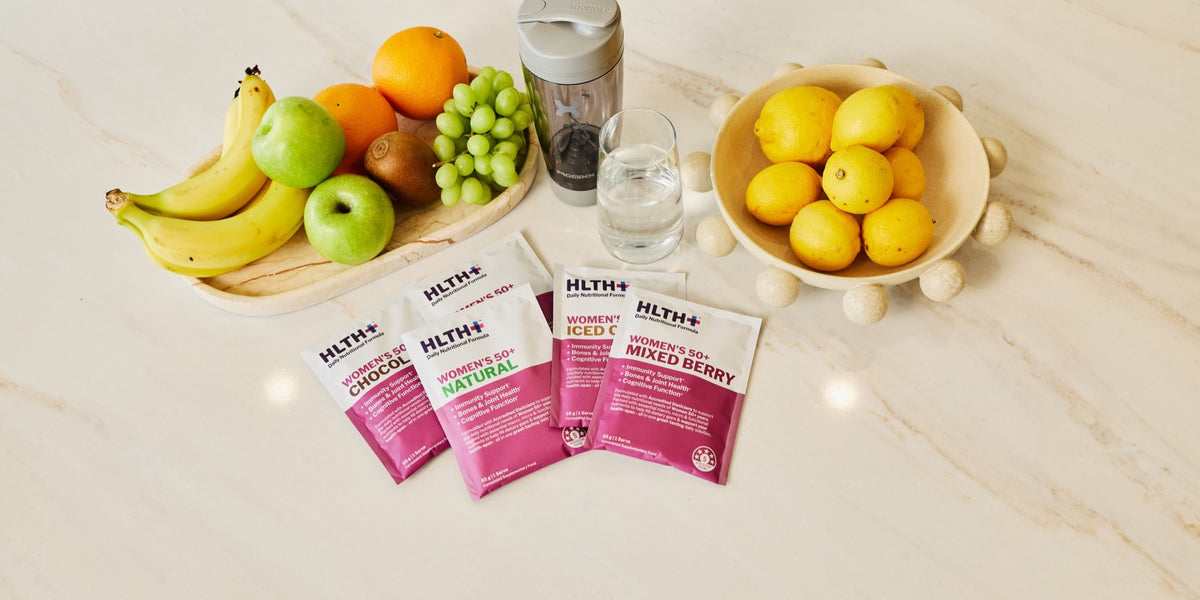
- Label words: healthdirect says to look for milk solids, non-fat milk solids, whey and milk sugar. One brand's six formulas show how milk and gluten statements differ by product.
What does dairy contribute, and how do you keep protein and calcium in without it?
Dietitians Australia says dairy foods are important sources of calcium, protein and other nutrients, and NIDDK says that avoiding all milk and milk products may leave you with less calcium and vitamin D than you need. Healthdirect says a dietitian can help you lower the lactose in your diet and still get enough vitamin B12. Over 90% of Australian adults do not meet dietary guidelines (AIHW), so a food group that drops out is worth replacing on purpose.
Learn more about nutrition when appetite is lower.
Every food below lists lactose as 0g in the AFCD; milk is the comparison row. Same serve rules as above.
| Food (AFCD entry) | Serve | Lactose | Protein | Calcium |
|---|---|---|---|---|
| Milk, regular fat (for comparison) | 250mL | 13.8g | 8.5g | 273mg |
| Soy beverage, regular fat (about 3%), added calcium | 250mL | 0.0g | 9.5g | 295mg |
| Oat beverage, added calcium | 250mL | 0.0g | 3.5g | 290mg |
| Almond beverage, no added sugar, added calcium | 250mL | 0.0g | 1.3g | 173mg |
| Tofu, firm | 120g | 0.0g | 15.4g | 247mg |
| Salmon, red, canned in brine, drained (flesh, bones and skin) | 100g | 0.0g | 24.4g | 130mg |
| Chickpeas, canned, drained | 150g | 0.0g | 9.5g | 68mg |
NIDDK names fish with soft bones such as canned salmon, tofu, almonds, dried beans, broccoli and leafy greens, and products with added calcium such as some soy milk. Healthdirect says soy products with added calcium contain no lactose, and Dietitians Australia says to look for the word "calcium" in a plant milk's ingredient list, because only fortified versions match the table. The AFCD soy beverage entry lists added sugars of 1.8g per 100g, so check your carton.
A 250mL glass of soy beverage (9.5g), 120g of firm tofu (15.4g) and 150g of canned chickpeas (9.5g) add up to 34.3g of protein. For protein quality, Better Health Channel says animal and dairy products "have large amounts of all of the essential amino acids and are known as high-quality protein", and soy products do too, while other plant proteins such as beans and lentils "contain all of the essential amino acids, but the amounts of one or two of these amino acids may be low".
For ready-made options, dairy-free meal replacement shakes reads the labels.
Where does a Formulated Supplementary Food fit beside food?
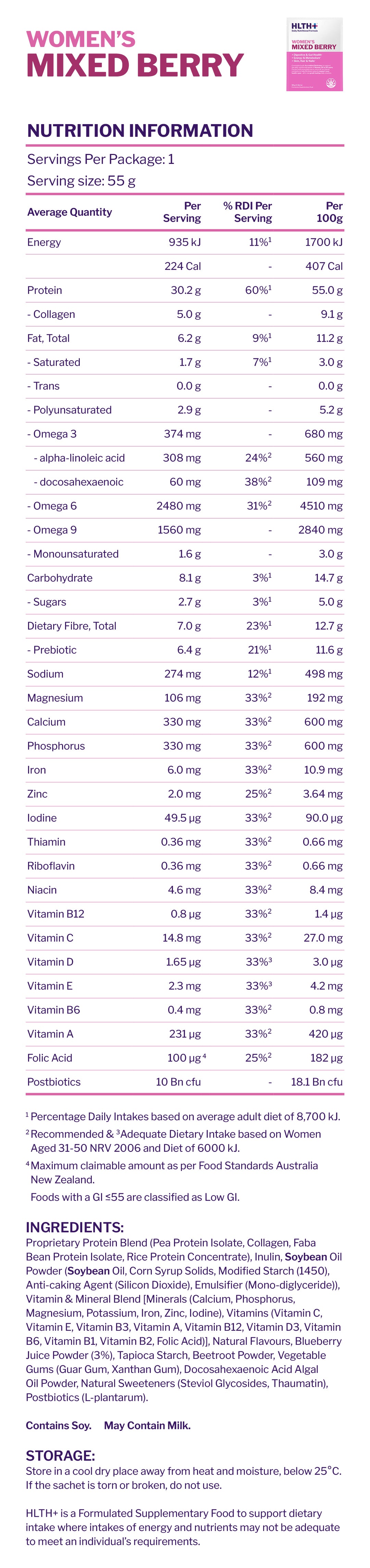
We believe in a food-first approach, but the AIHW figure above says food alone is not covering everyone. HLTH+ is an Australian-owned and made Formulated Supplementary Food under the FSANZ Food Standards Code, built to sit next to a diet, not replace it. One 55g Women's sachet carries 30g protein, 7g dietary fibre and 30 essential daily nutrients.
HLTH+ is dairy-free and gluten-free, so it is lactose-free. Allergen line: contains soy. The Women's Vanilla panel lists its protein blend as pea protein isolate, collagen, faba bean protein isolate and rice protein concentrate, so part of the 30g protein comes from collagen.
Under Schedule 4 of the Food Standards Code, protein contributes to the maintenance of muscle mass, as part of a healthy diet involving a variety of foods. Women's, Women's 50+, Men's and Men's 50+ are each formulated by Accredited Dietitians to the Nutrient Reference Values, the intakes published in 2006 by the National Health and Medical Research Council, the Australian Government Department of Health and Ageing and the New Zealand Ministry of Health.
HLTH+ is made in facilities complying with Good Manufacturing Practice and sells at hlthplus.com at RRP $6.00, or $5.10 a day on a 28-serve subscription at $142.80, plus Amazon AU and Chemist Warehouse online. The ✦ Find My Formula quiz shows what your current routine is not giving you: take the 30-second quiz.
If you can keep hard cheese, a little yoghurt or lactose-free milk, those carry protein and calcium on the food side. If you eat dairy-free, fortified soy or oat drinks, tofu and canned fish with bones do the same. If you want protein, dietary fibre and a balanced multivitamin profile in one dairy-free sachet, that is the job HLTH+ is formulated for.
See what your current stack is not giving you. The ✦ Find My Formula quiz shows the gaps in your existing routine before you buy anything. Start the quiz.
Frequently Asked Questions
How long after eating dairy do lactose intolerance symptoms start?
Healthdirect says symptoms usually happen soon after you eat or drink products containing lactose, and NIDDK says they may start within a few hours. Both point to the amount: healthdirect says the more dairy you have, the worse the symptoms get, and NIDDK says they can be mild or severe depending on how much lactose you have.
Can lactose intolerance cause vomiting?
It can. NIDDK includes vomiting in its list of lactose intolerance symptoms, while healthdirect and Better Health Channel leave it off theirs. Healthdirect also lists vomiting, with swelling or tightness in the throat and difficulty breathing, as a sign of severe milk allergy, and says to get urgent medical advice if you suspect a serious allergic reaction.
Can lactose intolerance go away?
Sometimes. Better Health Channel says secondary lactose intolerance, which can follow gastroenteritis, often improves after several weeks as the gut lining recovers, and NIDDK says that once the cause of the injury is resolved you may tolerate lactose again. Healthdirect says it can be a short-term problem and that you can slowly take in more dairy over time.
Leave a comment
This site is protected by hCaptcha and the hCaptcha Privacy Policy and Terms of Service apply.