

Ranked on calcium, the nutrient with the widest gap among those the Australian Bureau of Statistics reports for women aged 50 to 64, Blackmores Multivitamins for 50+ comes first and Centrum For Women 50+ second. Blackmores lists 325mg per tablet and Centrum 300mg, against the Food Standards Code labelling reference of 800mg, while Swisse Ultivite Women's 50+ lists 42mg and Cenovis Women's 50+ lists 26mg.
You are comparing four products that all say 50+, the amounts sit in small type on the back, and the front does not say what changed when the age on the label did.
This page sets out what to check, shows which nutrients Australian women over 50 fall short on, and ranks four products on their own published labels. HLTH+ publishes it and makes a Formulated Supplementary Food, so it sits outside the ranking, in a labelled comparison row.
What should a woman over 50 look for in a multivitamin?
Start from the gap. Over 90% of Australian adults do not meet dietary guidelines (AIHW), yet healthdirect notes that most people can get the vitamins and minerals they need from a balanced diet, so a tablet earns its place only where it covers what your food misses (do multivitamins work reads the trial evidence).
- Dose as a share of the reference figure. Schedule 1 of the Food Standards Code sets the reference figures labels are measured against (the RDIs): calcium 800mg, magnesium 320mg, zinc 12mg, iron 12mg, vitamin B6 1.6mg, vitamin B12 2 micrograms and vitamin D 10 micrograms a day.
- Whether it goes after your gaps. After 50 the Australian data points hardest at calcium and vitamin B6, while iron falls away (next section), and healthdirect lists calcium and vitamin D among the supplements that can help in specific situations.
- Whether the numbers change at 50. The Nutrient Reference Values, published in 2006 by the National Health and Medical Research Council, the Australian Government Department of Health and Ageing and the New Zealand Ministry of Health, set requirements in age bands that move at 50 and again at 70.
- Form and warning lines. Tablet or capsule, the allergen line and the printed warnings.
- Price per day. Pack price divided by days; only one of the four product pages below publishes a price.
How HLTH+ compares
HLTH+ is not a multivitamin tablet and does not rank below, so it appears in a labelled comparison row under the table. Women's 50+ is a Formulated Supplementary Food in a 55g sachet that carries 30g protein and 7g dietary fibre per serve, and none of the four panels lists either. The ✦ Find My Formula quiz shows what your current routine is not giving you (take the quiz).
Which vitamins and minerals are Australian women over 50 short of?
The Australian Bureau of Statistics models usual intake from food and drink and leaves supplements out, so it measures the gap a tablet would have to fill. In the 2023 release, 90.7% of females aged 50 to 64 had an inadequate calcium intake and 77.7% an inadequate vitamin B6 intake (Australian Bureau of Statistics, Usual Nutrient Intakes, 2023).
| Females, by age | Inadequate calcium intake | Inadequate vitamin B6 intake | Inadequate magnesium intake | Inadequate zinc intake | Inadequate iron intake |
|---|---|---|---|---|---|
| 30 to 49 | 70.3% | 60.2% | 26.0% | 10.9% | 42.2% |
| 50 to 64 | 90.7% | 77.7% | 26.4% | 12.9% | 9.8% |
| 65 to 74 | 87.6% | 80.2% | 28.1% | 13.1% | 9.9% |
| 75 and over | 87.2% | 80.0% | 39.6% | 18.6% | 9.4% |
Figures from the Australian Bureau of Statistics, Usual Nutrient Intakes, 2023, released 17 March 2026, food and beverages only. Inadequate means a usual intake below the Estimated Average Requirement.
Iron moves the other way, from 42.2% at 30 to 49 to 9.8% at 50 to 64, and all four products list 5mg or 6mg, so whether you want iron in a daily tablet is a question for your doctor. Nutrient by nutrient: calcium, vitamin D, vitamin B12 and magnesium.
Which multivitamin is best for women over 50 in Australia?
Ranked on how much of the 800mg calcium reference figure each product lists, because calcium is the widest gap above. None of the four reaches even the 800mg, which is a labelling reference rather than an intake target for your age, so the ranking shows which goes furthest, not which closes the gap.
| Per daily dose, as published (reference figure) | 1. Blackmores Multivitamins for 50+ | 2. Centrum For Women 50+ | 3. Swisse Ultivite Women's 50+ | 4. Cenovis Women's 50+ |
|---|---|---|---|---|
| Published for | People over 50, not split by sex | Women 50+ | Women aged 50 and above | Women over 50 |
| Form and daily dose | 1 tablet with food | 1 tablet | 1 film coated tablet during or after a meal | 1 capsule with the morning meal |
| Calcium (800mg) | 325mg (41%) | 300mg (38%) | 42mg (5%) | 26mg (3%) |
| Zinc (12mg) | 10mg (83%) | 8mg (67%) | 5mg (42%) | 2mg (17%) |
| Magnesium (320mg) | 105mg (33%) | 100mg (31%) | 105mg (33%) | 100mg (31%) |
| Vitamin D (10 micrograms) | 15 micrograms (150%) | 20 micrograms (200%) | 25 micrograms (250%) | 24.9 micrograms (249%) |
| Vitamin B6 (1.6mg) | 1.7mg (106%) | 9.7mg, printed as pyridoxine hydrochloride | 24.68mg (1,543%) | 456 micrograms, printed as pyridoxine hydrochloride |
| Vitamin B12 (2 micrograms) | 2.4 micrograms (120%) | 35 micrograms (1,750%) | 50 micrograms (2,500%) | 2 micrograms (100%) |
| Iron (12mg) | 5mg (42%) | 6mg (50%) | 5mg (42%) | 5mg (42%) |
| Allergen line on the page | Contains soya bean products and sulfites | None published on the page | Contains soya beans | Contains soya bean and fish products; sulfites |
Figures are each brand's published product information, retrieved 6 October 2026. Percentages are our arithmetic against the Food Standards Code Schedule 1 reference figures, rounded; Centrum and Cenovis print vitamin B6 as the pyridoxine hydrochloride salt rather than the vitamin, so no percentage is shown for those two. Brands reformulate; check the current label before you buy.
To see how the same brands' standard versions for women compare, learn more in best multivitamin for women.
For comparison, a different category (not ranked above, because HLTH+ is a Formulated Supplementary Food and not a multivitamin):
| The four products above | HLTH+ Women's 50+ | |
|---|---|---|
| Form | Tablet or capsule | One 55g sachet mixed with water |
| Protein per serve | Not listed on the panel | 30g |
| Dietary fibre per serve | Not listed on the panel | 7g |
| Category | Multivitamin | Formulated Supplementary Food, not a multivitamin |
What each one does best, on its own page:
- Blackmores Multivitamins for 50+ lists the most calcium and zinc of the four, as a sustained release tablet published for people over 50 rather than for women specifically.
- Centrum For Women 50+ is second on calcium and lists 35 micrograms of vitamin B12; its page publishes no allergen line and no price.
- Swisse Ultivite Women's 50+ has the widest ingredient list, with 12 plant extracts, and is the only page that publishes a price: $52.99 for 60 tablets (about 88 cents a day) and $63.99 for 90 (about 71 cents). It carries a vitamin B6 tingling warning and a black cohosh liver warning.
- Cenovis Women's 50+ is the only capsule, listing fish oil and evening primrose oil among its ingredients, with the lowest calcium and zinc of the four.
Is there a best multivitamin for menopause?
Two of the four pages use menopause language: Centrum's 50+ page lists "Post-Menopausal Health" among its product benefits, and Swisse's panel includes black cohosh extract at 40mg (equivalent to 200mg of dry root and rhizome). Those are the brands' own statements, and what the evidence supports is covered in menopause supplements, with the symptoms themselves in menopause symptoms. This page ranks a tablet only on how much of the nutrient gaps above it lists.
Is a multivitamin worth taking after 50?
Not for disease prevention, on the evidence of one large trial in older adults. COSMOS followed 21,442 US adults (12,666 women aged 65 and over and 8,776 men aged 60 and over) for a median of 3.6 years and found no significant effect of a daily multivitamin on total invasive cancer (HR 0.97, 95% CI 0.86 to 1.09), with cardiovascular events similar in both groups (HR 0.98, 95% CI 0.86 to 1.12) (Sesso and colleagues, American Journal of Clinical Nutrition, 2022).
The case for a tablet is the intake gap. Do multivitamins work reads the trials in full, and best multivitamin for women covers the all-ages version.
What should you check on the label of a 50+ multivitamin?
- Find the amount of the nutrient itself, not the compound. Blackmores prints "calcium carbonate 812.5mg, equivalent calcium 325mg", and the mineral is the smaller number. Vitamin B6 is printed two ways across these four: Blackmores and Swisse give the pyridoxine, Centrum and Cenovis give the heavier pyridoxine hydrochloride salt.
- Convert the units before you compare. Blackmores prints vitamin D as 15 micrograms (600 IU) and Cenovis as 24.9 micrograms (996 IU), while Swisse and Centrum print micrograms only.
- Read the warnings, not just the benefits. Blackmores, Swisse and Cenovis all print the vitamin A pregnancy warning and the 150 micrograms a day selenium ceiling for supplements.
- Watch for doubling up. healthdirect warns that you may be at risk of taking too much if you use multiple products with the same ingredient, which matters if you add a calcium or vitamin D tablet on top.
More on what changes when you eat less: the HLTH+ vitality page.
What if you are eating much less than you used to?
Every percentage on a label assumes food underneath it. When appetite drops, whether from illness, a change in routine or a GLP-1 medication, intake shrinks first, and dietary fibre is one of the numbers that shows it: in a 2025 study of people on these medications, average dietary fibre intake was 14.5g a day against the 28g recommended (Frontiers in Nutrition, 2025).
This is general information, not medical advice, and decisions about any medication belong with your doctor. If your intake has dropped a long way, an Accredited Practising Dietitian can help.
What if what you want from a multivitamin is the daily nutrition?
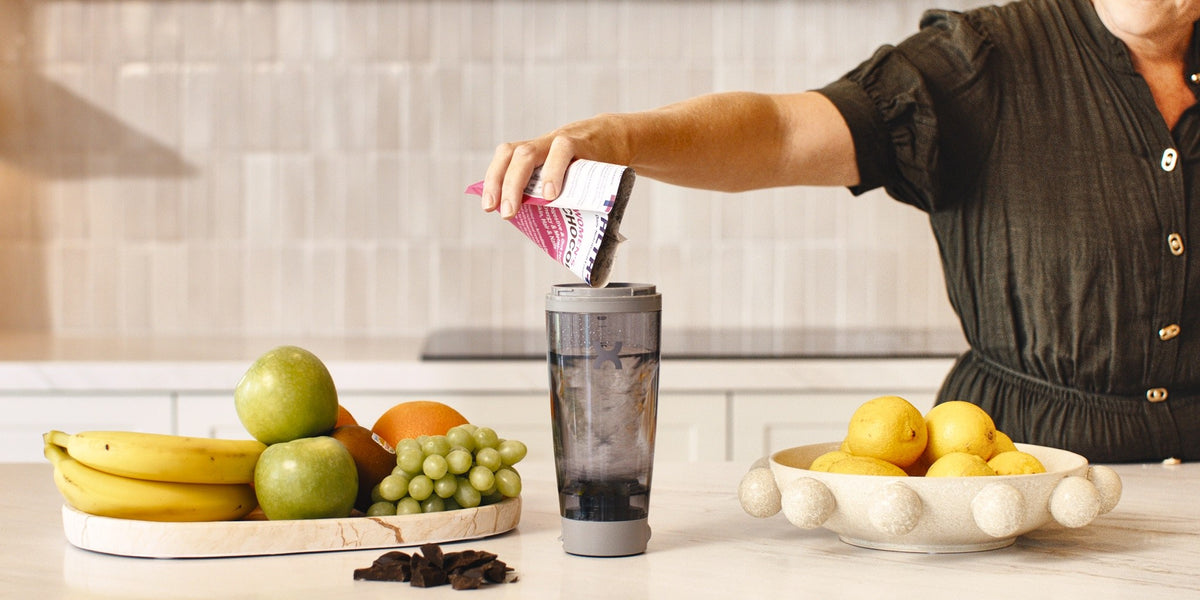
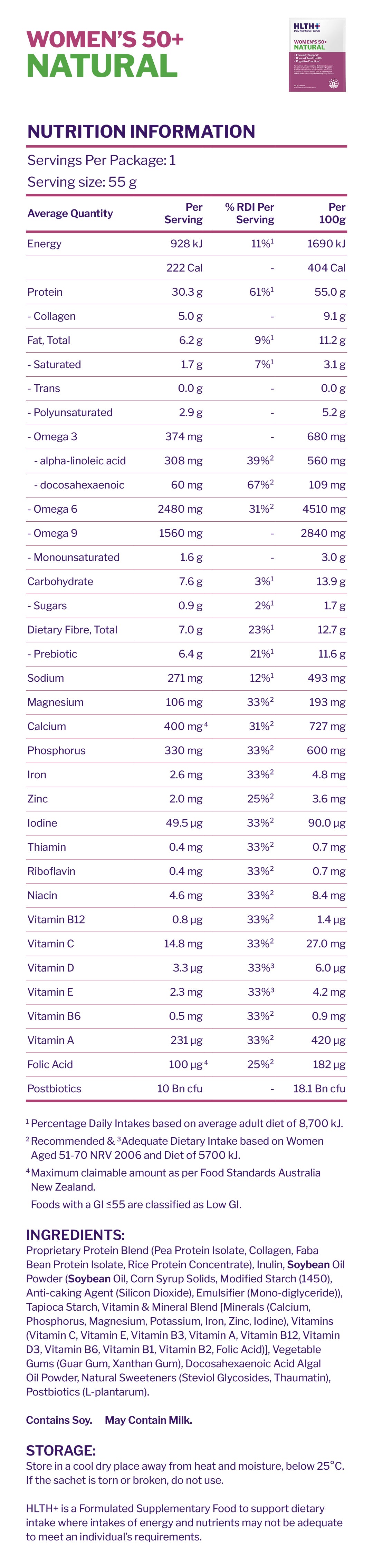
HLTH+ Women's 50+ is a Formulated Supplementary Food, not a multivitamin tablet: one 55g sachet mixed with water. Each serve carries 30g protein and 7g dietary fibre alongside a balanced multivitamin profile, 5g collagen, 10 billion CFU Lactobacillus Plantarum Postbiotic and 60mg DHA.
Protein contributes to the maintenance of muscle mass, and dietary fibre contributes to regular laxation, as part of a healthy diet involving a variety of foods. Counted across protein, dietary fibre, vitamins, minerals, collagen and DHA, that is 30 essential daily nutrients in one sachet, dairy-free and gluten-free. Allergen line: contains soy.
Women's 50+ is formulated to the Nutrient Reference Values for women at that life stage, the 2006 reference values developed by the National Health and Medical Research Council, the Australian Government Department of Health and Ageing and the New Zealand Ministry of Health. Food labels calculate percentage daily intakes against an average adult diet of 8,700 kJ (Standard 1.2.8 of the Food Standards Code), a labelling reference value above what the Nutrient Reference Values recommend for most adults, so a formula built to it over-serves the individual.
If you already buy a multivitamin, a dietary fibre supplement, a collagen powder and a protein powder, one sachet is one habit instead of four. It is made in Australia in facilities that comply with Good Manufacturing Practice. RRP $6.00, or $5.10 a day on a 28-serve subscription at $142.80, at hlthplus.com, on Amazon AU and at Chemist Warehouse online.
For protein on its own, see protein powder for women over 50.
So which should you buy?
One pick per reader, on the labels above.
- If calcium is the gap you are chasing: Blackmores Multivitamins for 50+, at 325mg.
- If you want one published for women, with the next most calcium: Centrum For Women 50+, at 300mg.
- If you want the widest ingredient list and a published price: Swisse Ultivite Women's 50+, from about 71 cents a day, with its warnings read first.
- If you would rather take a capsule: Cenovis Women's 50+.
- If you want protein, dietary fibre and a balanced multivitamin profile in one sachet: HLTH+ Women's 50+.
Find out what your current stack is actually missing. The ✦ Find My Formula quiz takes about 30 seconds and shows what your current supplement stack is not giving you. Take the quiz.
Frequently Asked Questions
Do women over 50 need a different multivitamin?
Your reference values change, because the Nutrient Reference Values, published in 2006 by the National Health and Medical Research Council, the Australian Government Department of Health and Ageing and the New Zealand Ministry of Health, move their age bands at 50. Whether a 50+ product changes with them is a label question: compare both panels.
Is Centrum or Swisse better for women over 50?
On published labels retrieved 6 October 2026, Centrum For Women 50+ lists 300mg calcium and Swisse Ultivite Women's 50+ lists 42mg, against an 800mg labelling reference. Swisse lists 24.68mg of vitamin B6 against Centrum's 9.7mg of pyridoxine hydrochloride, and prints a tingling warning for it. Which suits you depends on your gap.
Should a woman over 50 take a multivitamin with iron?
Iron looks different after 50: the 2023 Australian Bureau of Statistics data puts inadequate iron intake at 9.8% of females aged 50 to 64, against 42.2% at 30 to 49. The four products compared here list 5mg or 6mg. Whether you want iron in a daily tablet is a question for your doctor.
Can you take a multivitamin with a calcium or vitamin D supplement?
healthdirect warns that taking too many supplements can cause health problems, and that you may be at risk of taking too much if you use multiple products with the same ingredient. Check each label for the nutrient you are adding, and tell your doctor or pharmacist what you take before you start.
Is HLTH+ Women's 50+ a multivitamin?
No. HLTH+ Women's 50+ is a Formulated Supplementary Food in a 55g sachet, carrying a balanced multivitamin profile alongside 30g protein and 7g dietary fibre per serve. None of the four multivitamin panels compared here lists protein or dietary fibre. RRP $6.00, or $5.10 a day on a 28-serve subscription.

Leave a comment
This site is protected by hCaptcha and the hCaptcha Privacy Policy and Terms of Service apply.