

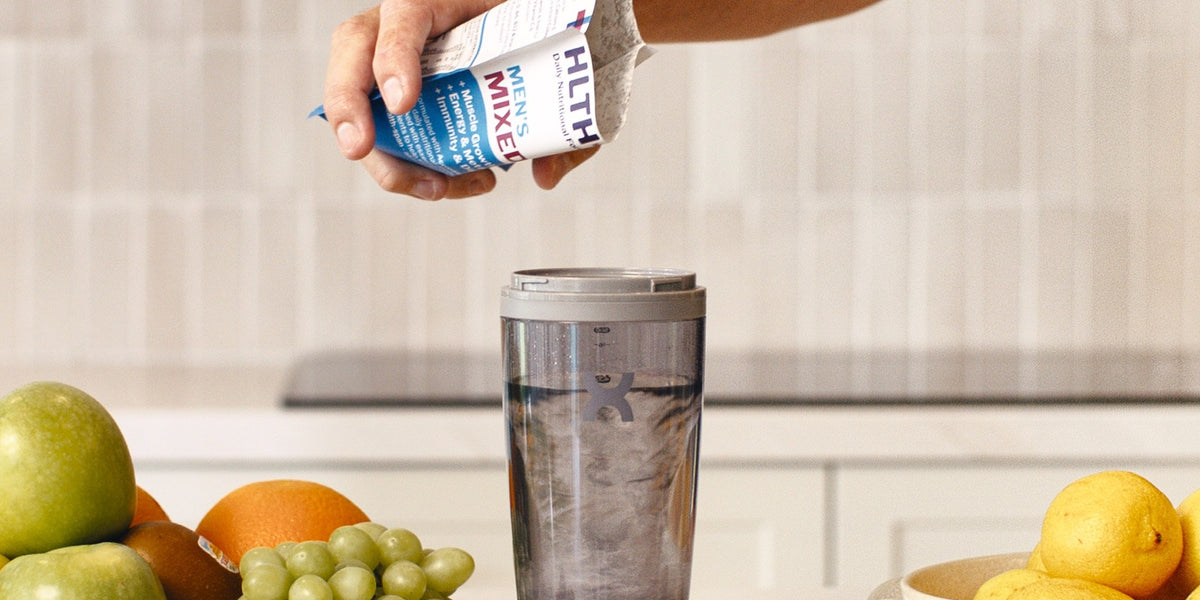
A super greens powder is a small daily scoop of dried vegetables, grasses, algae and fruit, usually with a plant-extract blend, added vitamins and a probiotic culture. "Super" is a marketing word: it is not defined in the Standards that govern claims, labels and nutrition panels, so it promises no minimum amount of anything. What a label can claim is set by Schedule 4 of the Food Standards Code, and what is in the scoop is on the panel and the ingredient list.
If you are holding the pouch, the front says "super" and counts its ingredients, and nothing on it says which lines are numbers you can check. The useful question is which parts of a label are set by law and which are only a name.
This page sets out what is in a super greens powder, what "super" means on a label, what an Australian label can and cannot claim, and how to read two published labels line by line.
What is in a super greens powder?
Seven kinds of ingredient turn up across these labels. Bare Blends' Bare Greens lists 11 ingredients in a 7g serve; Nuzest Good Green Vitality states over 75 in a 10g serve (both pages read 6 October 2026). A count says how many names are on the list, not how much of each is in the scoop.
| Ingredient class | What it is | Example on a published label |
|---|---|---|
| Grasses | Young cereal grasses, dried | Wheat grass and barley grass (Bare Greens); organic barley grass and wheatgrass (Nuzest) |
| Algae | Dried algae | Chlorella and spirulina (Bare Greens); red marine algae (Nuzest) |
| Vegetables | Dried or freeze-dried vegetables | Kale and spinach (Bare Greens); broccoli sprout, carrot and beetroot (Nuzest) |
| Fruit | Dried or freeze-dried fruit | Apple, mango and lemon (Bare Greens); apple (Nuzest) |
| Tea, herbs and mushrooms | Plant ingredients and extracts | Matcha green tea (Bare Greens); green tea, ashwagandha and shiitake mushroom (Nuzest) |
| Added vitamins and minerals | A vitamin and mineral premix | 13 vitamins and 11 minerals with amounts (Nuzest); no amounts printed (Bare Greens) |
| Live cultures | A probiotic culture, counted in CFU (colony-forming units) | Lactobacillus acidophilus and Bifidobacterium bifidum (Nuzest); none listed (Bare Greens) |
With a vitamin premix and a probiotic added, one scoop is three products at once. Whether a multivitamin works is its own question, and what a greens powder carries and leaves out is covered separately.
What does "super" mean on a super greens powder label?
Nothing the Code defines. We searched the current text of Standards 1.1.2 (definitions), 1.2.4, 1.2.7 (claims), 1.2.8, 1.2.10 and 1.3.2, plus Schedule 4, for "super" and "superfood". Neither appears as a defined term, descriptor or condition (searched 6 October 2026).
The words the Code does define each carry a minimum. A claim about dietary fibre of any kind needs at least 2g per serving, "good source" needs 4g and "excellent source" needs 7g, and a vitamin or mineral content claim needs at least 10% of the recommended dietary intake (RDI) per serving, or 25% for "good source" (Schedule 4, section S4-3).
So "super" is a name, not a claim with a threshold. Whether a particular use misleads is a separate test under section 18 of the Australian Consumer Law, which looks at the overall impression a label gives.
How does HLTH+ compare with a super greens powder?
HLTH+ is a Formulated Supplementary Food rather than a greens powder, so it sits beside this category, not inside it. Its 55g Women's sachet is read on another axis: 30g protein per serve, 7g dietary fibre and 30 essential daily nutrients in total, against a 7g to 10g scoop of greens. The ✦ Find My Formula quiz shows what your current routine is not giving you.
What can a super greens powder label legally claim in Australia?
Standard 1.2.7 covers claims on labels and in advertisements (section 1.2.7-3), so a pouch, a product page and an ad follow the same rules. The table sets out each claim shape and what it needs, and our greens powder explainer gives the short version of why a greens powder's pre-approved claims are written nutrient by nutrient.
| What the label says | What the Code asks for | Where |
|---|---|---|
| An amount of a nutrient, or a descriptor such as "good source of dietary fibre" | The panel shows the amount; the descriptor needs its minimum (4g a serving for "good source", 7g for "excellent source") | Schedule 4, S4-3 |
| A vitamin or mineral content claim | At least 10% of the RDI per serving (25% for "good source"), and the amount and percentage RDI printed in the panel | S4-3; Standard 1.2.8, sections 1.2.8-6 and 1.2.8-9 |
| A plant compound or other component with no row in the table | May state only that the food contains it, or how much; no descriptor such as "rich in" | Standard 1.2.7, section 1.2.7-13 |
| A health claim about a nutrient (for example vitamin B12 "necessary for normal cell division") | The nutrient meets its conditions; the claim names the nutrient and the specific effect from the table and carries a dietary context statement; unless the food is a special purpose food, it also meets the nutrient profiling scoring criterion | Sections 1.2.7-18 and 1.2.7-20; S4-5 |
| A health claim about the blend as a whole | Each row in the table names a specific food or property of food, so the other route is a relationship established by systematic review and notified to FSANZ before the claim is made | Sections 1.2.7-18(3)(b) and 1.2.7-19 |
| A therapeutic claim | Not permitted at all | Section 1.2.7-8 |
Every fruit and vegetable row in the Schedule 4 health claims tables is about heart health and applies only to a food of no less than 90% fruit or vegetable by weight, and the Code's definition of "vegetable" leaves out herbs, spices, fungi, nuts, dried legumes and seeds (sections 1.2.7-2, S4-4 and S4-5). This page does not assess any product against those rows, and the Vital Greens review sets one brand's own site claims beside what its labels print.
Section 1.2.7-8 sets the outer limit: no claim may refer to "the prevention, diagnosis, cure or alleviation of a disease, disorder or condition". Comparing vitamin or mineral content with another food is barred unless the Code permits it (section 1.2.7-9).
Does a super greens powder count as vegetables?
No. Food and nutrition scientist Emma Beckett told ABC News (Anna Chisholm, 24 July 2025): "People are probably buying these thinking a scoop is equivalent to a veggie and it definitely is not." ABC reports she also describes the powders as "refined and processed plant matter", which makes it hard to say whether they count towards the five serves of vegetables a day.
Over 90% of Australian adults do not meet dietary guidelines on the AIHW poor-diet measure, and fewer than 1 in 20 eat the recommended serves of vegetables (ABS, 2023). When calories drop, through a deliberate deficit or a reduced appetite, fewer meals are left to carry protein, dietary fibre and micronutrients.
A 7g to 10g scoop adds 2.2g protein and 1.5g to 1.8g dietary fibre on the two labels read below, and the protein row is covered here. More on what changes when you are eating less.
How do you read a super greens powder label?
Seven checks turn a label into numbers, applied here to two published labels.
| Per serve, as each brand publishes it | Bare Blends Bare Greens | Nuzest Good Green Vitality |
|---|---|---|
| Serve size | 7g | 10g |
| Calories | 20.2 Cal (84.6kJ) | 33 Cal (137kJ) |
| Protein | 2.2g | 2.2g |
| Sugars | 1.1g | 1.2g |
| Dietary fibre | 1.5g | 1.8g |
| Vitamin and mineral amounts | Not printed on the page | 13 vitamins and 11 minerals, each with amount and percentage RDI |
| Live cultures | None listed | 8 billion CFU: Lactobacillus acidophilus 5 billion, Bifidobacterium bifidum 3 billion |
| Caffeine | 34.0mg | Not printed on the panel |
Figures are each brand's published product information, retrieved 6 October 2026. Flavours vary and brands reformulate; check the current label before buying.
- Serve size and pack. The panel states the serve in grams and the number of serves in the pack (Standard 1.2.8, section 1.2.8-6). Divide the pack price by the serves, because a 7g serve and a 10g serve are not the same product size; the best greens powders in Australia works that arithmetic through for five products.
- Ingredient order. Ingredients must run in descending order of ingoing weight (Standard 1.2.4, section 1.2.4-5). Nuzest's list opens with pea protein isolate, apple, organic spirulina, potassium phosphate dibasic and natural vanilla flavour; Bare Greens opens with wheat grass, chlorella, barley grass, apple and spirulina.
- The panel's core. The panel must carry kilojoules, protein, carbohydrate, sugars, fat, saturated fat and sodium; other nutrients appear when a claim is made about them (section 1.2.8-6). Dietary fibre is not on that list, so check the line exists.
- Vitamin amounts. When a label makes a vitamin or mineral claim, the amount and the percentage RDI go in the panel (sections 1.2.8-6 and 1.2.8-9). A percentage is the amount divided by a reference intake, nothing more: Nuzest's, which its footnote says are set against the 2006 Nutrient Reference Values for adults aged 19 to 70, run from 10% (potassium) to 4,167% (vitamin B12), while Bare Greens' page names vitamins and minerals in its description and prints no amounts.
- Extract rows. Nuzest prints its plant extracts as "mg equiv" beside an extract ratio, for example grape seed (120:1) at 3,600mg. Its 21 extract rows total 9,545mg and its 20 plant food rows 6,035mg, together 15,580mg against a 10,000mg scoop, so the units on a row decide what the number means.
- Live cultures. Look for named strains, a CFU count and when it is counted. Nuzest says its count "is based on levels at the time of manufacture". The AG1 review and Vital All-In-One review apply the same check to two other labels.
- Warnings and caffeine. Nuzest's label reads "Contains Vitamin K. People taking warfarin should seek medical advice before consumption." Bare Greens prints caffeine at 34.0mg per 7g serve, and its ingredient list includes matcha green tea.
That last check is general information, not medical advice; anyone on prescribed medication checks a label with their doctor or pharmacist.
An ingredient emphasised on the label in words, pictures or graphics is a characterising ingredient, and its proportion must be declared as a percentage, with exceptions such as small amounts used to flavour the food (Standard 1.2.10). AG1 alternatives covers the field around the best-known name.
If what you want from a super greens powder is the daily nutrition, where does HLTH+ fit?
A super greens powder is built to put dried greens, grasses and algae in a glass. Protein, dietary fibre and a broad set of daily nutrients in one serve is a separate brief, and it is the brief a Formulated Supplementary Food is designed for.
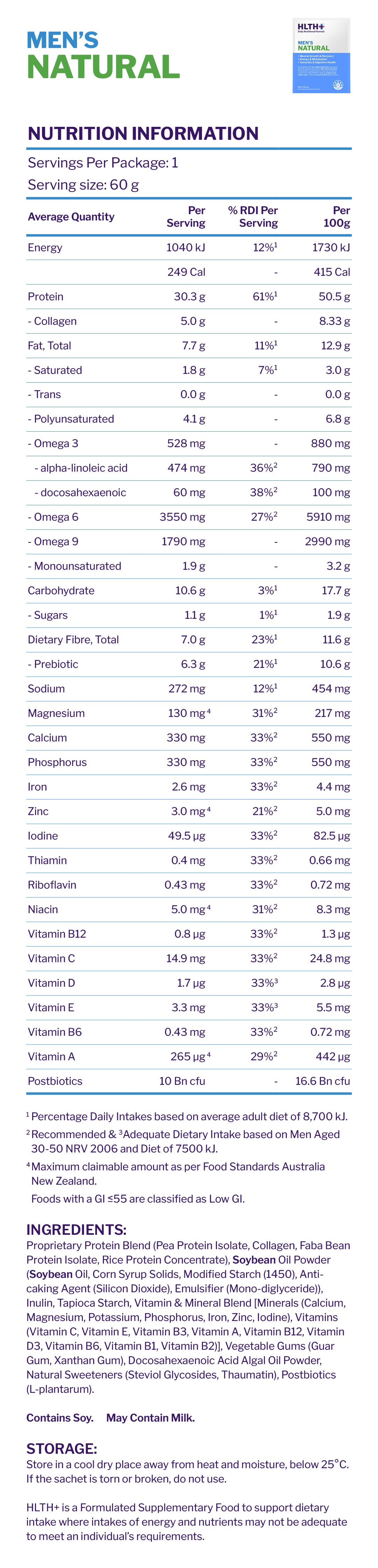
Read on the same panel lines as the table above, a 55g HLTH+ Women's sachet lists 30g protein per serve, 7g dietary fibre (the Schedule 4 level for an "excellent source" claim) and 1.5g sugars, with no added sugar. It also lists 5g collagen and 60mg DHA, and 30 essential daily nutrients in total across protein, dietary fibre, vitamins, minerals, collagen and DHA.
Accredited Dietitians formulate HLTH+ by life stage, across Women's, Women's 50+, Men's and Men's 50+, to the Nutrient Reference Values published by the National Health and Medical Research Council, the Australian Government Department of Health and Ageing and the New Zealand Ministry of Health. It carries a balanced multivitamin profile.
Each serve also lists 10 billion CFU of Lactobacillus Plantarum Postbiotic. The 2021 ISAPP consensus statement defines a postbiotic as "a preparation of inanimate microorganisms and/or their components", so nothing in the serve depends on cells surviving in the pouch. A postbiotic count and a live-culture CFU count measure different things, so the two numbers do not compare like for like.
HLTH+ is Australian made in facilities that comply with Good Manufacturing Practice, it is dairy-free and gluten-free, and it carries a 5-star Health Star Rating. A serve is RRP $6.00 at hlthplus.com, a 28-serve subscription at $142.80 works out to $5.10 a day, and it is also stocked by the HLTH+ store on Amazon AU and Chemist Warehouse online.
Which should you choose?
- If you want a scoop of vegetables, grasses and algae in water, a super greens powder, read with the seven checks above.
- If you want a vitamin and probiotic premix in the same scoop, one that prints its amounts and its strains.
- If you want protein, dietary fibre and a balanced multivitamin profile in one sachet, HLTH+.
Not sure what your current routine is leaving out? The ✦ Find My Formula quiz takes about 30 seconds and shows what your current supplements are not giving you. Take the quiz.
Frequently Asked Questions
What is the difference between a greens powder and a super greens powder?
The Food Standards Code defines no difference. "Super" is not a defined term or descriptor in the Standards that govern claims and labels, so it sets no minimum amount of any ingredient or nutrient. Compare the panel instead: the serve size, the protein, dietary fibre and sugars lines, and whether vitamin amounts and live-culture strains are printed.
Does a super greens powder have to say how much of each ingredient it contains?
Not for every ingredient. The ingredient list must run in descending order of ingoing weight (Standard 1.2.4), and an ingredient emphasised on the label as characterising the food needs its proportion declared (Standard 1.2.10). A claimed vitamin or mineral needs its amount and percentage RDI in the nutrition information panel.
Can a super greens powder claim to support immunity or gut health?
Only through a relationship the Code allows. A health claim about a nutrient must use a row of the Schedule 4 table, name the nutrient and the specific effect, and carry a dietary context statement; a claim about the blend itself needs a systematic review notified to FSANZ. Therapeutic claims are not permitted at all.
How much dietary fibre does a super greens powder have?
On the two labels read for this page, 1.5g per 7g serve (Bare Greens) and 1.8g per 10g serve (Nuzest Good Green Vitality), retrieved 6 October 2026. For scale, Schedule 4 sets 2g per serving as the minimum for any dietary fibre claim, 4g for "good source" and 7g for "excellent source".
Can a super greens powder contain caffeine?
It can. Bare Blends' Bare Greens prints 34.0mg of caffeine per 7g serve on its panel and lists matcha green tea among its ingredients, while the Nuzest Good Green Vitality panel prints no caffeine line (both read 6 October 2026). Check the panel for a caffeine row and the ingredient list for tea.
This article is general information, not medical advice. Decisions about any medication belong with your doctor.


Leave a comment
This site is protected by hCaptcha and the hCaptcha Privacy Policy and Terms of Service apply.