

Is Vital All-In-One worth it in Australia?
Vital All-In-One is a well-documented greens and micronutrient powder sold in Australia: its own product page lists 78 ingredients in a two-teaspoon (10g) serve, 14 billion CFU of probiotics across four named strains and $3.18 a serve on the 300g tub (retrieved 29 September 2026). What that page does not carry is a nutrition information panel, so there is no protein total, dietary fibre, sugars or calorie figure to read. If you buy it for the breadth of the ingredient list, the page backs that up; if you assumed it also covers protein and dietary fibre, it is silent on both.
If you already take it, or are about to, the question is quieter than "is it good": it is what a long ingredient list covers across a day.
This review reads Vital's published figures row by row, tests the all-in-one claim against them, and sets the result beside AG1 and a daily nutritional formula on the same rows.
Every Vital figure below was read from its product page and FAQ page (Original flavour) on 29 September 2026. The AG1 figures come from its Australian label as recorded on 2 September 2026, so check the pack you are actually sold.
What does the Vital All-In-One label publish, serve by serve?
The product page carries an ingredient table rather than a nutrition information panel, which decides which rows of a comparison can be filled.
| Row | What the Vital All-In-One page states |
|---|---|
| Serve | Two heaped teaspoons (10g), mixed into 200ml of water, juice or a smoothie |
| Ingredients | 78 by the page's own count; 70 lines in the ingredient table carry a quantity |
| Protein | No total protein line; 1,000mg of Vital Pea Protein Isolate is listed as an ingredient |
| Dietary fibre | Not published; 800mg of inulin, a prebiotic, is listed as an ingredient |
| Sugars | Not published |
| Calories | Not published |
| Live cultures | 14 billion CFU: Lactobacillus acidophilus 5 billion, Bifidobacterium lactis 5 billion, Bifidobacterium bifidum 3 billion, Bifidobacterium longum 1 billion |
| Flavour and sweetener lines | Natural flavours, thaumatin and xanthan gum; the page states no artificial colour, flavours or sweeteners |
| Allergen line | "The product contains soy"; the FAQ says the lecithin is derived from soy |
| Storage | In the fridge once opened, used within 90 days of opening |
Figures from Vital's published product page and FAQ page, retrieved 29 September 2026; check current labels before purchase.
Is Vital Greens the same as Vital All-In-One?
Yes, by the brand's own account: its FAQ says All-In-One is the exact same formula as Vital Greens, renamed because it is more than greens. The brand also sells a separate Vital Plant Protein product, which this page does not cover.
How HLTH+ compares
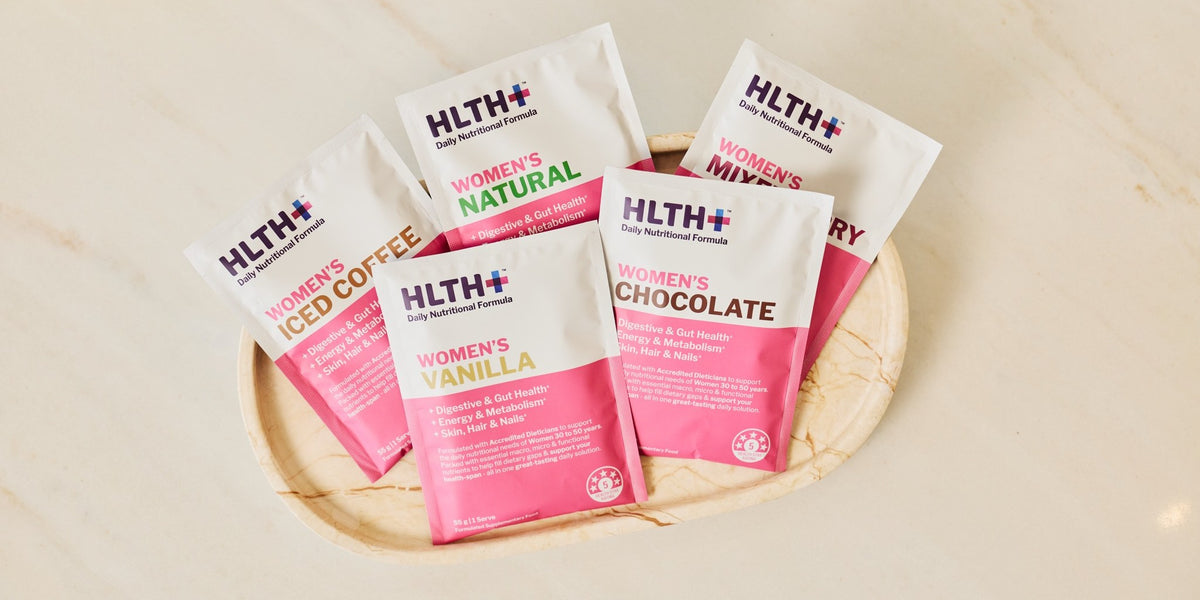
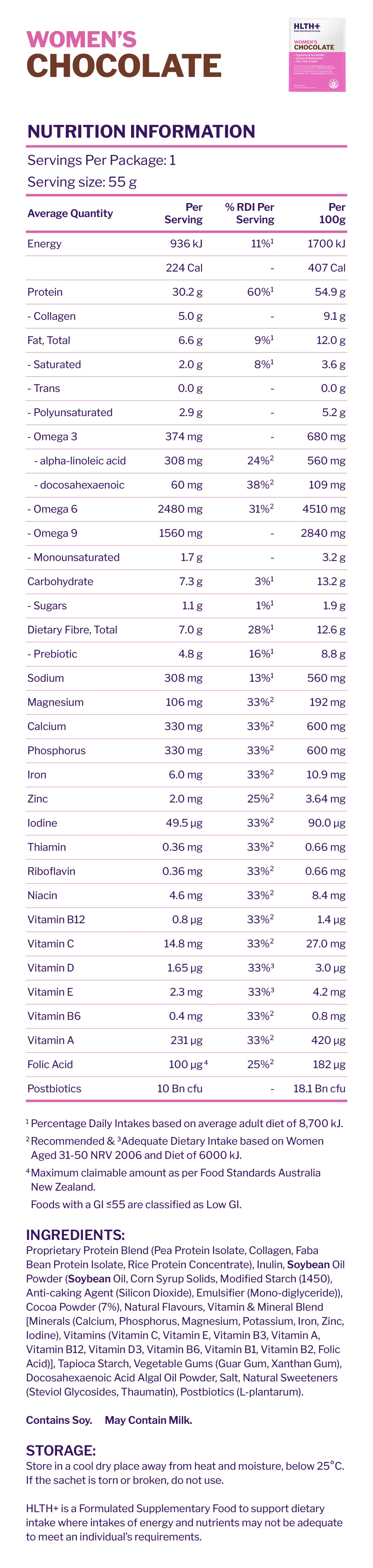
Vital All-In-One is a 10g scoop of greens, botanicals, vitamins and cultures; HLTH+ is a 55g Formulated Supplementary Food sachet that lists 30g protein, 7g dietary fibre and 30 essential daily nutrients per serve. The two answer different questions, which is why the label-to-label table further down gives HLTH+ its own column rather than a rank. The ✦ Find My Formula quiz shows what your current routine is not giving you.
How does the all-in-one claim hold up against the panel?
The page's own copy promises "more nutrients, better transparency and all-in-one convenience". Tested against its table, the claim holds on some rows and is silent on others.
- Vitamins and minerals: yes, with amounts. The vitamins and minerals group lists 24 lines with a quantity, including vitamin C at 333mg, vitamin B12 at 28µg, zinc at 10mg, calcium at 132mg and magnesium at 42mg.
- Cultures and prebiotics: yes, with amounts. Four named strains at 14 billion CFU in total, alongside 800mg of inulin.
- Protein: an ingredient, not a total. The table lists 1,000mg of pea protein isolate, which is 1g of one ingredient in a 10g serve, and no total protein line.
- Dietary fibre, sugars and calories: not published.
- Iron and iodine: no line in the table. The FAQ answer on what vegans need names B12, iron, zinc, iodine and omega-3 and says the product covers these; the table has amounts for B12 and zinc and no line for iron or iodine.
Adding the 66 table lines stated in milligrams or micrograms gives about 11.3g against a 10g serve. The page does not say whether an extract's quantity is its dry weight or the fresh material it was made from, so read the milligram column as the brand's statement rather than a weighing.
So "all-in-one" means greens, botanicals, vitamins, minerals and cultures in one scoop, quantified line by line, not protein, dietary fibre or calories you can count. Its FAQ says the product should not replace fruit and vegetables, and the gap a scoop sits beside is real: over 90% of Australian adults do not meet dietary guidelines on the Australian Institute of Health and Welfare poor-diet measure.
Does Vital All-In-One have protein?
Its page lists 1,000mg (1g) of pea protein isolate as an ingredient and no total protein line (retrieved 29 September 2026). AG1's Australian label prints 2g protein per 13g serve, which the AG1 review walks through. HLTH+ lists 30g protein per serve, and what greens powders publish on protein has its own page.
Vital All-In-One, AG1 and HLTH+, label to label
| Per serve | Vital All-In-One (page, 29 Sep 2026) | AG1 (Australian label, 2 Sep 2026) | HLTH+ Women's (55g) |
|---|---|---|---|
| Serve size | 10g (two teaspoons) | 13g (one scoop) | 55g sachet |
| Protein | No total line; 1,000mg pea protein isolate listed as an ingredient | 2g | 30g |
| Dietary fibre | Not published | 2g | 7g |
| Sugars | Not published | Under 1g | 1.5g, none added |
| Calories | Not published | 41 (172 kJ) | 223 |
| Live cultures | 14 billion CFU, four named strains | 10 billion CFU, five named strains | 10 billion CFU Lactobacillus Plantarum Postbiotic, plus prebiotics |
| Vitamins and minerals | 24 lines with amounts, including vitamin C 333mg and zinc 10mg | Amounts printed, including vitamin C 500mg and zinc 15mg | A balanced multivitamin profile |
| Collagen and DHA | Neither listed | Neither on the recorded panel | 5g collagen, 60mg DHA |
| Allergen line | Contains soy | Contains soy | Dairy-free and gluten-free; contains soy |
| Formulated for | One formula | One formula | Women's, Women's 50+, Men's and Men's 50+ |
| Category | Daily greens and micronutrient powder | Daily greens powder | Formulated Supplementary Food, 30 essential daily nutrients per serve |
Vital figures from its product page and FAQ page, retrieved 29 September 2026. AG1 figures from its Australian label as recorded on 2 September 2026; AG1's own site could not be re-read automatically on 29 September 2026, so check the pack you are sold. HLTH+ figures are per serve for Women's; brands reformulate, so check current labels before purchase.
AG1 prints the four rows Vital's page leaves out, and Vital's page quantifies its ingredient list line by line. HLTH+ is a different job on the same rows: protein and dietary fibre in grams, in a sachet where the greens powders are a scoop. Learn more about keeping your day covered when overall intake drops.
The live cultures row is three different things: a probiotic is a live organism, which is why Vital's page asks for the fridge and a 90-day window once the tub is open. A postbiotic is the material a bacterial culture produces during fermentation together with the inactivated cells, so it does not depend on organisms surviving storage. HLTH+ uses a Lactobacillus Plantarum Postbiotic at 10 billion CFU, alongside prebiotics, and because the two counts measure different things, 10 billion beside 14 billion is not a like-for-like comparison (prebiotics, probiotics and postbiotics explains the difference).
The formulation row is the one that has nothing to do with grams: HLTH+ publishes separate Women's, Women's 50+, Men's and Men's 50+ versions, formulated by Accredited Dietitians to the Nutrient Reference Values, the intakes published in 2006 by the National Health and Medical Research Council, the Australian Government Department of Health and Ageing and the New Zealand Ministry of Health, which set different intakes by age and sex. Vital and AG1 each sell one formula, a legitimate design for one daily scoop. Australian labels state percentage daily intakes against an average adult diet of 8,700 kJ under Standard 1.2.8 of the Food Standards Code, a labelling reference value that sits above what those Nutrient Reference Values advise for most adults.
How much does Vital All-In-One cost per serve in Australia?
On its own store the 300g tub is $95.33 for 30 serves, which is $3.18 a serve (95.33 divided by 30), falling to $2.32 a serve on the 1.1kg tub (retrieved 29 September 2026). Per-serve figures are derived: the pack price divided by the servings the page states.
| Pack | Serves | One-time price | Per serve | Subscription price | Per serve |
|---|---|---|---|---|---|
| 30 travel sachets | 30 | $102.37 | $3.41 | $72.16 | $2.41 |
| 300g | 30 | $95.33 | $3.18 | $66.67 | $2.22 |
| 360g | 36 | $95.33 | $2.65 | $66.67 | $1.85 |
| 1.1kg | 110 | $254.91 | $2.32 | $174.85 | $1.59 |
Prices in Australian dollars from Vital's own store, retrieved 29 September 2026. Vital also lists 12, 60 and 100-serve packs.
HLTH+ is RRP $6.00, or $5.10 a day on a 28-serve subscription at $142.80. A 10g scoop of greens and micronutrients is a different job from a 55g sachet listing 30g protein and 7g dietary fibre, and on price per serve the greens powder is the cheaper of the two. For the wider field, the best greens powders in Australia are ranked on the same criteria.
What do the reviews of Vital All-In-One show?
Counts only, because sentiment is not a fact, and different sites are different populations. Vital's own product page shows 4.89 out of 5 from 392 reviews, and the ProductReview.com.au listing showed 2.8 out of 5 from 17 reviews (both retrieved 29 September 2026). Live search results are mostly the brand's pages, retailers and review blogs.
Can you take Vital All-In-One every day?
Its page directs two heaped teaspoons (10g) daily. For anyone new to it, the FAQ recommends starting with half a serve (one teaspoon, 5g) for the first two to four weeks. It says some people may notice mild nausea, bloating, excessive flatulence, general gut discomfort or minor skin irritation at first, and to talk to a health care practitioner if symptoms become extreme.
The FAQ also recommends consulting a health care professional before taking it while pregnant or breastfeeding, and telling one about any prescription medications. This page is general information, not medical advice, and decisions about any medication belong with your doctor.
What changes when you are eating less than you used to?
A 10g scoop is built to sit beside a full plate. When the plate shrinks, through a deliberate deficit, a reduced appetite, or rapid weight loss, reduced eating and medically induced weight loss, the nutrients food carries in grams slip first. In trial conditions, GLP-1 medicines reduced ad libitum food intake by roughly a quarter of daily calories (Blundell and colleagues, Diabetes, Obesity and Metabolism, 2017).
One consequence is measurable: in a 2025 study, people on GLP-1 medications averaged 14.5g of dietary fibre a day against the 28g recommended (Frontiers in Nutrition, 2025). A page that publishes no dietary fibre figure gives you nothing to count towards that gap. Learn more about what multivitamins do and do not cover.
Who does each one suit?
- You want a wide ingredient list, quantified line by line, at the lowest price per serve. Vital All-In-One.
- You want the label to print protein, dietary fibre, sugars and calories. AG1's Australian label prints all four, and the IM8 and AG1 comparison covers the premium end.
- You avoid every animal-derived ingredient. Vital's page states 100% plant-based; part of HLTH+'s 30g protein is bovine collagen.
- You want protein, dietary fibre and a balanced multivitamin profile in one sachet, alongside real food. HLTH+: 30g protein, 7g dietary fibre and 30 essential daily nutrients per 55g Women's sachet.
Allergen line: Vital's page, AG1's Australian label and HLTH+ all state that the product contains soy.
If you want a quantified greens-and-vitamins scoop, Vital All-In-One. If you want protein, dietary fibre and a balanced multivitamin profile in one sachet, HLTH+. The greens powder explainer and the AG1 alternatives page cover the category.
HLTH+ is not designed as a meal replacement, because it complements a food-first approach, but it works fine as a healthy snack or to tie you over.
HLTH+ is Australian-owned and Australian-made in facilities complying with Good Manufacturing Practice, carries a 5-star Health Star Rating and holds hundreds of reviews. It sells at hlthplus.com at RRP $6.00, or $5.10 a day on a 28-serve subscription at $142.80, and through Amazon AU and Chemist Warehouse online.
Find out what your current routine is not giving you. The 30-second ✦ Find My Formula quiz reads your existing routine and shows the gaps it leaves.
Frequently Asked Questions
How many probiotics are in Vital All-In-One?
Its product page lists 14 billion CFU across four named strains: Lactobacillus acidophilus (5 billion), Bifidobacterium lactis (5 billion), Bifidobacterium bifidum (3 billion) and Bifidobacterium longum (1 billion), retrieved 29 September 2026. The page recommends keeping the tub in the fridge once opened and using it within 90 days.
Is Vital All-In-One gluten-free and dairy-free?
Its page states gluten-free, dairy-free and 100% plant-based, with a note that the product contains soy because the lecithin is derived from soy (retrieved 29 September 2026). The FAQ says anyone with a history of allergy is best to avoid it. HLTH+ is dairy-free and gluten-free, and contains soy.
What is the difference between Vital All-In-One and AG1?
Vital's page states 78 ingredients, most with a quantity, in a 10g serve and publishes no protein, dietary fibre, sugars or calorie figure. AG1's Australian label prints 2g protein, 2g dietary fibre, under 1g sugars and 41 calories per 13g serve. Vital shows 14 billion CFU across four strains; AG1 shows 10 billion across five.
How is HLTH+ different from Vital All-In-One?
Vital All-In-One is a 10g scoop of greens, botanicals, vitamins and cultures. HLTH+ is a Formulated Supplementary Food in a 55g sachet, sold as Women's, Women's 50+, Men's and Men's 50+, listing 30g protein, 7g dietary fibre, 5g collagen and 60mg DHA per serve. Vital is the cheaper serve.
This article is general information, not medical advice. Decisions about any medication belong with your doctor. Figures quoted are each brand's published information at the retrieval date shown; check current labels before buying.


Leave a comment
This site is protected by hCaptcha and the hCaptcha Privacy Policy and Terms of Service apply.