


This is a printable seven-day plan for a reduced appetite: three small meals and two snacks a day, protein first at each eating time, with protein and dietary fibre added up for every meal. Days 2 and 5 use softer textures, and the whole week contains one HLTH+ sachet.
When your appetite has dropped, a normal plate looks like a chore, and a day can slide past on tea and a few biscuits. Most meal plans are built for a larger appetite, or hand you a food list with no sums behind it.
This week is built from small serves, every number comes from the Australian Food Composition Database, and each day is its own table, so you can print this page for the fridge.
What does a reduced appetite change about eating?
A class of prescription medicines called GLP-1 medications works through glucagon-like peptide-1, a hormone made in the gut that delays gastric emptying and reduces food intake (Müller and colleagues, Molecular Metabolism, 2019). A smaller appetite is therefore expected, and the STEP 1 trial reported nausea and diarrhoea most often among its adverse events (STEP 1 trial report, 2021). Your prescriber is the person to ask about the medication itself.
This article is general information, not medical advice. Decisions about any medication belong with your doctor.
From here the page is written for anyone eating less, whatever the cause. Rapid weight loss, reduced eating and medically induced weight loss pose the same practical problem: fitting a day's nutrition into a smaller appetite.
AIHW data: over 90% of Australian adults do not meet dietary guidelines (AIHW's poor diet report). A smaller intake therefore often begins below where it should.
What foods should you eat on a reduced appetite?
Four habits shape every day in the plan. Each comes from a 2025 joint advisory by the American College of Lifestyle Medicine, the American Society for Nutrition, the Obesity Medicine Association and The Obesity Society, supported by United States National Institutes of Health grants. It reflects expert consensus on the literature rather than a trial (Mozaffarian and colleagues, 2025, American Journal of Clinical Nutrition).
- Small and often: the advisory says small, frequent meals may be effective when hunger and food interest are low, and suggests a small breakfast followed by small meals every 3 to 4 hours.
- Protein is a priority: it states that sufficient dietary protein should be a priority, so each eating time here leads with a protein food.
- Appealing over heavy: smoothies, protein drinks, cottage cheese and soups are described as often more appealing than red meats, cold cuts or hard cheeses.
- Fluids: its eating-habits list includes ensuring adequate fluids, and it names ginger or peppermint tea among the foods to encourage.
The principles have their own pages: what to eat on a reduced appetite, the principles behind the diet, what the diet is and the foods that suit a smaller appetite. Protein when appetite is low and dietary fibre when you are eating less have pages too; this one is the concrete seven days.
To go further on a smaller appetite and daily nutrition, learn more.
How were the protein and dietary fibre figures worked out?
Each food's protein and dietary fibre come from Release 3.0 of the Australian Food Composition Database (AFCD, from Food Standards Australia New Zealand, read on 13 October 2026), scaled to the weight on the plate. Cooked entries are used where one exists. Each sum is added in full and rounded once, so a printed total can differ from its parts by 0.1g.
The figures are counts, not targets: the plan sets no kilojoule, calorie or weight goal. The one product line is a HLTH+ sachet's label figures, 30g protein and 7g dietary fibre.
What is a typical 7-day meal plan on a reduced appetite?
The protein food is listed first at every eating time, and quantities are deliberately small, so add or drop a half-serve to suit your appetite on the day. Fluids are the same every day: sips of water or unsweetened tea between eating times, with no amount set here.
Day 1
| Meal | What is on the plate | Protein | Dietary fibre |
|---|---|---|---|
| Breakfast | Scrambled egg, 100g; Wholemeal toast, 30g | 14.5g | 2.4g |
| Snack | Natural yoghurt, 125g; Frozen mixed berries, 50g | 6.9g | 1.8g |
| Lunch | Boiled lentils, 100g; Boiled butternut pumpkin, 100g; Boiled spinach, 40g | 10.6g | 7.2g |
| Snack | Cottage cheese, 60g; Kiwifruit, 80g | 11.2g | 2.4g |
| Dinner | Steamed barramundi, 100g; Boiled sweet potato, 100g; Boiled broccoli, 50g | 26.0g | 4.1g |
| Day total | Five small eating times | 69.1g | 17.8g |
Day 2 (soft textures)
| Meal | What is on the plate | Protein | Dietary fibre |
|---|---|---|---|
| Breakfast | Porridge made with milk, 200g; Sliced banana, 50g | 11.3g | 4.3g |
| Snack | Ricotta, 50g; Peeled apple, 80g | 5.4g | 1.4g |
| Lunch | Canned tuna in water, drained, 60g; Boiled white rice, 80g; Boiled zucchini, 60g | 18.9g | 1.4g |
| Snack | Natural yoghurt, 100g | 5.3g | 0.1g |
| Dinner | Casseroled chicken breast, 80g; Boiled potato, 100g; Boiled carrot, 60g | 23.8g | 4.0g |
| Day total | Five small eating times | 64.6g | 11.2g |
Soft textures throughout, for a day when food looks unappealing.
Day 3
| Meal | What is on the plate | Protein | Dietary fibre |
|---|---|---|---|
| Breakfast | One HLTH+ sachet (30g protein, 7g dietary fibre); Regular milk, 200g; Banana, 50g | 37.5g | 8.1g |
| Snack | Hard-boiled egg, 50g; Wholemeal toast, 30g | 9.9g | 2.4g |
| Lunch | Firm tofu, 100g; Boiled white rice, 80g; Boiled broccoli, 50g | 16.7g | 2.9g |
| Snack | Hummus, 40g; Pear, 100g | 3.2g | 4.6g |
| Dinner | Canned pink salmon, drained, 80g; Boiled sweet potato, 100g; Boiled spinach, 40g | 19.3g | 4.0g |
| Day total | Five small eating times | 86.5g | 21.9g |
The only sachet of the week sits at breakfast, shaken with milk and a banana.
Day 4
| Meal | What is on the plate | Protein | Dietary fibre |
|---|---|---|---|
| Breakfast | Wheat biscuit cereal, 30g, with regular milk, 150g; Frozen mixed berries, 50g | 9.0g | 5.0g |
| Snack | Cottage cheese, 60g; Peeled apple, 80g | 10.4g | 1.4g |
| Lunch | Casseroled chicken breast, 70g; Boiled white rice, 80g; Boiled butternut pumpkin, 80g | 23.1g | 2.2g |
| Snack | Wholemeal toast, 30g; Peanut butter, 15g | 7.3g | 3.4g |
| Dinner | Boiled lentils, 120g; Boiled zucchini, 60g; Boiled white rice, 60g | 11.3g | 6.1g |
| Day total | Five small eating times | 61.1g | 18.1g |
Day 5 (soft textures)
| Meal | What is on the plate | Protein | Dietary fibre |
|---|---|---|---|
| Breakfast | Natural yoghurt, 150g; Chia seeds, 8g; Frozen mixed berries, 60g | 10.2g | 4.8g |
| Snack | Hard-boiled egg, 50g | 6.2g | 0.0g |
| Lunch | Canned pink salmon, drained, 80g; Boiled potato, 100g; Boiled carrot, 60g | 18.7g | 4.0g |
| Snack | Ricotta, 50g; Banana, 60g | 6.0g | 1.3g |
| Dinner | Firm tofu, 100g; Boiled sweet potato, 100g; Boiled spinach, 40g | 15.5g | 5.0g |
| Day total | Five small eating times | 56.7g | 15.0g |
A second soft-texture day, built on yoghurt, tinned salmon, ricotta and tofu.
Day 6
| Meal | What is on the plate | Protein | Dietary fibre |
|---|---|---|---|
| Breakfast | Scrambled egg, 100g; Wholemeal toast, 30g; Avocado, 30g | 14.9g | 4.2g |
| Snack | Natural yoghurt, 125g; Kiwifruit, 80g | 7.6g | 2.5g |
| Lunch | Canned tuna in water, drained, 60g; Boiled chickpeas, 80g; Boiled zucchini, 60g | 22.1g | 6.8g |
| Snack | Hummus, 40g | 2.8g | 1.6g |
| Dinner | Casseroled chicken breast, 80g; Boiled sweet potato, 100g; Boiled broccoli, 50g | 24.7g | 4.1g |
| Day total | Five small eating times | 72.1g | 19.1g |
Day 7
| Meal | What is on the plate | Protein | Dietary fibre |
|---|---|---|---|
| Breakfast | Porridge made with milk, 200g; Peanut butter, 10g | 13.0g | 3.9g |
| Snack | Cottage cheese, 60g; Pear, 100g | 10.6g | 3.0g |
| Lunch | Boiled lentils, 100g; Boiled butternut pumpkin, 100g; Boiled carrot, 60g | 10.2g | 8.0g |
| Snack | Natural yoghurt, 100g | 5.3g | 0.1g |
| Dinner | Steamed barramundi, 100g; Boiled white rice, 80g; Boiled spinach, 40g | 26.5g | 1.8g |
| Day total | Five small eating times | 65.6g | 16.7g |
What should be avoided on a reduced appetite?
The advisory's table of foods to minimise lists refined carbohydrates, sugar-sweetened beverages, red and processed meats, most fast foods, and sweet and savoury snacks. Its eating-habit list adds large meals, long gaps without food and alcohol beyond a minimum, which is why the week above has no red meat, sweet drinks or large plates. The one refined grain it keeps is a small serve of white rice as a soft base; brown rice is the swap if you prefer a wholegrain.
The foods that suit a smaller appetite and a nausea-day guide go into more detail on textures.
What happens if you eat too little?
Intake of vitamins and minerals falls with the food that carries them. According to the advisory, a sudden and large cut in calories can leave vitamin and mineral intakes insufficient, with iron, calcium, magnesium and zinc listed as nutrients of concern.
A 2025 study of 69 adults on a prescribed appetite-lowering medication used a 3-day food record and found their mean dietary fibre intake was 14.5g daily, against a recommended 28g (Johnson and colleagues, Frontiers in Nutrition). The work was cross-sectional, applied US reference values, and was paid for by its authors' employer, a supplements retailer.
Persistent vomiting, or being unable to keep fluids down, is a conversation for your doctor, because the advisory notes reports of dehydration from nausea and vomiting alongside kidney problems. A plan like this is general, and an Accredited Practising Dietitian tailors it: find an APD through Dietitians Australia.
What is the best breakfast on a reduced appetite?
The plan offers small, protein-first breakfasts rather than one winner. Scrambled egg with wholemeal toast reaches 14.5g of protein, porridge made with milk and banana 11.3g, and natural yoghurt with chia seeds and berries 10.2g. The sachet breakfast on Day 3 reaches 37.5g, because the sachet carries 30g on its own.
More ideas sit in high-protein breakfast ideas, protein smoothie recipes and high-protein snacks.
Where does a Formulated Supplementary Food fit in a smaller week?
A smaller appetite shrinks every plate, and the nutrients on it shrink too. HLTH+ starts from a food-first approach; the AIHW figure above is the reason it works as nutritional insurance beside a varied diet and never as a replacement for one.
What a serve of HLTH+ carries
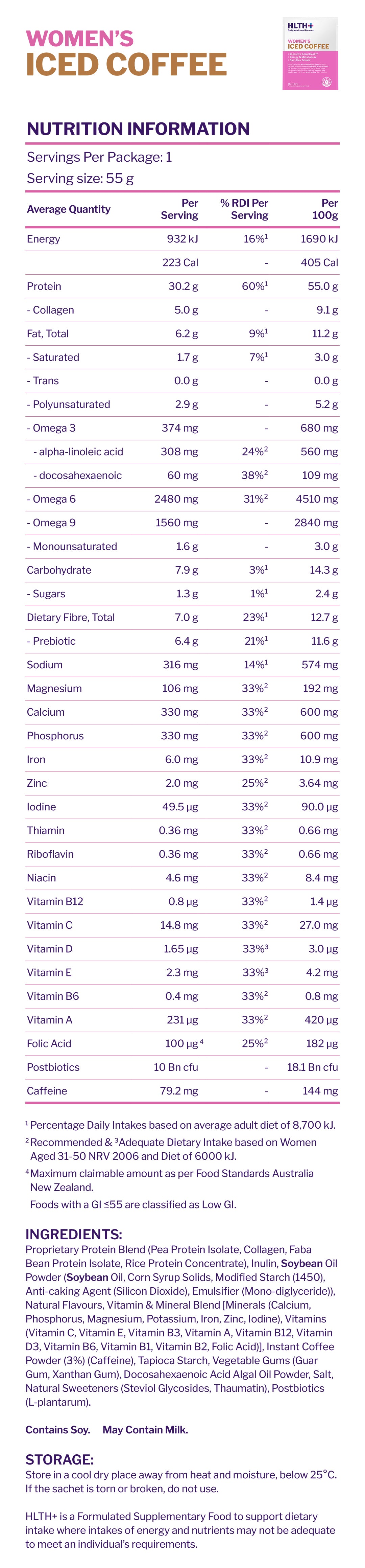
Each HLTH+ sachet is an Australian made, dietitian formulated Formulated Supplementary Food. A serve provides 30 essential daily nutrients, 30g protein and 7g dietary fibre, and the Women's sachet weighs 55g at RRP $6.00. HLTH+ is formulated to the Nutrient Reference Values set by the National Health and Medical Research Council, the Australian Government Department of Health and Ageing and the New Zealand Ministry of Health, dated 2006, which shape a separate formulation for Men's, Men's 50+, Women's and Women's 50+.
As part of a healthy diet involving a variety of foods, every serve's 30g protein contributes to the maintenance of muscle mass. HLTH+ is not designed as a meal replacement because it complements a food-first approach; but it works fine as a healthy snack or to tie you over. Subscription pricing: $142.80 across 28 serves is $5.10 a day, and you can also find HLTH+ through Chemist Warehouse online and Amazon AU.
The ✦ Find My Formula quiz shows what your current routine is not giving you. Try it here.
Taking the plan further
If the question is the week itself, the seven tables above are the answer, and a dietitian can fit them to you. If you would rather have protein, dietary fibre and a balanced multivitamin profile in a single sachet beside your meals, HLTH+ is built for that.
Check what your routine leaves out. The quiz is diagnostic: it reads your current supplement stack and shows the gaps. Take the quiz.
Frequently Asked Questions
Is there a PDF of this plan?
This page is the printable version: each day is its own table, so use your browser's print option. A downloadable file is not available yet, and one will follow once the site can host it. Until then, printing this page gives you the same seven days on paper.
Can I swap foods in the plan?
Yes. Keep the shape and change the food: a protein item at every eating time, small serves, and softer textures on the days food looks unappealing. Swap a lentil lunch for tinned salmon, or ricotta for cottage cheese, and add up the new protein from the database entry.
Does the plan set a calorie or weight target?
No. It sets no kilojoule or calorie target and no weight goal. It lists the protein and dietary fibre in each small meal, added up from the Australian Food Composition Database, so you can see what a day on a smaller appetite contains. A dietitian can set targets for you.
Who should tailor a plan like this?
An Accredited Practising Dietitian can. A plan like this is general, and a dietitian fits it to your medical history, allergies, medication and food preferences. Dietitians Australia lists them by location, and your doctor can refer you if you prefer.
Why does the plan have five small eating times?
Small, frequent meals may be effective when hunger and food interest are low, according to a 2025 joint advisory of four US professional societies. The plan spaces three small meals and two snacks through the day, so no single plate has to be large.
This article is general information, not medical advice. Decisions about any medication belong with your doctor.

Leave a comment
This site is protected by hCaptcha and the hCaptcha Privacy Policy and Terms of Service apply.