

On a meal replacement shake, the panel on the back settles more than the pack on the front. The Food Standards Code puts a floor under every shake sold as a meal replacement: 850 kJ of energy, 12g of protein and a quarter of the Recommended Dietary Intake (RDI) for every vitamin and mineral on the schedule list, per serve. Above that floor, brands differ, and the differences are printed in milligrams.
Shelves and "best for women" lists are crowded with tubs in the same colours, and most lists rank by taste or sentiment without saying which numbers they used. A woman comparing two tubs needs a short list of label checks, applied to real panels.
This page gives the legal floor, five checks for a shake panel, the printed figures for three shakes sold to women, and where a Formulated Supplementary Food sits beside the category.
What does Australian law require of a meal replacement shake?
In the Code, the product class is called a formulated meal replacement: a food made to stand in for one meal or more in a day, never for a whole diet, and sold as such (Standard 2.9.3, Food Standards Code, version of 13 September 2024, retrieved 13 October 2026). Under section 2.9.3-3 each serve must carry at least 12g protein and 850 kJ, plus, for every vitamin and mineral in the Schedule 29 table, a quarter of its RDI.
Two things follow for a reader who wants a product made for women. The same floor applies to every brand, so "for women" on the front is a positioning choice and not a different standard. And a shake printing fewer than 850 kJ falls outside the floor for a formulated meal replacement, which is why the energy line is the first number to read.
Neighbouring categories play by other rules. A very low calorie diet shake is sold into a supervised program, and the meal replacement shake guide covers the category from the top.
Which meal replacement shake is best for women?
No page can answer that for you, because the answer depends on which of five numbers matters to you. What a page can do is show the checks, apply them to real panels and leave the pick with the reader. Each check below is a fact you can read off any label.
1. Protein per serve
The legal floor is 12g. The shakes in the table below print 17.7g to 30.2g, and a higher number is not automatically better: the right amount depends on which meal the shake replaces and what else you eat that day. The meal replacement shake versus protein shake comparison explains why a protein shake is a different product.
2. Dietary fibre per serve
Fibre is the line most often skipped, and intakes run low. A 2025 study of 69 adults using an appetite-lowering medication measured average fibre at 14.5g a day against 28g recommended (Johnson et al, Frontiers in Nutrition, 2025). It was small and cross-sectional and used US reference values, so read it as one signal.
On the panels below, fibre runs from 0.8g to 6.4g.
3. Calcium and iron, printed or not
Calcium is the clearest case for women. In the 2011-12 National Nutrition and Physical Activity Survey, as reported by Better Health Channel, 73% of females consumed less calcium than recommended, against 51% of males (Better Health Channel, Calcium, retrieved 13 October 2026). The same page notes that women over 50 have greater than average requirements.
Because a meal replacement has to deliver a quarter of the RDI for each listed mineral, the practical check is that calcium and iron appear on the panel in milligrams.
4. Sugars, and what they are made of
Read the sugars line beside the ingredient list. On a milk-based shake, part of the total is lactose, the sugar naturally present in milk, and panels often print it on its own sub-line.
5. Sweeteners and cost per serve
The ingredient list names the sweeteners. The pack price divided by the number of serves gives cost per serve, with no marketing in it.
If you are shopping for the over-50 stage, protein powder for women over 50 covers what changes after menopause.
How HLTH+ compares
HLTH+ sits beside this category as a Formulated Supplementary Food, so it appears under the table as a labelled row for comparison and does not rank within it. On its own axis, per serve, Women's comes as a 55g sachet holding 30g protein, 7g dietary fibre and 30 essential daily nutrients, with its label category set as Formulated Supplementary Food. The ✦ Find My Formula quiz shows what your current routine is not giving you: find out in 30 seconds.
What do the labels of three shakes women shortlist say?
Three shakes surface for this search: a retail shake sold to women, and two shakes sold for very low calorie diet programs. All figures come from each brand's own nutrition panel, read on 13 October 2026, for the Chocolate flavour (the core Chocolate for The Lady Shake). Panels change by flavour and over time, so confirm on the pack before you buy.
| Per serve | The Lady Shake Chocolate | OPTIFAST VLCD Shake Chocolate | OptiSlim VLCD Classic Shake Chocolate |
|---|---|---|---|
| Serve size | 56g | 53g powder | 43g sachet |
| Energy | 850 kJ / 203 cal | 850 kJ / 203 Cal | 692 kJ / 165 Cal |
| Protein | 30.2g | 20g | 17.7g |
| Dietary fibre | 6.4g | 3.6g | 0.8g |
| Sugars | 2.2g (lactose 0.7g) | 12.7g (lactose 11.7g) | 13.7g |
| Calcium | 400mg | 400mg | 279mg |
| Iron | 4.8mg | 8.4mg | 5.4mg |
| Sweeteners listed | Steviol glycosides, thaumatin | Aspartame, acesulfame potassium | Sweetener (955) |
| Allergen line | Milk, soy (soy lecithin) | Contains milk | Contains gluten, milk, soy and caffeine |
| Price as published | $3.66 a serve ($54.95 for the 15-serve pack) | None published | $2.14 a meal, the brand's own figure |
For comparison, on its own axis (Formulated Supplementary Food, not a meal replacement):
| Per serve | HLTH+ Women's |
|---|---|
| Serve size | 55g sachet |
| Calories | 223 |
| Protein | 30g |
| Dietary fibre | 7g |
| Sugars | 1.5g, none added |
| Allergen line | Contains soy |
| Price | RRP $6.00 |
Reading across the columns
On energy, The Lady Shake and OPTIFAST both print 850 kJ, exactly the floor, and OptiSlim prints 692 kJ. OPTIFAST describes its shakes as VLCD products, short for very low calorie diet, and its footer says a healthcare professional must supervise their use; OptiSlim's page places its shake within a VLCD program. A supervised program is a choice for you and your doctor, and this page does not replace that conversation.
On the five checks, all three print calcium and iron, which settles the third. The fibre line differs most, from 0.8g to 6.4g. OPTIFAST's 12.7g of sugars includes 11.7g of lactose, so most of that figure is milk sugar.
Each ingredient list names its sweeteners, so you can match them to your own preference.
The Lady Shake panel changes by flavour: across its core range, protein runs from 28.4g to 30.2g and dietary fibre from 3.2g to 8.9g (the brand's nutritional information page, read 13 October 2026). Read the panel for the flavour you buy. The Lady Shake review and whether The Lady Shake works go further, and Optifast versus The Lady Shake sets those two side by side.
Can I use meal replacement shakes to lose weight?
The strongest evidence measures programs, not products: a 2019 meta-analysis of 23 randomised trials found diets incorporating meal replacements produced 1.44 kg more weight lost at one year than alternative diets (Astbury et al, Obesity Reviews, 2019, abstract read 13 October 2026). The weight loss shakes evidence read sets out that review's limits in full.
That is a finding about programs, averaged across people, at one year. It does not say which shake to buy, and it says nothing about HLTH+, which makes no weight claim. If weight is the question, a dietitian can look at your intake with you.
Which protein powder is best for women for weight loss in Australia?
There is no single best, and a protein powder is a different product from a meal replacement. A powder is mostly protein, with no 850 kJ or vitamin and mineral floor; a meal replacement has to clear the Standard 2.9.3 floor. For a protein-first read, weight loss shakes covers what is in them and what the law calls them.
What if the goal is nutrition while eating less, not a swapped meal?
Some women searching for a meal replacement are not swapping a meal at all. Calories drop under rapid weight loss, reduced eating and medically induced weight loss. One route to the third is a GLP-1 medication, and these readers want the nutrition to keep pace with the plate.
That is a harder starting point than it sounds, because AIHW reports over 90% of Australian adults do not meet dietary guidelines, so a smaller intake leaves less margin. More on nutrition when you eat less is on the nutrition guide.
This article is general information, not medical advice. Decisions about any medication belong with your doctor, and so does the choice of a supervised diet program.
Where do HLTH+ Women's and Women's 50+ fit?
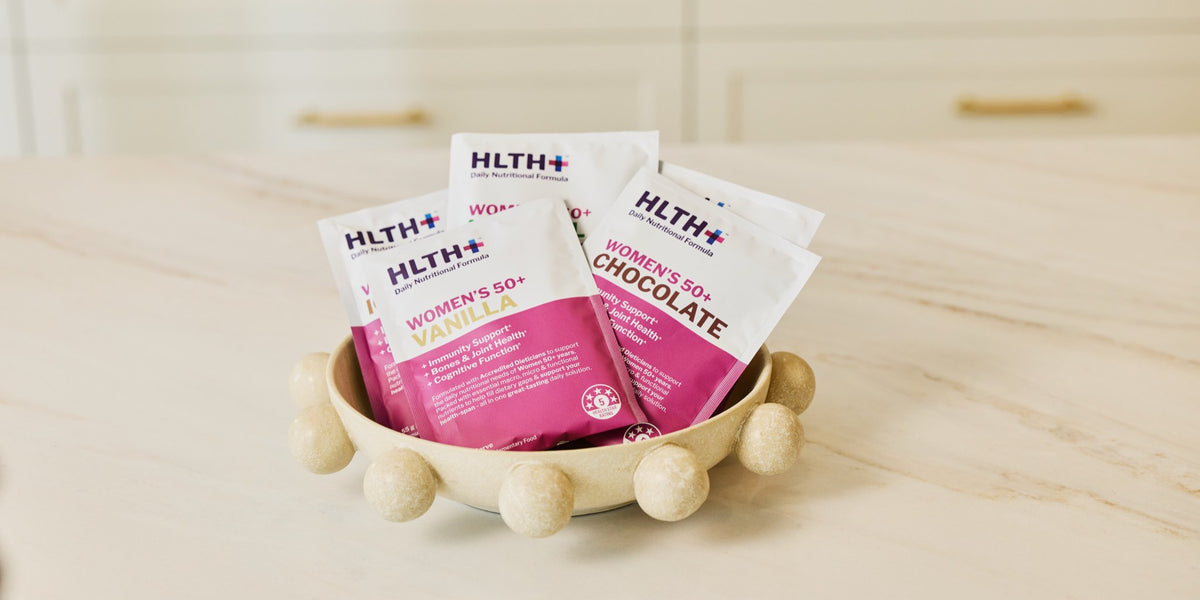
HLTH+ is not designed as a meal replacement because it complements a food-first approach. Its label category is Formulated Supplementary Food. It works fine as a healthy snack or to tie you over.
Accredited Dietitians formulated Women's and Women's 50+ to the Nutrient Reference Values, a joint 2006 publication of the National Health and Medical Research Council, the Australian Government Department of Health and Ageing and the New Zealand Ministry of Health. Women's sachets pair 30g protein and 7g dietary fibre with a balanced multivitamin profile.
Soy is in the ingredient list; the sachet is dairy-free and gluten-free. Protein contributes to the maintenance of muscle mass, as part of a healthy diet involving a variety of foods.
Order from hlthplus.com, the Amazon AU brand store or Chemist Warehouse online. Priced per day, $142.80 across 28 serves is $5.10 a day on subscription.
Which option suits which reader
- For a structured meal swap on a milk-based shake, a formulated meal replacement from the table is built for it, and the panel shows its numbers.
- Inside a supervised diet program, keep to what your clinician set.
- Want protein, dietary fibre and a balanced multivitamin profile in a single sachet? That is HLTH+.
Unsure where your routine falls short? Our ✦ Find My Formula quiz is diagnostic: it maps what your current supplement stack misses. Start the quiz.
Frequently Asked Questions
What protein number should a shake for women print?
The Code sets a 12g floor per serve for a formulated meal replacement. The three panels compared here print between 17.7g and 30.2g. A bigger number is not automatically better, since the right amount depends on the meal being replaced and the rest of your day.
Do meal replacement shakes have to list calcium and iron?
Standard 2.9.3 requires a quarter of the Recommended Dietary Intake for each vitamin and mineral in its Schedule 29 table, per serve, in a formulated meal replacement. Rather than check the schedule yourself, confirm the panel prints calcium and iron in milligrams, as the three shakes compared here do.
Are meal replacement shakes for women different from those for men?
The law applies the same floor to both. The difference is positioning and, in some brands, formulation: The Lady Shake and The Man Shake share a serve size and 850 kJ but print different protein and fibre figures by flavour. Compare panels for the exact flavours, not the packaging.
Is Optifast a meal replacement shake?
OPTIFAST describes its shakes as very low calorie diet products, and its footer says a healthcare professional must supervise their use. A formulated meal replacement is a separate category under Standard 2.9.3, covering one meal or more, never a whole diet. That supervised program is a choice for you and your doctor.
Where does HLTH+ fit beside a meal replacement shake?
HLTH+ is not designed as a meal replacement because it complements a food-first approach; its label category is Formulated Supplementary Food. It works fine as a healthy snack or to tie you over. In a Women's sachet, a balanced multivitamin profile sits beside 30g protein and 7g dietary fibre in 55g.
This article is general information, not medical advice. Decisions about any medication belong with your doctor, and so does the choice of a supervised diet program.


Leave a comment
This site is protected by hCaptcha and the hCaptcha Privacy Policy and Terms of Service apply.