


Hair that sheds in the weeks after a large drop in weight is most often a delayed shed, not damage to the follicle. DermNet NZ places the rise in hair fall 2 to 4 months after the trigger, lists weight loss and unusual diets among the triggers, and says it tapers back to normal over 6 to 9 months in most cases (DermNet NZ, Telogen effluvium).
If more hair is collecting in the brush while your appetite is small, the timing feels unfair, because the shed arrives after the hardest part. Pages on this topic tend to say either that it is nothing or that it is permanent, and the sources say something in between.
This page sets out what trials and large cohort studies report about hair loss on an appetite-reducing medication, why the shed is delayed, what the nutrition research on hair does and does not show, and when a GP visit is the better step.
Do the trials show more hair loss on the medication?
A GLP-1 medication is a prescription drug that copies a gut hormone, one that delays gastric emptying and lowers food intake, which is why a smaller appetite is an expected effect (Müller et al, Molecular Metabolism, 2019). The STEP 1 trial reported nausea and diarrhoea as its commonest adverse events (Wilding et al, 2021). Your prescriber is the person to ask about the medicine itself.
Hair loss has been pooled across trials since. A 2026 meta-analysis combined nine interventional studies, seven randomised controlled trials and two non-randomised, with 4,114 treated people: hair loss was more common than on placebo, with a risk ratio of 3.252 (95% CI 1.437 to 7.358), and 3.587 (2.100 to 6.124) in the trials of people with overweight or obesity (Cheng and Chang, Diabetes Research and Clinical Practice, 2026). A single-arm analysis put the event rate after treatment at 3.9%, and the confidence interval is wide, so the true ratio could sit well below or above the estimate.
| Source | Design | What it reported about hair loss |
|---|---|---|
| Cheng and Chang, 2026 | Meta-analysis of 7 randomised trials and 2 non-randomised studies, 4,114 treated people | Risk ratio 3.252 against placebo (95% CI 1.437 to 7.358); single-arm event rate 3.9% after treatment |
| Tang et al, BMJ 2026 | Health-record study of adults with type 2 diabetes, about 12,000 people starting the medication in each of two comparisons | Hazard ratio 1.37 (1.08 to 1.73) against one comparison drug class and 1.68 (1.28 to 2.20) against another; the authors call the absolute risk low and the association weakened after their negative-control calibration |
| Viquez Burboa et al, 2026 | Meta-analysis of 17 studies (cohorts, pharmacovigilance reports, case series), 1,091,743 patient-exposures | Pooled odds ratio for non-scarring alopecia 1.40 (1.33 to 1.48) from 3 cohorts; telogen effluvium adjusted odds ratio 1.76 (1.34 to 2.32) at 12 months; alopecia areata not significant (1.08, 0.87 to 1.34) |
The table shows an association. The abstracts do not say whether the medication, the weight lost, the smaller intake or all three explain it, and the health-record study compares against other diabetes drugs (Tang et al, BMJ, 2026; Viquez Burboa et al, Skin Appendage Disorders, 2026). The shed they describe, telogen effluvium, also follows fevers and surgery, and the hair-cycle detail is covered in telogen effluvium.
This article is general information, not medical advice. Decisions about any medication belong with your doctor.
Is the shed really delayed by 2 to 4 months after weight drops?
Hair does not fall at the moment the stress arrives. A shock moves many follicles into a resting phase together, and the hairs release when that rest ends, which is why DermNet NZ puts the increase in hair fall 2 to 4 months after the triggering event. Healthdirect describes the same delay, noting that you may only notice the loss a few months after the trigger (healthdirect, Alopecia).
Its trigger list includes sudden weight loss and nutritional deficiencies such as iron or zinc deficiency, alongside childbirth, prolonged high fever, surgery and starting or stopping some medicines. That list matters in both directions. Rapid weight loss, reduced eating and medically induced weight loss can all feature on it, but so can an illness or an operation from the same months, so a shed alone does not prove the diet was the cause.
Count back 2 to 4 months from the first heavy shed and note what changed in that window, whether it was eating much less, an illness or something else on the list. More on the other changes that tend to arrive with a small appetite is in side effects of GLP-1 and what causes each one.
Does hair grow back after a fast drop in weight?
In most cases the sources say yes. DermNet NZ calls telogen effluvium self-correcting, says regrowth usually follows once the trigger is removed, and puts the taper back to normal at 6 to 9 months in most cases. Healthdirect agrees that the loss is likely to ease after the trigger is managed, and explains that because new hairs take time to grow, the thinning is temporary.
Two caveats come from the same DermNet NZ page. Recovery may be incomplete in some cases, and chronic forms can run for long periods, sometimes years. A shed that has run well past the usual window is the one to take to a doctor, because a different cause may be behind it.
Regrowth runs behind the shed by design. Loose skin is another change people watch for after a large drop, and why skin loosens after weight loss has its own page.
Which vitamins and minerals are linked to hair loss?
A 2019 open-access review in Dermatology and Therapy went through vitamins and minerals in non-scarring alopecia. Its own conclusion is that large double-blind placebo-controlled trials are still needed to show whether supplementing changes hair growth in people who have both a deficiency and hair loss (Almohanna et al, 2019). The authors report no funding, and one discloses consulting for hair-care and supplement companies.
| Nutrient | What the review reports | The limit it states |
|---|---|---|
| Iron | The most common nutritional deficiency worldwide, and one that contributes to telogen effluvium; common in women with hair loss | The link to low ferritin has been debated for years, and evidence that replacing iron changes the outcome of the shed is insufficient |
| Zinc | Alopecia is a known sign of established zinc deficiency; fish and meat are the main dietary sources | Studies of zinc levels in telogen effluvium are not consistent: one found 9.6% of 115 people deficient, another found no difference from controls |
| Vitamin D | Lower levels reported in alopecia areata (a meta-analysis of 14 studies) | That evidence is for alopecia areata, the patchy autoimmune form, not the diffuse shed on this page |
| Vitamin B12 and folate | Both are needed for DNA synthesis in fast-dividing cells | Few studies exist, and the data are not sufficient to recommend screening or supplementing |
| Protein | Protein-energy malnutrition produces prominent hair and skin changes | The examples given are severe malnutrition in children, not a smaller portion |
| Biotin | Levels can be low in people reporting hair shedding | Supplementing is not supported by evidence from trials, and extra biotin can interfere with some laboratory tests |
Low protein intake and crash dieting are also on the StatPearls trigger list for telogen effluvium (StatPearls, Telogen Effluvium). A US advisory written jointly by four professional societies warns that eating far fewer calories in a short time can leave vitamin and mineral intakes insufficient, and it lists iron, calcium, magnesium and zinc as nutrients of concern; it is expert consensus, not a trial (Mozaffarian et al, 2025, American Journal of Clinical Nutrition).
What do the sources say about food while the shed runs? DermNet NZ's recommendations for telogen effluvium include a nutritious diet with plenty of protein, fruit and vegetables, and the review names fish and meat as the main dietary sources of zinc. No study in the review shows that a particular food or supplement grows hair back in a diffuse shed.
Each of these nutrients has its own page, including vitamin B12, vitamin D, vitamins when intake falls and protein on a small appetite. What the trials say about collagen supplements and hair is on collagen for skin.
What can you do while the shed runs its course?
The sources support a short list of steps, and none of them is a purchase:
- Find the trigger: ask what changed 2 to 4 months before the shed began, since that is the window the timeline points to.
- Ask for bloods: DermNet NZ advises correcting any abnormality in thyroid function and in iron, vitamin B12 and folic acid levels, and a test is how you find out.
- Look at the plate: a three-day food record shows how much protein and iron-rich food you actually eat, and a dietitian can read it with you.
- Mention biotin: if you take it, tell whoever orders your blood tests, because it can interfere with some of them.
- Keep medication decisions with your prescriber: nothing here is a reason to change a dose.
When should you see a GP about hair loss?
Healthdirect puts normal shedding at around 100 hairs a day, and advises talking to your doctor if you are losing a lot more than usual or the hair is falling out in clumps. Take it in sooner for any of these:
- The loss is patchy or in one area, which healthdirect links with alopecia areata, an autoimmune condition.
- The shed has run well beyond 6 to 9 months, the taper DermNet NZ describes for most people.
- The skin where hair is lost looks red, swollen, scaly or blistered, which healthdirect links with scarring forms that need early treatment.
- The hair thinning fits a family pattern, since pattern hair loss is usually inherited.
A doctor will usually ask about your history and examine the scalp, and may refer you for blood tests to rule out other conditions. DermNet NZ notes that telogen effluvium is usually diagnosed from its clinical features, with a scalp biopsy rarely needed.
Eating well on a smaller appetite: learn more.
What role does a Formulated Supplementary Food play in a smaller diet?
Over 90% of Australian adults do not meet dietary guidelines (AIHW). What follows is a separate question from the sections above, and it concerns food intake alone. Protein, dietary fibre and micronutrients arrive with the food that carries them, so they fall when the food does.
What one sachet of HLTH+ provides
The Formulated Supplementary Food from HLTH+ is Australian made and dietitian formulated, and a serve costs RRP $6.00: the 55g Women's sachet holds 30 essential daily nutrients, 7g of dietary fibre and 30g of protein. Each life-stage blend is formulated to the Nutrient Reference Values set by the National Health and Medical Research Council, the Australian Government Department of Health and Ageing and the New Zealand Ministry of Health (2006 edition), with Men's, Men's 50+, Women's and Women's 50+ versions. Protein contributes to the maintenance of muscle mass, as part of a healthy diet involving a variety of foods.
Where it sits beside your plate: HLTH+ is not designed as a meal replacement because it complements a food-first approach, but it works fine as a healthy snack or to tie you over. Bought as a 28-serve subscription it costs $5.10 a day, and you can also buy it through Amazon AU or Chemist Warehouse. The ✦ Find My Formula quiz shows what your current routine is not giving you, in about 30 seconds: open the quiz.
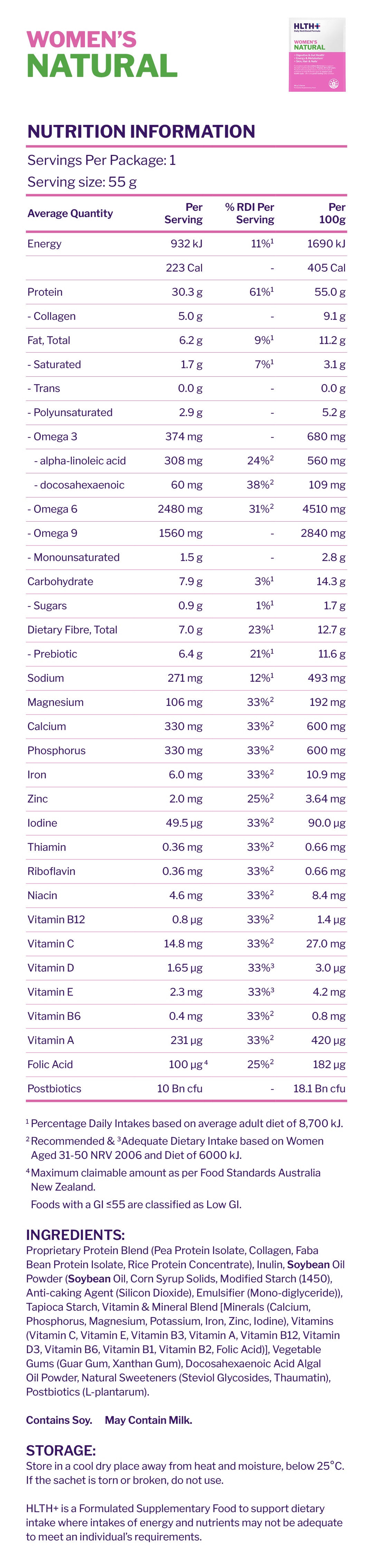
Choosing between the routes
Take any test or diagnosis question to your GP. Separately, HLTH+ is built for a reader whose meals have shrunk and who wants 30g protein, 7g of dietary fibre and 30 essential daily nutrients together in a single sachet.
See what your supplement stack leaves out. The quiz is a diagnostic, listing what your present routine does not cover. Take the quiz.
Frequently Asked Questions
How many hairs is it normal to lose in a day?
Healthdirect puts normal shedding at around 100 hairs a day, so some hair in the brush or the shower is expected. It advises talking to your doctor if you think you are losing a lot more hair than usual, or it is falling out in clumps.
Is shedding after a fast drop in weight the same as pattern baldness?
No. Healthdirect describes pattern hair loss as usually inherited, driven by follicle sensitivity to androgen hormones, while telogen effluvium is a temporary shed after a physical or psychological shock. DermNet NZ calls telogen effluvium self-correcting, though recovery may be incomplete in some cases. A GP can tell the two apart by history and examination.
Which blood tests look for causes of hair shedding?
DermNet NZ advises correcting any abnormality in thyroid function and in iron, vitamin B12 and folic acid levels, and healthdirect notes a doctor might refer you for blood tests to rule out health conditions behind hair loss. Which tests suit you is a decision for your GP, who also knows your history.
Does biotin help with hair shedding?
A 2019 review in Dermatology and Therapy found biotin levels can be low in people reporting hair shedding, yet supplementing is not supported by evidence from trials. It also notes that extra biotin can interfere with some laboratory tests. If you take it, tell whoever orders your blood tests (Almohanna et al, 2019).
Is this page a substitute for seeing a GP?
No. Studies report averages across groups, so none of them can name the cause of hair loss in your own case. A GP can assess your history and scalp, and an Accredited Practising Dietitian can look at what you eat. Medication questions go to your prescriber.
This article is general information, not medical advice. Decisions about any medication belong with your doctor.


Leave a comment
This site is protected by hCaptcha and the hCaptcha Privacy Policy and Terms of Service apply.