


Nausea on a GLP-1 medication is common and is most likely in the first weeks of treatment and after a dose change; the main trial's adverse-event list was headed by nausea and diarrhoea (Wilding et al, 2021, NEJM). What the Australian and clinical sources describe for the plate is small amounts, eaten often, of plain foods that are easy to face, with sips of fluid between, and a wide berth for fatty, spicy, very sweet and large meals.
If you are feeling sick right now, the worry is usually two questions at once: how long will this go on, and how do I keep eating enough while it does. A reduced appetite already makes meals smaller, and nausea can shrink them further. Most pages answer one half of that and skip the other.
This page covers why the nausea happens, what the trial papers say about how long it lasts, what the sources suggest eating and avoiding, and the signs that mean a call to a doctor.
Why does nausea come with this class of medicine?
This class of prescription medicine mimics glucagon-like peptide-1, a hormone released by the gut, whose natural effects include slower gastric emptying and less food intake (Müller et al, 2019, Molecular Metabolism). A reduced appetite is an expected effect. Nausea and diarrhoea topped the list of adverse events in STEP 1, and a 2025 joint advisory from American lifestyle, nutrition and obesity societies reports nausea in 25% to 44% of participants across obesity trials, with diarrhoea, vomiting, constipation and abdominal pain also listed (Mozaffarian et al, 2025, American Journal of Clinical Nutrition). Questions about doses and timing belong with your prescriber.
The mechanism has two parts. Delayed gastric emptying and altered gut motility lead to distension and fullness, and the medicine also acts on a brainstem region that triggers nausea and vomiting (Alhazmi and le Roux, 2026, Frontiers in Endocrinology). The authors of that opinion article, who declared no funding, write that these effects are most pronounced when treatment starts and when doses rise, a time when, they suggest, the stomach may be less adapted.
This article is general information, not medical advice. Decisions about any medication belong with your doctor.
Will GLP-1 nausea go away, and how long does it last?
Nausea tends to ease, though how fast varies from person to person. Two sources describe the pattern, and neither can say how long it will last for you.
| Source | What it says about timing | What kind of source |
|---|---|---|
| Joint advisory (Mozaffarian et al, American Journal of Clinical Nutrition, 2025) | Side effects are more likely in the first weeks and with dose escalation, and tend to become less frequent and less severe on a stable dose. Nausea often comes in the morning or after a long gap without eating | Expert consensus supported by US National Institutes of Health grants, not a trial |
| Opinion article (Alhazmi and le Roux, 2026) | Nausea and vomiting often diminish over time with continued treatment, but the variation between people is large and nobody can predict beforehand who will be affected | Expert opinion, no funding declared |
The advisory's note on timing is the one you can act on today: a long gap between meals is described as a trigger.
If the nausea has not eased after a few weeks, or it comes back after each dose change, that is a conversation for your prescriber. The advice from healthdirect for any nausea is the same: if it doesn't go away, see your doctor (reviewed June 2025, healthdirect).
What should you eat when you are nauseous on a GLP-1?
The advice in the sources is plain and consistent: eat small amounts, often, of food that is easy to face, and keep fluids going. None of it is specific to a medication, which is why the same pattern appears in general guidance for nausea from any cause. A full food-by-food list sits on foods that help nausea (and the ones that make it worse), and a worked day of eating is on what to eat when you're nauseous.
| What to try | What the source says | Source |
|---|---|---|
| Dry cracker biscuits, salty chips, noodles, clear soup | Some foods may be easier to eat; healthdirect lists these | healthdirect, nausea page |
| Small amounts more often | Try not to skip meals, as an empty stomach can make nausea worse | healthdirect |
| A small breakfast, then small meals every 3 to 4 hours | Suggested counselling for people on these medications, with adequate fluids | Mozaffarian et al, 2025 |
| Ginger or peppermint tea | Described by the advisory authors as potentially beneficial; it is a consensus statement and not a trial result | Mozaffarian et al, 2025 |
| Small sips of cold, clear fluids | Water, herbal tea, lemonade, ginger ale, fruit juice or rehydration solutions; ice cubes or icy poles if drinking is hard | healthdirect |
| Eating slowly and finishing a meal at the first sense of fullness | Practices that help the stomach accommodate food | Alhazmi and le Roux, 2026 |
Two details are easy to miss. The advisory notes that vomiting is more likely after large meals, which is the reason for the small-meal pattern. It also says nausea may trigger cravings for comfort foods built on sugar or refined carbohydrate, such as white flour and white rice, and that waiting until you are overly hungry can push food choices the same way.
What should you avoid when nausea is the problem?
According to healthdirect, fatty, spicy or very sweet foods can make nausea worse and are best avoided. Alhazmi and le Roux add high-fat meals and large-volume meals to the list of things to avoid. Between them, the sources name a few habits to drop:
- Lying down straight after eating. Both advise against it.
- Eating and drinking at the same time. healthdirect suggests trying not to do both at once.
- Letting the stomach sit empty. Both healthdirect and the advisory describe a long gap as a trigger.
- Alcohol. The advisory states that alcohol may worsen nausea and reflux and should be minimised.
The advisory also suggests avoiding fatty or high-fibre foods during the first few days of treatment. That is general guidance, and how much to restrict is something to settle with your doctor or a dietitian who sees your whole intake.
Should you keep eating if you feel like throwing up?
Yes, in small amounts, according to the sources. The advisory describes a cycle that some people fall into: nausea means they skip meals, an empty stomach makes the nausea worse, and that makes the next meal less likely. Its suggested way out is a small breakfast followed by small meals every 3 to 4 hours, with enough fluid. The same message appears in healthdirect's own words: eat small amounts more often, and if you can't drink, try sucking on ice cubes or icy poles.
Fluids matter as much as food. The healthdirect page notes that being dehydrated makes you feel even more nauseous, and that nausea which stops you eating and drinking can lead to dehydration and malnutrition and, in turn, kidney problems. The joint advisory goes further, stating that dehydration from severe nausea, vomiting or diarrhoea can cause acute kidney injury and that efforts should be made to prevent it.
When does nausea need a doctor?
Nausea on a bad day is not the same as nausea that is stopping you eating and drinking. Both healthdirect and the advisory set out lines worth knowing.
- See a doctor if the nausea doesn't go away, or if you are vomiting a lot for more than 24 hours (per healthdirect).
- Go to a hospital emergency department or call triple zero (000) for severe pain in the stomach, chest pain, confusion, a high fever, a stiff neck, blurred vision or a bad headache (per healthdirect).
- Tell your prescriber early about persistent vomiting or severe abdominal pain. The advisory lists gallbladder disease and pancreatitis among the rare side effects of this medication class, and dehydration as a route to kidney injury.
- Ask about a dietitian if the nausea follows particular foods; healthdirect says a dietitian can help work out the cause.
The healthdirect helpline on 1800 022 222 has a registered nurse available 24 hours a day. Whether to change a dose, a timing or a medicine is a decision for you and your prescriber, and it is not one to make from an article.
For the wider picture of digestive effects, GLP-1 side effects, the full list of side effects, digestion questions answered and sulphur burps each take one piece.
What happens to nutrition when intake falls?
Nutrition is a separate question from the nausea. It applies whenever intake falls, whatever the reason, an illness included, and also rapid weight loss, reduced eating and medically induced weight loss. Context matters: AIHW data show over 90% of Australian adults fall short of the dietary guidelines already, so eating less often begins from a gap.
The joint advisory describes how this can happen day to day. A limited interest in food, reduced hunger and increased fullness may leave people going several hours without eating, which for some means inadequate nutrient intake. It also warns that cutting calories a lot and fast can leave vitamin and mineral intake short, and its examples include iron, calcium, magnesium and zinc. Treat it as expert consensus backed by public grants, not as trial evidence.
An Accredited Practising Dietitian can map what a typical week of eating contains and where the gaps sit. More on eating less and nutrition: learn more. A seven-day plan built around small meals is on a 7-day nutrition plan for a reduced appetite.
Where does HLTH+ sit beside meals?
The sections above are about the plate, and this one is about a sachet beside it. As a Formulated Supplementary Food, HLTH+ sits beside meals and does not stand in for them; nutritional insurance is the right way to see it.
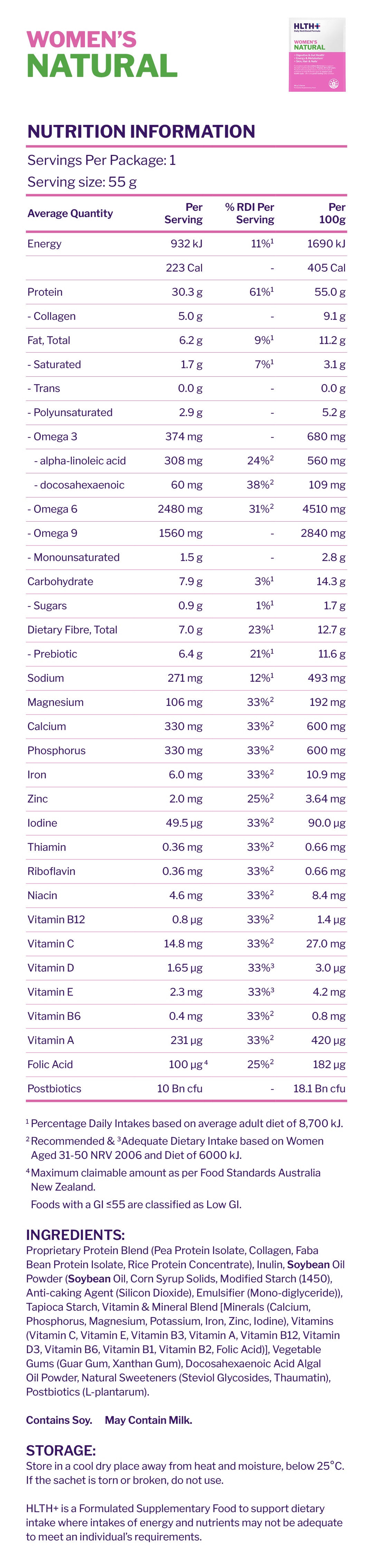
What a serve of HLTH+ carries
Australian made and dietitian formulated, one 55g Women's sachet provides 30 essential daily nutrients, among them 30g protein and 7g dietary fibre, priced at RRP $6.00. Whether it is Women's, Women's 50+, Men's or Men's 50+, the formulation follows the Nutrient Reference Values, authored jointly by the National Health and Medical Research Council, the Australian Government Department of Health and Ageing and the New Zealand Ministry of Health. Choose the 28-serve subscription and each day costs $5.10. Other places to buy are Chemist Warehouse online and the Amazon AU brand store.
Where to take it from here
The ✦ Find My Formula quiz shows what your current routine is not giving you.
See the gaps in your current stack. It takes 30 seconds and reads what you take now. Take the quiz.
Frequently Asked Questions
Is it normal to feel sick after the dose goes up?
It is a documented pattern. A 2025 joint advisory from American lifestyle, nutrition and obesity societies says gastrointestinal side effects are more likely in the first weeks of treatment and with dose escalation, and tend to become less frequent and less severe on a stable dose (Mozaffarian et al, 2025). Dose questions are for your prescriber.
Can drinking too little make nausea worse?
Yes. According to healthdirect, being dehydrated makes you feel even more nauseous, and it advises small sips of water. Its self-care list includes cold, clear fluids such as water, herbal tea and rehydration solutions, and icy poles or ice cubes if drinking is hard. Vomiting a lot for more than 24 hours is a reason to see a doctor.
What do the sources say about ginger?
healthdirect lists ginger among foods that may be easier to eat when nauseous. The joint advisory says ginger or peppermint tea can be beneficial, which is a consensus statement and not a trial result (Mozaffarian et al, 2025). Neither source treats it as a replacement for medical advice if nausea persists.
Should I lie down after eating?
healthdirect says to try not to lie down right after eating, and Alhazmi and le Roux also advise avoiding lying flat straight after meals. Eating slowly and finishing a meal at the first sense of fullness are the other habits they describe (Frontiers in Endocrinology, 2026).
Is this page a substitute for medical advice?
No. Nothing here is personal medical advice, and any choice about a medication is for you and your doctor. A dietitian can review what you eat. Trial figures describe groups of people on average, so they cannot tell you what is happening in your own body or how long your nausea will last.
This article is general information, not medical advice. Decisions about any medication belong with your doctor.

Leave a comment
This site is protected by hCaptcha and the hCaptcha Privacy Policy and Terms of Service apply.