


Neck, chest and upper-arm skin can look different after a large or fast weight loss, and the reasons sit in anatomy and skin ageing, not in your effort. Training one area does not aim fat loss at it, so these sites change as the fat layer under the skin shrinks, and how the skin follows is presumed to depend on factors such as age, sun exposure, genetics and the amount lost. The evidence on those factors is incomplete.
If you have noticed a crepey neck, a softer chest or looser upper arms, the usual reaction is dismay about something you worked for. Most pages either sell a tightening routine or say nothing useful, and neither helps someone who wants to know what is known. Nothing in the research reads loose skin as a measure of effort.
This page covers why these areas change, what the sources state about each one, what has and has not been tested for supporting skin, and when a doctor is worth seeing. The general case sits on why skin loosens after weight loss.
Does the reason for the weight loss change what happens to skin?
The research on skin after weight loss mostly follows people after bariatric surgery, so it does not test the cause of the loss. GLP-1 medications are prescription medicines that reduce appetite, which means people taking them eat less, and nausea and diarrhoea topped the adverse events in the STEP 1 trial report (Wilding et al, New England Journal of Medicine, 2021). Anything about the medication itself is a conversation for your prescriber.
Everything after this applies to rapid weight loss, reduced eating and medically induced weight loss, whichever describes you, because skin does not record the reason. Where a source studied one particular group, the text says which.
This article is general information, not medical advice. Decisions about any medication belong with your doctor.
Is fat loss something training can target?
Not on the best evidence found for this page, which measured arms. In a trial of 104 people who trained one arm with supervised resistance exercise for 12 weeks, MRI found no difference in subcutaneous fat between the trained and untrained arm, and the authors read that as supporting the view that spot reduction does not occur (Kostek et al, Medicine and Science in Sports and Exercise, 2007). Skinfold calipers did show a drop in the trained arm in men but not in women, so the method changed the answer.
One trial does not settle regional fat loss, but it weighs against the idea that training or eating can aim fat loss at a single spot. That puts the question where it belongs, which is on the skin and the tissue under it. The face has a page of its own, face fat loss after weight loss.
Why is my neck sagging after weight loss?
The neck is more than skin. A 2025 review of neck contouring states that both genetic predisposition and ageing contribute to the malposition of deep neck structures and a poorly contoured neckline, so part of the neckline is set by structures below the skin (Su-Genyk and Quatela, Facial Plastic Surgery, 2025).
The skin itself has a second history. DermNet NZ describes extrinsic ageing, driven by chronic ultraviolet exposure and smoking, as affecting habitually exposed areas such as the face, neck and arms, laid over the intrinsic ageing that affects skin all over the body (DermNet NZ, Skin ageing). It adds that the signs of intrinsic ageing begin at around 50 to 60 years and that women develop them earlier than men, which it attributes to the fall in oestrogen's protective effect at menopause.
The wider picture of why skin loosens is in why skin loosens after weight loss.
What happens to the chest and breasts after weight loss?
A 2026 national registry study opens by stating that massive weight loss after bariatric surgery is often associated with changes in breast shape: ptosis, excess skin, poor tissue elasticity and altered nipple position (Hansson et al, Plastic and Reconstructive Surgery, 2026). That paper is about breast augmentation, so it describes the changes and does not measure how often they happen.
Chests change in men too. Pseudogynecomastia after massive weight loss is described as excess skin in the chest, the side of the chest, the armpit and the upper abdomen without enlargement of the breast gland (Affara et al, Aesthetic Plastic Surgery, 2025).
The source is a small surgical series, and it is used here only for the definition. Body composition behind the scale is a separate topic, covered in what the scale hides about muscle and micronutrients.
| Area | What the source states | Source |
|---|---|---|
| Neck | Genetics and ageing both shape neck anatomy, including the deep structures under the skin | Su-Genyk and Quatela, 2025 |
| Chest and breasts | Massive weight loss after bariatric surgery is often associated with ptosis, excess skin, poor tissue elasticity and altered nipple position | Hansson et al, 2026 |
| Chest in men | Pseudogynecomastia after massive weight loss is excess skin without enlargement of the breast gland | Affara et al, 2025 |
| Upper arms | Brachioplasty is most commonly performed after massive weight loss; excess skin and ptosis can cause intertrigo, poor hygiene and infections | StatPearls, Brachioplasty, 2025 |
What about the upper arms?
The upper arms are the area where surgical sources are most direct. The StatPearls entry on brachioplasty states that the procedure is most commonly performed after massive weight loss, and that excess skin and ptosis can cause intertrigo, poor hygiene, infections and psychosocial morbidity (StatPearls, Brachioplasty, 2025).
How much people want the areas changed is measured separately. Of 360 people more than a year after bariatric surgery, high or very high desire for contouring was reported by 62.2% for the waist and abdomen, 37.6% for the upper arm, 35.6% for the rear and buttock, and 28.3% for the chest and breast (Giordano et al, Aesthetic Surgery Journal, 2014). That is a survey of desire, not a count of how many people have excess skin there.
The factors you can and cannot influence are on how to prevent loose skin after weight loss.
Will loose skin eventually tighten after weight loss?
No source read for this page gives a timeline for the neck, chest or arms. The closest regional measure is Swedish: in adults after obesity surgery and weight loss, measured excess skin was significantly lower on the arms, breasts and abdomen than before surgery, while the inner thighs rose (Elander et al, 2019). That compares skin during obesity with skin after the loss; it does not track loose skin settling over time.
Your doctor is the person to ask about your own skin. The options and what each source states sit on loose skin tightening options.
Does exercise tighten skin after weight loss?
The training research measures muscle, not skin. Pooling 34 randomised trials in 1,455 people, the review by Deller et al (2026) put the gain at 0.87 kg (95% CI 0.59 to 1.16) of extra fat-free mass when exercise accompanied calorie restriction. The point estimates favoured strength training, and just two studies reported skeletal muscle mass.
How often to train, and what the Australian sources say about it, is on how to prevent loose skin after weight loss.
A PubMed search on 13 October 2026 for excess skin or skin laxity with exercise or resistance training found no trial that measured skin retraction as its outcome. The evidence backs training for the muscle underneath and is silent on the skin on top. For the muscle side, read how much protein to build muscle and sarcopenia.
If your appetite has dropped, learn more about the aesthetic side of eating less.
What does DermNet NZ advise for sun-exposed neck and arm skin?
Sun and smoking are the two factors on the DermNet NZ list that a person can change. It advises sun-protective clothing, a broad-brimmed hat, very high factor broad-spectrum sunscreen on exposed skin and not smoking (DermNet NZ, Skin ageing). It notes that UV exposure and smoking drive extrinsic ageing.
The page is about skin ageing, and it does not test sun protection against skin retraction after weight loss.
Water has a thin evidence base. A systematic review of six studies called it weak, and observed a slight rise in skin hydration after extra water, particularly in people who drank little to begin with, and a slight rise in skin elasticity (Akdeniz et al, Skin Research and Technology, 2018). Its authors say the mechanism is unknown and that it is unclear whether the finding holds in older skin.
DermNet NZ also says oral supplements with antioxidant and anti-inflammatory properties have been advocated to slow skin ageing, and that their role is unclear. What the collagen supplement trials measured has its own page in collagen for skin.
When is it worth seeing a doctor?
When the skin causes problems, not only when it bothers you. The functional problems StatPearls lists for the upper arms (intertrigo, poor hygiene, infections) are the kind to raise, so skin that rubs, rashes or limits movement belongs with your GP, who can examine it and talk about next steps.
The options a surgeon or doctor may raise are listed by the American Society of Plastic Surgeons as an arm lift for sagging upper arms, a breast lift, and a facelift for the jowls and neck (American Society of Plastic Surgeons). The options page, loose skin tightening options, reads each source in turn. A 2018 review of arm contouring found no studies showing the superiority of any technique, and called nonsurgical skin tightening of the arms promising but short of the evidence needed (Miotto et al, Aesthetic Surgery Journal, 2018).
This article is general information, not medical advice. Decisions about any medication belong with your doctor.
Eating less: what leaves the plate with the food?
Across the country, over 90% of Australian adults do not meet dietary guidelines (AIHW). Eating less takes protein, dietary fibre and micronutrients out with the food that carried them. The nutrition pillar page has more: learn more.
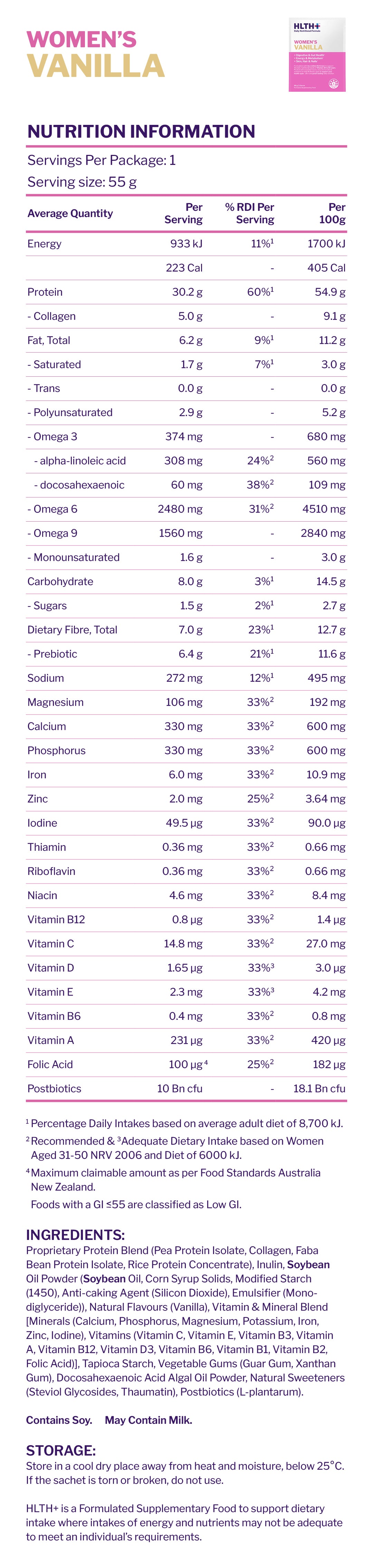
HLTH+ is built as nutritional insurance to sit alongside food-first eating, and it replaces nobody's varied diet.
What a serve of HLTH+ carries
A serve of HLTH+ gives you 30g protein and 7g dietary fibre, and the formula as a whole carries 30 essential daily nutrients. The sachet is 55g in Women's, RRP $6.00, and the product is an Australian made, dietitian formulated Formulated Supplementary Food.
HLTH+ is formulated to the Nutrient Reference Values (2006) set by the National Health and Medical Research Council, the Australian Government Department of Health and Ageing and the New Zealand Ministry of Health. Women's, Men's, Women's 50+ and Men's 50+ each carry their own version, matched to a life stage.
On subscription the 28-serve pack costs $5.10 a day, and you can also buy HLTH+ through Chemist Warehouse online or the Amazon AU brand store.
As part of a healthy diet involving a variety of foods, protein contributes to the maintenance of muscle mass. Every serve carries 30g protein.
Where to take it from here
If you are eating less and want one sachet to sit beside your meals, with the 30g protein and 7g dietary fibre above, choose HLTH+.
The ✦ Find My Formula quiz shows what your current routine is not giving you.
See what your supplement stack leaves out. The quiz is diagnostic, and it takes 30 seconds. Take the quiz.
Frequently Asked Questions
Do chests change in men after weight loss too?
Yes. Pseudogynecomastia after massive weight loss is excess skin across the chest, the side of the chest, the armpit and the upper abdomen, without enlargement of the breast gland (Affara et al, 2025). The source is a surgical series of 15 patients, so it describes what the condition is, not how common it is.
Does drinking more water change skin?
A systematic review of six studies called the evidence weak. It saw a slight rise in skin hydration after extra water, mostly in people who drank little beforehand, and a slight rise in elasticity (Akdeniz et al, 2018). The mechanism is unknown, and it is unclear whether the finding holds in older skin.
When is excess skin a medical question and not a cosmetic one?
When it causes problems. Excess skin and ptosis on the upper arms can cause intertrigo, poor hygiene, infections and psychosocial morbidity (StatPearls, Brachioplasty). Skin that rubs, rashes or limits how you move is worth raising with your GP, who can examine it and advise on next steps, whatever caused the weight loss.
This article is general information, not medical advice. Decisions about any medication belong with your doctor.
Leave a comment
This site is protected by hCaptcha and the hCaptcha Privacy Policy and Terms of Service apply.