


A flat scale is a normal stage of weight change, not a sign that something has broken. A smaller body uses less energy than the larger one did, so the gap between what goes in and what is used narrows, and the curve levels off. The sources below also list a short set of things worth checking before anything else.
If the number has sat still for weeks while you are still eating much less than you used to, the worry is usually that nothing you do counts any more. Most pages hand over a list of tips without saying who was studied, what was counted, or over what period.
This page sets out why weight change slows, how long a stall can run, which food and lifestyle factors have trial evidence behind them, and the order to look at them in. The general plateau mechanisms, from resting energy expenditure to reporting error, are on weight loss plateau: why it happens, so this page does not repeat that table.
Is it normal for the scale to stall on a GLP-1?
Yes, and the trial literature says so. GLP-1 medications are prescribed drugs that act like glucagon-like peptide-1, a hormone the gut makes itself, with slower gastric emptying and lower food intake among its effects (Müller and colleagues, Molecular Metabolism, 2019).
Eating less is the expected result, and nausea and diarrhoea were the commonest adverse events reported in STEP 1 (Wilding and colleagues, NEJM, 2021). A 2025 review of the weight-loss medication trials (Reiss et al, Biomolecules, 2025) describes weight levelling off after the early phase of treatment and links plateaus to metabolic adaptation.
This article is general information, not medical advice; decisions about any medication belong with your doctor.
Dose is a matter between you and your prescriber, and this page leaves it there. The sections that follow describe any body that is eating less, from any cause: rapid weight loss, reduced eating and medically induced weight loss.
What happens when weight loss hits a plateau?
Energy use falls with body size, so the same intake that produced loss at a higher weight produces less change at a lower one. A 2011 modelling study in The Lancet simulated adult energy expenditure during weight change and found that the bodyweight response to a change in energy intake is slow, with half times of about 1 year (Hall et al, The Lancet, 2011). It also found that adults with more body fat start with a larger expected change for the same intake, and take longer to reach their steady weight.
Two cautions go with that paper. It is a mathematical model of adults on average, not a trial of any one person, and it describes the curve flattening, not the scale freezing. The 2025 review above makes a related point: a plateau is often framed as "more loss is wanted but is hard to get", and for some people the goal is simply to hold a weight already reached.
If you have been on the same weekly pattern of eating and the scale has not moved, that is consistent with the model. The next step is to look at the inputs the research names, not to cut further.
How long can a plateau last?
The sources do not give one number, because the answer depends on the starting body and the size of the change in intake. In the Lancet model the half time of about a year means the response keeps arriving slowly long after the early weeks, so a few flat weeks sit inside a longer curve. That is why the trend across several weeks says more than any one reading, and why the factors below are worth checking before anything else.
Day-to-day readings also carry noise from water and carbohydrate stored in muscle, which is why the plateau page suggests reading a two to three week trend instead of a single morning.
| Factor | What the source measured | Who and how big |
|---|---|---|
| A smaller body uses less energy | Modelled energy expenditure during weight change (Hall et al, 2011) | Adults on average; a model |
| Lean mass lost with fat | Fat-free mass with calorie restriction, with and without exercise (Deller et al, 2026) | 34 randomised trials, 1,455 participants |
| Protein intake | Lean mass change with protein above the recommended allowance (Hudson et al, 2020) | 18 studies, 22 comparisons |
| Short sleep | Fat and fat-free mass lost on the same diet (Nedeltcheva et al, 2010) | 10 adults, 14 days per condition |
| Alcohol | Four routes by which it may affect weight (Better Health Channel, 2022) | A health-information page, not a trial |
| Nutrient intake on a smaller appetite | Three-day food records (Johnson et al, 2025) | 69 adults, cross-sectional |
What holds weight loss back besides the body adapting?
Lean mass is the first place to look. Pooling 34 randomised trials, a 2026 review compared calorie restriction alone with restriction plus exercise: the exercise arms finished 0.87 kg ahead on fat-free mass, with a confidence interval of 0.59 to 1.16 kg, and lost 45.7% less of it (Deller and colleagues, Diabetes, Obesity and Metabolism, 2026). The review measured kilograms of fat-free mass, not strength, and only two of its studies reported skeletal muscle mass.
Protein intake was reviewed separately. Eighteen studies compared intakes above the recommended dietary allowance with intakes at it: under energy restriction the higher intakes were associated with lean mass losses 0.36 kg smaller (confidence interval 0.06 to 0.67 kg; 14 comparisons), while lean mass did not differ for people who were neither dieting nor training (Hudson and colleagues, Advances in Nutrition, 2020).
Lean mass includes more than muscle, and the medication-trial figures sit in muscle and micronutrients when the scale moves. The per-meal side of protein sits in protein when appetite is low and how much protein to build muscle, and the age-related version of the question is on the sarcopenia page.
Can sleep or alcohol keep the scale flat?
Both have evidence, though of different strength. In a randomised crossover study, 10 overweight adults ate a moderately reduced diet for 14 days with 8.5 hours or 5.5 hours of sleep opportunity. Shorter sleep cut the share of weight lost as fat by 55% and raised the fat-free mass lost by 60%, and it came with increased hunger (Nedeltcheva et al, Annals of Internal Medicine, 2010). Its authors flag the small sample and short duration.
For alcohol, Victoria's Better Health Channel lists four reasons it may play a role in weight: it stops the body burning fat, it is high in kilojoules, it can lead to greater hunger, and it can lead to cravings for salty and greasy foods. The same page says it is unclear whether alcohol is a risk factor for weight gain, so it is a factor to look at, not a proven cause (Better Health Channel, Alcohol and weight gain, reviewed December 2022). A smaller appetite changes how drinking feels, and alcohol on a smaller appetite takes that on its own.
What should you change first?
The order below follows the strength of the sources above, from the most studied to the least, and none of it is a product.
- Protein across the day. Check that each meal carries a protein food, since the meta-analysis above measured intake above the recommended allowance.
- Strength training. Healthdirect, citing the Australian physical activity guidelines, suggests adults do strength training at least twice a week (healthdirect, reviewed May 2025).
- Sleep. The crossover study above held the diet constant and changed only the sleep opportunity.
- Alcohol. Count it in kilojoules and see what it displaces from the plate.
- A three-day food record. Researchers used one in 69 adults to see where protein, dietary fibre and other nutrients landed (Johnson and colleagues, Frontiers in Nutrition, 2025).
- A conversation with your prescriber and an Accredited Practising Dietitian. They can read your results, your intake and your history together, which no article can.
Nutrition shifts as intake settles, and you can learn more on the metabolism page.
Does a smaller appetite also shrink nutrient intake?
It can, and that is a separate question from the scale. AIHW reporting shows over 90% of Australian adults do not meet the dietary guidelines (AIHW), so a reduced intake often begins from a shortfall. Four US professional societies wrote a joint advisory saying that cutting calories sharply and quickly can leave vitamin and mineral intakes insufficient, naming iron, calcium, zinc and magnesium (Mozaffarian and colleagues, American Journal of Clinical Nutrition, 2025). That is expert consensus, not a trial.
In the 69-adult food-record study, daily dietary fibre averaged 14.5g where 28g is recommended, and calcium, iron, magnesium and potassium sat below the reference intakes as well. The comparison used US reference values, and the authors worked for the supplements retailer that funded it. Dietary fibre when you eat less is covered in dietary fibre on a reduced appetite, and the symptom-by-symptom picture is in GLP-1 side effects.
Where does a Formulated Supplementary Food sit on a smaller plate?
This part concerns the plate alone and is separate from the evidence above. Smaller meals carry less protein, dietary fibre and everything else, and a Formulated Supplementary Food exists to top up a diet that may fall short. HLTH+ is not designed as a meal replacement because it complements a food-first approach, but it works fine as a healthy snack or to tie you over.
What is in one sachet
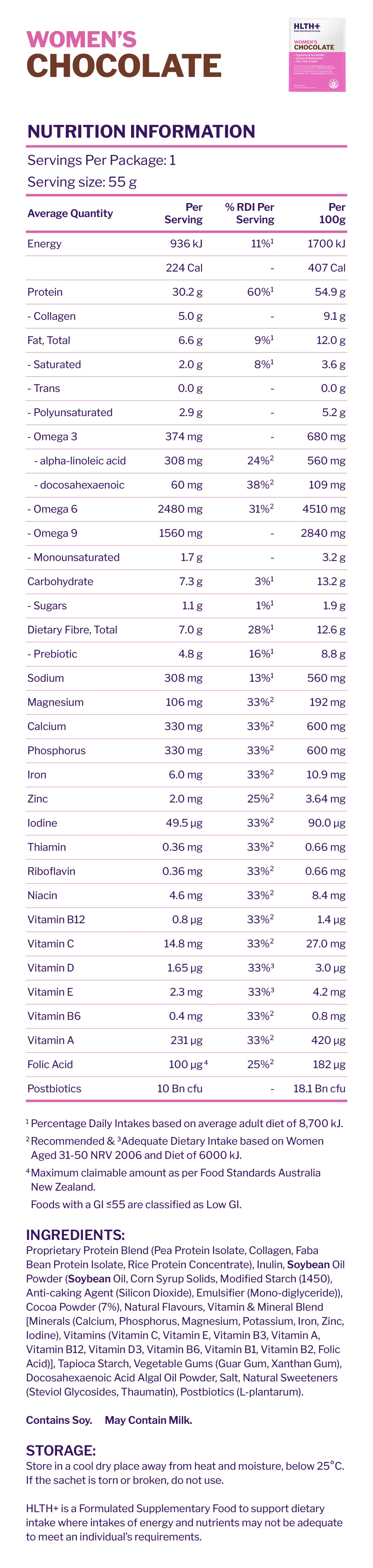
HLTH+ is formulated by Accredited Dietitians. In one sachet (55g for Women's): 30g protein, 7g dietary fibre and 30 essential daily nutrients. 30g of protein contributes to the maintenance of muscle mass as part of a healthy diet involving a variety of foods.
Across Women's and Men's, Women's 50+ and Men's 50+, every formula is formulated to the Nutrient Reference Values set by the National Health and Medical Research Council, the Australian Government Department of Health and Ageing and the New Zealand Ministry of Health.
Price: RRP $6.00. Subscribers pay $142.80 across 28 serves, which is $5.10 a day. The Amazon AU brand store stocks it, as does Chemist Warehouse online.
Which route suits which reader
If the scale is your question, the studies above are the evidence and a prescriber or Accredited Practising Dietitian can go through them with you. For the reader eating less: if you want protein, dietary fibre and a balanced multivitamin profile in one sachet, HLTH+.
Check your gaps. The ✦ Find My Formula quiz shows what your current routine is not giving you. Open the quiz.
Frequently Asked Questions
Does a flat scale mean my body is doing something wrong?
No. A 2011 energy-balance model of adults found the bodyweight response to a change in intake is slow, with half times of about 1 year, so levelling off is part of the expected curve (Hall et al). As a model of averages, it says nothing certain about one person.
Can poor sleep affect how much fat is lost?
In one crossover study, 10 overweight adults ate a reduced diet for 14 days with 8.5 or 5.5 hours of sleep opportunity. Shorter sleep cut the share of weight lost as fat by 55% and increased hunger (Nedeltcheva et al). The study was small and short, so it shows an association worth checking, not a rule.
Is alcohol a reason the scale stays flat?
Victoria's Better Health Channel lists four ways alcohol may play a role in weight: it is high in kilojoules, may increase hunger, can lead to cravings, and stops the body burning fat. The same page says it is unclear whether alcohol is a risk factor, so it is one factor to look at.
What can I track besides the scale?
A three-day food record is one option. Among 69 adults on a reduced appetite, it showed dietary fibre averaging 14.5g daily where 28g is advised (Johnson et al). Strength sessions per week and hours of sleep can be counted too. A dietitian or your doctor can read the results with you.
Who should I speak to when the scale has not moved for weeks?
Anything involving a medication, dose included, is for your prescriber or doctor; this page does not cover it. A dietitian with Accredited Practising Dietitian status can go through your intake with you. Nothing here is medical advice, only general information, so take medication questions to your doctor.

Leave a comment
This site is protected by hCaptcha and the hCaptcha Privacy Policy and Terms of Service apply.