

Whether you need a greens powder every day depends on what is in the scoop, and the label answers that in four numbers: serve size, protein, dietary fibre and price per day. On the Australian labels read for this page, a serve carries 1.2g to 2g of dietary fibre, and 100g of raw baby spinach carries 2.5g. Whether a daily powder suits you depends on the person, and three groups of readers should check with a doctor first.
If you have started a daily scoop and wonder whether it is doing the job of the salad you skipped, you are comparing a teaspoon of dried plant matter with a plate of food. The two are not measured the same way, so most pages either praise the powder or dismiss it without setting the numbers side by side.
This page sets them side by side: the label figures against Australian Food Composition Database values for spinach and broccoli, what trials of greens products have measured, the cautions public health sources give, and what each option costs per day.
What is a green powder supplement, and what makes one "daily"?
A green powder supplement is a blend of dried and ground plant foods, often grasses, leafy vegetables and algae, sold in a tub or pouch to be stirred into water. "Daily" is a way of using it. It is not a standard on the label. The panel you can compare is the same one printed on any packaged food: serve size, calories, protein, carbohydrate, sugars, fat, sodium and, where the maker chooses to print it, dietary fibre.
Serve sizes differ more than most buyers expect. Nuzest Good Green Vitality lists 10g (one scoop) stirred into 250mL of water, Vital Organic Greens lists a 5g serve, and the AG1 Australian label lists 13g. Compare per serve and per day, never per tub, because a larger tub with a smaller scoop is not a bigger dose.
Over 90% of Australian adults do not meet dietary guidelines, a figure from AIHW, Australia's health and welfare statistics agency. For vegetables, the Australian Bureau of Statistics 2023 national nutrition survey found fewer than 1 in 20 adults at the recommended number of serves. That gap is why a scoop is tempting, and why it helps to know what the scoop holds.
What does a daily serve deliver against 100g of vegetables?
The table puts three labels beside food values per 100g from the Australian Food Composition Database, version 3.0, read on 13 October 2026. Label figures come from each brand's own nutrition panel, read the same day, except AG1, whose Australian panel is carried from the record of 2 September 2026 because its site returned an error today. Check current labels before you buy.
| Per serve | Protein | Dietary fibre |
|---|---|---|
| Raw baby spinach, 100g (database value) | 2.8g | 2.5g |
| Raw broccoli, 100g (database value) | 4.0g | 3.5g |
| Boiled broccoli, 100g (database value) | 2.9g | 2.5g |
| Nuzest Good Green Vitality, 10g scoop | 2.2g | 1.8g |
| Vital Organic Greens, 5g serve | 1.8g | 1.2g |
| AG1 Australian label, 13g serve | 2g | 2g |
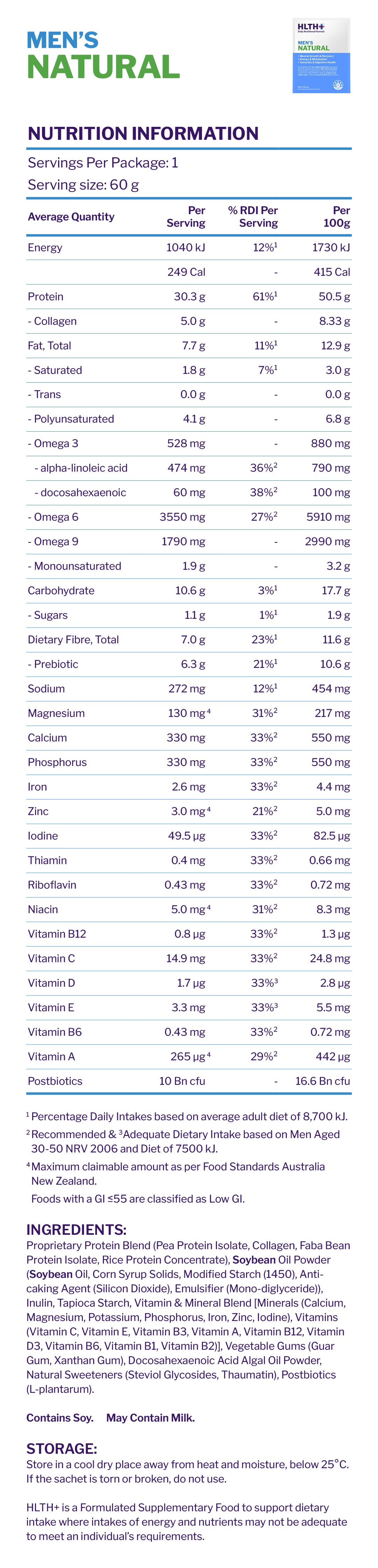
| For comparison: HLTH+ Women's, 55g sachet, a different category from greens | 30g | 7g |
Read on dietary fibre alone, the Nuzest scoop prints the same 1.8g that sits in 72g of raw baby spinach (1.8 divided by 2.5, times 100). The Vital serve prints 1.2g, the amount in 48g of spinach, and the AG1 serve prints 2g, the amount in 80g. That comparison uses one nutrient, and a leaf is a food with many other components that a panel does not list. It does show the scale: a scoop is a small amount of dietary fibre next to a plate of vegetables.
How does HLTH+ compare with a daily greens powder?
HLTH+ is not a greens powder; a greens powder carries the greens. HLTH+ is a Formulated Supplementary Food, read on its own axis: per 55g Women's serve it prints 30g protein, 7g dietary fibre and 30 essential daily nutrients in one serve beside your food. The ✦ Find My Formula quiz shows what your current routine is not giving you, in about 30 seconds.
Is it OK to take greens powder every day?
For most healthy adults the trials that exist ran daily, and none reported a safety problem. A PubMed search on 13 October 2026 returned no systematic review of greens powders, so the evidence is a handful of small trials, and the two found are described here as their authors describe them.
- A four week trial of the AG1 powder (La Monica et al, J Int Soc Sports Nutr, 2024) gave 30 healthy adults the powder or a placebo daily. The digestive quality of life score rose 62.5% in the powder group and fell 50% in the placebo group, and the authors wrote that there "may have been" a greater improvement (p = 0.058, above the usual 0.05 cut-off). Two authors are employees of the company that makes the product.
- A six month trial of a fruit, vegetable and berry juice powder concentrate (Ziegler et al, Nutrients, 2026) used six capsules a day in 34 older adults, open label. It found no safety-relevant deteriorations, and the authors called the other findings "hypothesis-generating rather than confirmatory". The funder was Green Beat, and two authors are affiliated with its nutrient research institute.
Neither trial compared a powder with eating more vegetables. Both measured whether a daily serve was tolerated and moved selected markers in small groups, over four weeks and six months. Neither supports a claim that a scoop replaces a serve of vegetables, and this page makes none.
So the honest reading of "every day" is that daily use has been tolerated in small, short trials, most of them with industry ties, and that the dietary fibre in a scoop is small. If the powder makes you more likely to eat a vegetable at dinner, that is your call. The label does not say it will.
Read more on how a label is built in our super greens powder guide, and on the whole category in the greens powder overview.
What does a daily greens powder cost a day?
Price per day is the one number that makes a tub and a pouch comparable. The figures below are Australian dollar list prices read on 13 October 2026 from each brand's online store, divided by the servings per pack that the store prints. They are one-time prices and leave out subscription discounts.
| Option | Pack | Servings | Cost per day |
|---|---|---|---|
| Vital Organic Greens (5g serve) | $32.31 for 200g | 40 | $0.81 |
| Vital All-In-One (10g serve) | $95.33 for 300g | 30 | $3.18 |
| Nuzest Good Green Vitality (10g scoop) | $106.50 for 300g | 30 | $3.55 |
| For comparison: HLTH+ Women's sachet, a different category | RRP $6.00 per serve; $142.80 for 28 serves on subscription | 28 | $5.10 |
Over a year of daily use (price divided by servings, times 365) the Nuzest scoop comes to $1,295.75 and the Vital Organic Greens serve to $294.83. The cheaper serve is also the smaller one: 5g against 10g, and 1.2g of dietary fibre against 1.8g. A low price a day and a high price a day are both fair on their own terms, and the label tells you what each buys. Read the full panels in the Vital Greens review and the AG1 review, see the options laid out in AG1 alternatives, or see the ranked list in best greens powder in Australia.
Eating less than you used to and wondering what a scoop leaves out? Read how daily nutrition shifts when calories drop.
Who should not take super greens every day?
Some readers should speak to a doctor or pharmacist before starting any daily powder. Take this as general reading, not medical advice: a doctor or pharmacist settles what suits you, particularly where a medicine is involved.
- People taking warfarin. The NHS warfarin page says foods high in vitamin K, such as broccoli, spinach and other green leafy vegetables, can affect how warfarin works, that you can still eat them, and that you should talk to your warfarin clinic. A powder that lists leafy greens is worth raising with the clinic in the same way, before you begin and not after.
- People who have had calcium oxalate kidney stones. NIDDK, the US kidney and digestive diseases institute, says people with these stones may want to avoid spinach and rhubarb, among other foods, to reduce oxalate in urine, and to talk with a health professional about other sources. The labels read for this page print no oxalate figure, so a reader cannot tell from them.
- People with a thyroid condition. The Victorian Better Health Channel lists seaweed (kelp) among foods that contain iodine, and says too much iodine can be harmful, especially with an underlying thyroid disorder. A blend that lists a seaweed is where this applies, and a label that prints no iodine figure leaves the reader unable to tell.
If none of those apply, a pharmacist can still check a new daily powder against any prescribed medication you take.
Should I take greens in the morning or at night?
The panels read for this page give a serve size and a liquid, with no time of day, and the two trials above report daily use without comparing morning with evening. So there is no evidence here to choose between them. The practical test is the habit you will keep: the Nuzest label directs one scoop in 250mL of water, and the Vital Organic Greens label directs 1 to 2 teaspoons mixed in.
If what you want from a daily greens powder is the daily nutrition
A greens powder carries the greens, in the amounts the panels above print. If what you are after each day is protein, dietary fibre and a wider nutrient set in one serve beside your food, that is the job HLTH+ is built for, and it is a different product from a greens blend.
Per serve, HLTH+ lists 30g protein. Protein contributes to the maintenance of muscle mass as part of a healthy diet involving a variety of foods. Taken together, DHA, collagen, minerals, vitamins, dietary fibre and protein make up 30 essential daily nutrients per serve.
A Women's sachet (55g) also lists 60mg DHA, 5g collagen and 7g dietary fibre. Its vitamin content reads as a balanced multivitamin profile.
Accredited Dietitians built each blend (Men's, Men's 50+, Women's and Women's 50+), formulated to the Nutrient Reference Values set by the National Health and Medical Research Council, the Australian Government Department of Health and Ageing and the New Zealand Ministry of Health. Every sachet is Australian made, manufactured in facilities that comply with Good Manufacturing Practices (GMP).
The price is RRP $6.00 per serve, and for a subscriber $142.80 across 28 serves is $5.10 a day. You can also find it at Chemist Warehouse online and on the HLTH+ Amazon AU store.
HLTH+ is not designed as a meal replacement because it complements a food-first approach. But it works fine as a healthy snack or to tie you over. Use it beside the vegetables you eat, not instead of them. For protein and greens read together, see greens powder with protein, and for the vitamin side see do multivitamins work.
Which option fits you
If you want the greens themselves and a low cost a day, a blend such as Vital Organic Greens prints the lowest price per day of the options read here. If you want a larger scoop, AG1's 13g label serve is the biggest of those read. If you want protein, dietary fibre and a balanced multivitamin profile in one sachet, HLTH+.
See what your supplement stack leaves out. The quiz is a 30-second diagnostic of the gaps in what you take now: take the quiz, then bring the result back to your shopping list.
Frequently Asked Questions
How much does a daily greens powder cost a day?
On Australian list prices read on 13 October 2026, a serve ran from $0.81 for Vital Organic Greens (5g) to $3.18 for Vital All-In-One and $3.55 for Nuzest Good Green Vitality (10g). These are one-time prices divided by servings per pack. The smallest serve is the cheapest, so compare dietary fibre and protein per serve as well.
How long have trials of greens products run?
The two trials found ran four weeks (30 adults, a commercial powder against placebo) and six months (34 older adults, a juice powder concentrate in capsules, open label). Their authors describe the results as limited, and several authors are affiliated with the companies involved. A PubMed search on 13 October 2026 returned no systematic review of greens powders.
Does the serve size change how I compare two greens powders?
Yes. The Nuzest scoop is 10g, the Vital Organic Greens serve is 5g and the AG1 Australian label serve is 13g, so a bigger tub does not mean a bigger dose. Compare protein, dietary fibre and price for one serve, then multiply by the number of days you would use it.
What do the labels say to mix a serve with?
The Nuzest Good Green Vitality panel lists a 10g scoop in 250mL of water. The Vital Organic Greens label directs mixing 1 to 2 teaspoons into a drink. Neither panel read for this page names a time of day. Follow the pack, and ask a pharmacist if you take prescribed medication.
Can this page stand in for advice from my doctor?
No. General information is all this page gives, and it is not medical advice. Your doctor decides about any medicine you take, and an Accredited Practising Dietitian can review what you usually eat. Trials and labels describe groups and products on average, so they cannot tell you what a daily powder would do in your case.
This article is general information, not medical advice. Decisions about any medication belong with your doctor.


Leave a comment
This site is protected by hCaptcha and the hCaptcha Privacy Policy and Terms of Service apply.