


Weight loss shows on the face because the fat under facial skin sits in separate compartments that also change with age, and a 2026 dermatology review describes what people see as volume deflation, skin laxity and loss of structural support (Fathizadeh et al, Clinics in Dermatology, 2026). A second 2026 review says the evidence on these skin changes is strongest for mechanistic plausibility and observational signals, with dermatology trials still limited (Vyas et al, Dermatologic Surgery, 2026).
If you have caught your reflection in a window and seen cheekbones, temples or eyes that look different, the worry is usually double: what happened, and whether anything can be done. Most pages on this topic either promise a fix or shrug, and the research sits between the two.
This page sets out what the anatomy papers and recent reviews say, what is and is not known about avoiding it, what the sources list for skin, which options a doctor discusses, and, in a separate section, the nutrition side of eating less.
Why does the face lose volume so visibly after weight loss?
A cadaver study of 30 half-faces found the subcutaneous fat of the face is divided into discrete anatomical compartments, with the cheek fat alone made up of three separate ones. Its authors concluded that facial ageing is partly characterised by how those compartments change with age, and that the face does not age as one confluent mass (Rohrich and Pessa, Plastic and Reconstructive Surgery, 2007). A later dissection paper from the same authors notes earlier observations that loss of deep fat in the temple, cheek and around the eye contributes to the ageing process (Rohrich and Pessa, 2009).
The change can follow rapid weight loss, reduced eating and medically induced weight loss, such as a very low calorie diet, bariatric surgery or a prescribed GLP-1 medication, a class of drugs that slows gastric emptying and lowers food intake, so a smaller appetite is an expected effect (Müller et al, Molecular Metabolism, 2019). One large trial in the class, STEP 1, listed nausea and diarrhoea as the most frequent adverse events, typically mild to moderate and easing with time (Wilding et al, 2021). Questions about a medication belong with your prescriber.
| Source | Type | What it reports about facial change |
|---|---|---|
| Rohrich and Pessa, 2007 | 30 cadaver hemifacial dissections | Facial subcutaneous fat is partitioned into discrete compartments; ageing is partly how they change |
| Fathizadeh et al, 2026 | Review | Weight-loss-associated facial change is described as volume deflation, skin laxity and loss of structural support; it examines dermal white adipose tissue, skeletal remodelling and sarcopenia |
| Barişkan et al, 2026 | Literature review, 20 references | Weight loss brings cosmetic challenges including skin laxity, body contouring and facial volume loss; the authors say further studies are needed |
| Vyas et al, 2026 | Narrative review | Evidence is strongest for mechanistic plausibility and observational clinical signals; dermatology-specific randomised trials remain limited |
None of these abstracts ranks body sites in order, so "the face goes first" describes what people notice, not a measured sequence. The neck, chest and arms have their own page: neck, chest and arms after weight loss.
At what age does the face lose volume?
The papers give no single age. The anatomy work above describes volume loss in deep facial fat as part of ageing in general, with no age threshold. DermNet NZ separates intrinsic ageing, which it says affects everyone whatever their skin type, from extrinsic ageing driven by ultraviolet radiation, smoking and pollutants (DermNet NZ, Skin ageing).
That means a face can look different after weight loss for two layered reasons: the weight change, and the age-related change already under way. Separating the two by eye is not something the sources claim anyone can do. A similar point applies to the body, where the general loose skin pages are why skin loosens after weight loss and how people try to avoid it.
Does everybody lose facial volume when their weight drops quickly?
The evidence cannot say who will. A scoping review of excess skin after bariatric surgery called the findings inconclusive on correlates like age and the weight lost, and noted there was no good evidence on which adults carry the greater risk (Baillot et al, Obesity Surgery, 2017). That review concerned excess body skin after surgery, not the face.
A 2024 histology paper on skin after massive weight loss names six factors presumed to affect how well skin draws back in: how fast weight came off, how much came off, the person's age, their smoking history, sun exposure, and inherited tendency (Hany et al, Obesity Surgery, 2024). The word "presumed" is the authors', and the paper does not rank the factors. Both papers were written about body skin after large losses, so their applicability to the face is an extension, not a finding.
Can the face keep its volume during weight loss?
The plain reading is that nobody has shown how. The 2026 dermatology reviews describe mechanisms and clinical observations, and the Dermatologic Surgery review says randomised trials in dermatology are limited (Vyas et al, 2026). The Clinics in Dermatology review proposes a "health-first approach that prioritizes tissue preservation" in the timing of care, and it is a framework for clinicians and not a trial result.
Of the presumed factors, pace, smoking and sun exposure are the ones a person can influence, and pace is a question for the GP or dietitian guiding the weight change. Pages promising that a supplement, cream or face exercise will hold volume in place are going beyond what these reviews say. What has a research base is general skin protection, set out next.
What do the sources list for skin during and after weight loss?
Among the habits DermNet NZ lists for ageing skin are a very high, broad-spectrum sunscreen (SPF above 30) on exposed skin, and not smoking. It states that ultraviolet radiation, smoking and other pollutants drive extrinsic ageing on top of the intrinsic kind, and that chemicals in tobacco smoke degrade collagen and elastin in the skin (DermNet NZ, Skin ageing).
- Sun protection: daily broad-spectrum sunscreen, per DermNet NZ.
- Not smoking: named by both DermNet NZ and the 2024 histology paper as a factor.
- Food and fluids: no source I read tests drinking more water, or any single food, against facial fat after weight loss, so none of that is stated here.
- Collagen supplements: trials on skin properties are covered by collagen for skin; none of the sources above tests them against facial fat.
- Hair shedding: often arrives in the same months and has its own explainer, telogen effluvium.
What options does a doctor discuss for a changed face?
One review lists dermal fillers, biostimulator agents and skin-tightening technologies as the approaches used by practitioners for facial volume loss after weight loss (Barişkan et al, Journal of Craniofacial Surgery, 2026). They are medical or procedural decisions with their own risks, costs and timing, so they belong in a consultation with a GP, dermatologist or plastic surgeon and not on a nutrition page. For the body, loose skin tightening options has its own read.
This article is general information, not medical advice; decisions about any medication belong with your doctor.
Take a face that has changed quickly, or weight that is dropping faster than planned, to your GP. The trial research on weight change itself sits on its own page: what the research says about weight loss.
What can a sachet add to a plate that has shrunk?
This section is separate from the one above and is only about what you eat. Over 90% of Australian adults do not meet dietary guidelines (AIHW). Eating less makes that gap harder to close.
Four US professional societies wrote a joint advisory (expert consensus, not a trial) saying a steep cut in intake can leave vitamins and minerals short, with iron, calcium, magnesium and zinc on their list of concern (Mozaffarian et al, 2025).
Nutrition on a smaller appetite: learn more.
What one sachet of HLTH+ provides
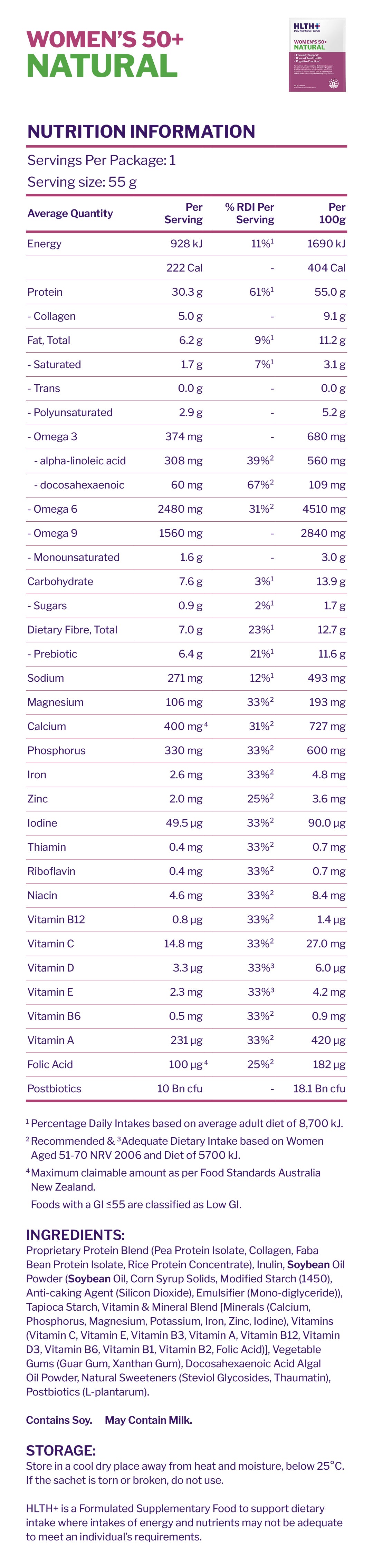
The Formulated Supplementary Food from HLTH+ is Australian made, dietitian formulated, and meant to sit beside meals, not stand in for them. A serve costs RRP $6.00 and the 55g Women's sachet holds 30 essential daily nutrients, 7g of dietary fibre, 30g of protein and 5g of collagen. Every life-stage formula follows the intake recommendations of the National Health and Medical Research Council, the Australian Government Department of Health and Ageing and the New Zealand Ministry of Health, issued as the 2006 Nutrient Reference Values, with versions for Women's and Women's 50+, and for Men's and Men's 50+.
As part of a healthy diet involving a variety of foods, every serve's 30g protein contributes to the maintenance of muscle mass. The ✦ Find My Formula quiz shows what your current routine is not giving you. Start it here, in 30 seconds: start the quiz.
On subscription the 28-serve pack comes to $5.10 a day; HLTH+ is stocked at Amazon AU and Chemist Warehouse online.
Choosing between the routes
For anyone on a smaller appetite who wants protein, dietary fibre and a balanced multivitamin profile together, in a 55g sachet taken next to meals, that is the job HLTH+ was formulated for.
See what your supplement stack leaves out. The quiz is a diagnostic, listing what your present routine does not cover. Take the quiz.
Frequently Asked Questions
Is it possible to keep facial volume while losing weight fast?
No published study shows a reliable way to do it. A 2026 dermatology review calls the evidence mostly mechanistic and observational, with limited randomised trials. For body skin, rate and amount of loss, age, smoking, sun exposure and genetics are the factors presumed to matter. Questions about the pace of your loss belong with your GP.
Why has my face lost so much volume?
The subcutaneous fat of the face sits in separate compartments, and cadaver work shows facial ageing is partly how those compartments change. When overall fat drops quickly, those pads are among the places people notice it, alongside skin laxity. A GP or dermatologist can examine your own face and history.
At what age does the face lose volume?
The sources I read give no single age. Plastic surgery anatomy papers describe volume loss in deep facial fat as part of ageing, and DermNet NZ says intrinsic skin ageing affects everyone. One review of excess skin called age inconclusive as a correlate, so no age can be promised.
Does everybody get a gaunt face after weight loss?
Not necessarily, and the evidence cannot predict who will. A scoping review of excess skin after bariatric surgery called the findings inconclusive on correlates like age and the weight lost. A 2026 review adds that dermatology trials are limited. If your face has changed, a GP or dermatologist can assess it.
Will collagen change how my face looks after weight loss?
This page makes no claim about collagen and the face. The research on collagen supplements and skin has its own page, collagen for skin, which sets out what those trials measured. Protein while eating less is a separate nutrition question, covered in the Formulated Supplementary Food section.


Leave a comment
This site is protected by hCaptcha and the hCaptcha Privacy Policy and Terms of Service apply.