

Whether an older person needs a nutrition drink depends on why they are eating less, and the drink on the shelf that fits depends on who is overseeing it. Some are medical products used under a doctor or dietitian, some are meal replacements, and some are Formulated Supplementary Foods that sit beside meals. Reading the label against the reason is the whole job.
If you are buying for a parent or a client who has gone quiet at the table, the shelf is a wall of tins that all say protein. The health service healthdirect puts about half of older Australians in the malnourished or at-risk group (healthdirect, reviewed August 2025), so the question is common, and the products are not interchangeable.
This page sets out when a nutrition drink comes into the picture, the categories a carer meets, a label table with one verified product from each, and the checks that matter before you buy.
Should older people drink protein shakes?
Sometimes, and the reason decides it. The national health information service healthdirect lists the causes of malnutrition in older adults as including poor appetite, trouble swallowing, and a long-term illness or medicines that dampen appetite, and it says to see a doctor if someone is losing weight without trying to or has a low appetite (healthdirect, Malnutrition). It adds that high calorie nutritional supplements may be part of the plan, which is a decision made once the cause is understood.
Four situations are the usual starting points, and each one is a reason to talk to a doctor or an Accredited Practising Dietitian first:
- Weight loss nobody planned: clothes loosening, a ring slipping, a lower number at the weigh-in.
- A small appetite that has lasted weeks: plates returned half full, meals skipped, tea and toast for dinner.
- Recovery from illness or a hospital stay, when the body is asking for more than the person feels like eating.
- Chewing or swallowing difficulty, where texture and thickness are a clinical decision, not a shopping one.
Ordinary ageing matters too. After 60, healthdirect says people may be less active and need fewer kilojoules, and some have a reduced appetite, which means vitamins, minerals, protein and fibre must be packed into smaller meals (healthdirect, Healthy eating over 60). Muscle is one reason protein gets the attention; the live page on sarcopenia covers it.
Signs that need a doctor or dietitian, not a new tin
Weight loss that was not intended, or a low appetite, is a reason to book a doctor, and healthdirect adds that a dietitian can help work out which foods are needed. A nutrition drink bought off the shelf does not tell you why the appetite fell. Swallowing trouble, repeated coughing at meals, new confusion or a sudden change in what someone will eat all belong in the same appointment.
What is the healthiest drink for seniors? Four shelf categories
No single product wins that question, because "nutrition drink" covers four regulated categories, and the Food Standards Code treats them differently. The panel table below sets one verified example from each side by side, with the category named in the row.
Medical nutrition (Food for Special Medical Purposes)
Ensure Powder, sold in Australia by Abbott, labels itself a Food for Special Medical Purposes, with an instruction to use it only under medical supervision. Sustagen OPTIMUM carries the same category line, with a line requiring a healthcare professional to supervise its use. How much a person has a day, and for how long, is therefore a clinician's instruction, not a pack instruction.
Formulated meal replacements
Sustagen Hospital Formula describes itself as a formulated meal replacement, with a footer saying it is not a total diet replacement. The category exists to stand in for a meal, which is a different job from topping up a day of eating.
Formulated Supplementary Foods
These are sold to be of assistance where a person's dietary intake may fall short on calories and nutrients, and they sit beside food. Sustagen Ready to Drink is one, by its own footer, and HLTH+ belongs to the same category.
Protein powders and shakes
A protein powder is a food with a protein number on the front. The Lady Shake is a milk-protein shake powder sold as a meal replacement for women, and it stands in here as the reference high-protein powder. For powders in more depth, see protein powder for seniors first, then the over-70s powder ranking.
How do the labels compare?
Every number below is taken from the brand's panel for the flavour named, with the retrieval date shown under the table. Where Ensure publishes a figure per 100 mL, the per-serve number is shown with the arithmetic.
| Product (category) | Serve as published | Calories (kcal) | Protein | Sugars | Dietary fibre |
|---|---|---|---|---|---|
| Ensure Powder, Vanilla (Food for Special Medical Purposes) | 53.8g powder in 195 mL water, a 230 mL serve | 230 | 8.6g | 10.8g (4.68g per 100 mL x 2.3) | 2.3g (1.01g per 100 mL x 2.3) |
| Sustagen OPTIMUM, Vanilla (Food for Special Medical Purposes) | 55g powder in 190 mL water | 251 | 10.2g | 7.5g | 3.1g |
| Sustagen Hospital Formula, Vanilla (formulated meal replacement) | 60g powder in 200 mL water | 225 | 13.8g | 27g | None printed |
| Sustagen Ready to Drink, Vanilla (Formulated Supplementary Food) | 250 mL | 244 | 12.5g | 23.8g | None printed |
| The Lady Shake, Chocolate (milk-protein shake powder, formulated meal replacement) | 56g powder | 203 | 30.2g | 2.2g | 6.4g |
| HLTH+ Men's (Formulated Supplementary Food, not medical nutrition) | 60g sachet (62g Chocolate) in 300 to 400 mL | 248 | 30g | 1.7g | 7g |
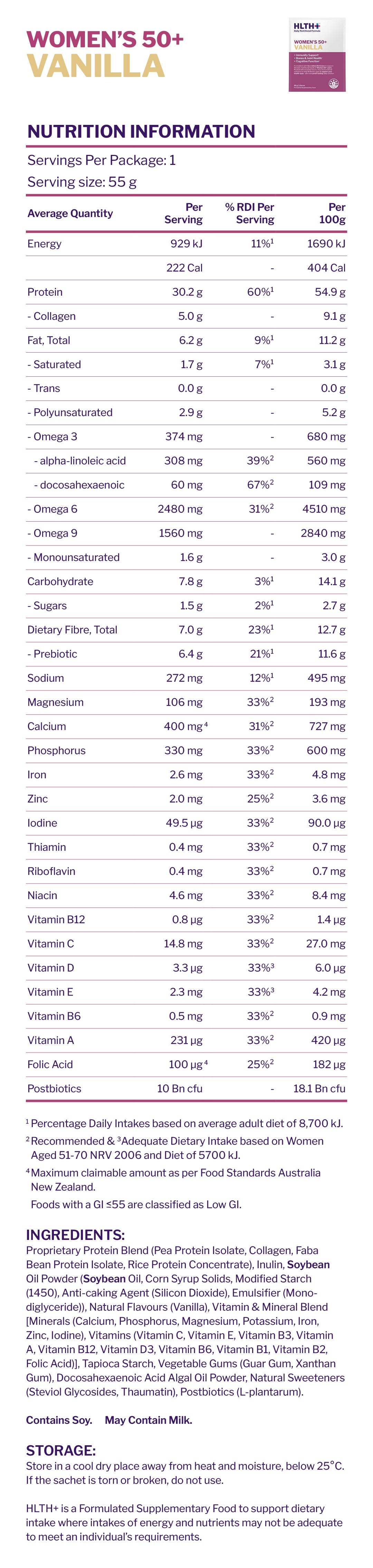
| HLTH+ Women's (Formulated Supplementary Food, not medical nutrition) | 55g sachet in 300 to 400 mL | 223 | 30g | 1.5g | 7g |
Retrieval dates: Ensure, Sustagen OPTIMUM, Hospital Formula and Ready to Drink were read from the brands' own pages and panel images on 29 September 2026 (Hospital Formula and Ensure also on 15 September), and The Lady Shake on 6 October 2026. HLTH+ rows are the brand's own published per-serve figures, and a per-SKU panel for the 50+ formulas is not printed here. Allergen lines differ: Ensure Powder lists soy and milk ingredients, Sustagen OPTIMUM contains milk and soy, Hospital Formula contains milk and may contain soy, and HLTH+ is dairy-free, gluten-free and contains soy.
Neither Abbott nor Sustagen publishes a price on its Australian pages, so no cost cell is printed for them. The Lady Shake's pack of 15 serves is priced at $54.95, which works out to about $3.66 a serve (54.95 divided by 15). HLTH+ is RRP $6.00, and $142.80 across 28 serves is $5.10 a day on subscription.
How does HLTH+ compare?
In the table, HLTH+ sits in its own category: a Formulated Supplementary Food, made in Australia, with 1.5g to 1.7g of sugars a serve beside 30g protein and 7g dietary fibre. The sachet is meant to be taken alongside a person's meals, which is a different job from a tin used under a dietitian's plan. The ✦ Find My Formula quiz shows what your current routine is not giving you: run it for a parent's routine.
What should a carer look for on the label?
Seven checks cover most decisions, and they run in the order a dietitian would ask them.
- Protein per serve, and the serve itself. Compare the serve as published: Ensure's 8.6g is a 230 mL serve, Hospital Formula's 13.8g is 60g of powder in 200 mL water.
- Calories for someone who needs more of them. Calories per serve run from 203 to 251 in the table. For someone losing weight unintentionally, the calorie target is a dietitian's to set.
- Dietary fibre. The panels range from no fibre row to 7g a serve, and healthdirect's over-60 page lists fibre among the nutrients that smaller meals still need to carry.
- Sugars. The table runs from 1.5g to 27g a serve; read the row, because a drink can look gentle and not be.
- Lactose and allergens. Sustagen's own FAQ says its products contain lactose, and says OPTIMUM is low in lactose once mixed with water (0.28g a serve). Soy appears on several lines.
- Texture and thickness. For anyone with swallowing difficulty, this belongs to a dietitian or speech pathologist, so the thickness to buy is theirs to specify.
- Cost per serve, counted over the weeks a drink will actually be used.
Calcium and vitamin D are not on a protein drink's front label, and the live pages on calcium supplements and vitamin D deficiency are the place for them.
How much Ensure or Sustagen a day is right?
That is a clinician's call, and the products say so. Ensure Powder's own page states "Use only under medical supervision", and none of the Sustagen product pages read for this page prints a number of serves a day. A dietitian sets an amount against the person's intake, weight and condition, and it can change as they recover.
For the Sustagen range on its own, the live pages cover Sustagen for the elderly, Sustagen against Ensure and Sustagen alternatives, and the bowel question has its own page, while the label read for tolerance is what the Sustagen label says about lactose, sugars and who it suits.
This article is general information, not medical advice. Decisions about any medication belong with your doctor.
Further reading on nutrition in later life: learn more.
Where does HLTH+ sit for an older person eating less?
This section stands apart from the medical discussion above. It is for an older person who is eating less than they used to and is not on a clinical plan. According to the AIHW, over 90% of Australian adults do not meet dietary guidelines. That gap explains why HLTH+ is offered as nutritional insurance next to a varied diet, never instead of one.
What one sachet holds
One sachet delivers 30g protein, 7g dietary fibre and 30 essential daily nutrients, and weighs 55g in Women's and 60g to 62g in Men's. Per serve, 30g of protein contributes to the maintenance of muscle mass as part of a healthy diet involving a variety of foods. Mix one sachet into 300 to 400 mL of water or milk. The two 50+ formulas follow the Nutrient Reference Values (2006), issued jointly by the National Health and Medical Research Council, the Australian Government Department of Health and Ageing and the New Zealand Ministry of Health. These formulas are made for the over-50s life stage, not to the 8,700 kJ labelling reference value.
HLTH+ is not designed as a meal replacement because it complements a food-first approach; but it works fine as a healthy snack or to tie you over. Separately, a sachet carries a balanced multivitamin profile, and it is available from hlthplus.com, Amazon AU or Chemist Warehouse online.
Which option fits which reader
- A doctor or dietitian has prescribed or advised a medical nutrition product: follow their plan, and ask them before adding anything else.
- You want a measured meal-sized drink with a clinical label: the meal replacement and medical rows in the table, as a clinician directs.
- You are after a daily sachet with protein, dietary fibre and a balanced multivitamin profile next to ordinary meals: HLTH+ Women's 50+ or Men's 50+.
Check the gaps in the supplements already in the cupboard. The quiz is diagnostic, so it reports what the current stack leaves out. Check my stack.
Frequently Asked Questions
Is it safe for an older person to have a nutrition drink every day?
It depends on the product and the person. Ensure Powder's page says to use it only under medical supervision, and Sustagen OPTIMUM is labelled for supervised use, so a daily amount is set by a clinician. A Formulated Supplementary Food sits beside meals; a dietitian can say whether it suits an individual's circumstances.
Can Sustagen cause constipation?
Sustagen's own pages describe the Hospital Formula Plus Fibre range as high in fibre and the Hospital Formula panel prints no fibre row. Its FAQ says its products contain lactose. For a bowel question, start with the live page on whether Sustagen affects the bowel, then a doctor or dietitian.
Is a nutrition drink a meal replacement?
Only some are. Sustagen Hospital Formula calls itself a formulated meal replacement, Ensure Powder carries the Food for Special Medical Purposes label and is used under supervision, and HLTH+ belongs to the Formulated Supplementary Food category, meant to be taken beside meals. The category on the label tells you which job the drink is made for.
Does an older person need more protein?
The healthdirect over-60 page says older people with a reduced appetite need to fit more nutrients, including protein, into a smaller amount of food. How much protein a person needs is for a dietitian to work out, and the figure on a tin is a serve size, not a target.
This article is general information, not medical advice. Decisions about any medication belong with your doctor.

Leave a comment
This site is protected by hCaptcha and the hCaptcha Privacy Policy and Terms of Service apply.