
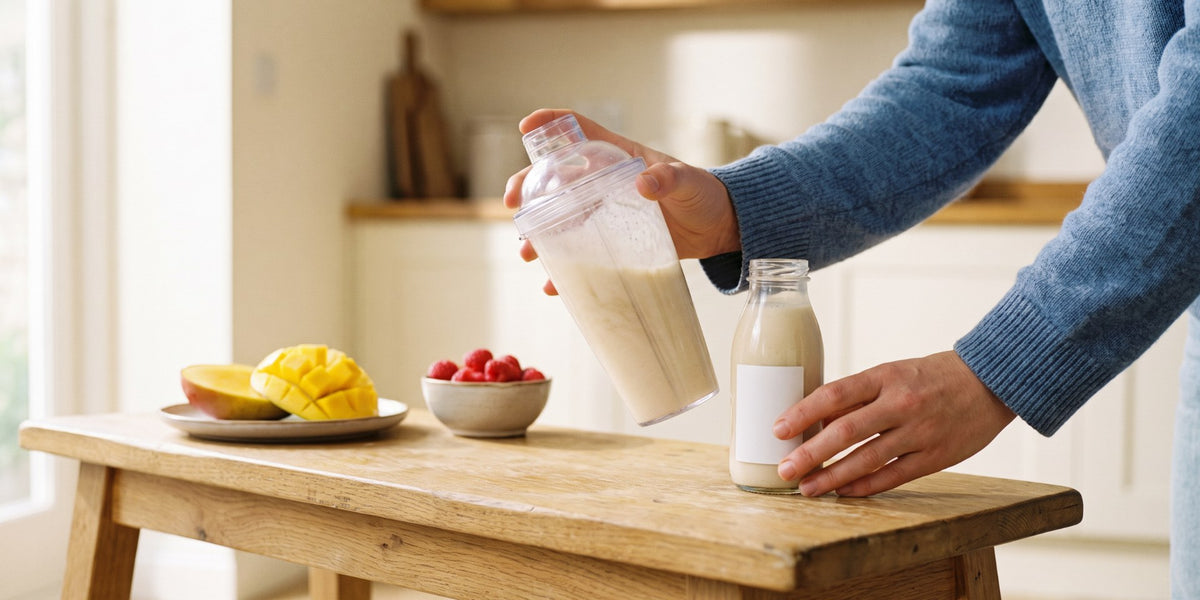
A Rokeby Protein Smoothie is a 425ml bottle of cold-filtered fresh milk that prints 30g of protein and 833mg of calcium on the brand's own panel, ready to drink straight from the fridge. The two things to weigh are sugar and storage: total sugars are 16.6g a bottle in the three no-added-sugar flavours and 25.1g in the four made with cane sugar, and every bottle has to stay chilled (brand pages and a Woolworths listing, read 11 November 2026).
This review is for the shopper who has seen the bottles in the dairy fridge and wants the label read properly before one becomes a daily habit.
The short version
- Every flavour prints 30g of protein, 6.4g of fat and 833mg of calcium per bottle, at 1,200 to 1,224 kJ.
- Sugar splits the range: Vanilla Wafer, Choc Honeycomb and Banana Honey + Cinnamon print 16.6g; the cane-sugar flavours print 25.1g.
- The range is low lactose, not lactose-free, and it contains milk.
- Woolworths listed a bottle at $3.70 on special on 11 November 2026, against a usual $5.00.
- A chilled bottle and a sachet mixed at home are different formats, so HLTH+ gets one separate section and no row in Rokeby's table.
What is a Rokeby Protein Smoothie, and what is in the bottle?
Rokeby Protein Smoothies are refrigerated, ready-to-drink flavoured milks sold by Rokeby Nutrition in 425ml single-serve bottles. The brand says the protein is concentrated, not added: milk from farms in and around Victoria is cold filtered to take out some water and lactose, and Rokeby states that it uses "2 litres of fresh milk to create 1 litre" (brand collection page, retrieved 11 November 2026).
Seven flavours were listed that day, and each product page repeats six claims: 30 grams of fresh protein, fresh milk with no powders, high in calcium, low fat, low lactose, and gluten and soy free. For scale, the Nutrient Reference Values put the protein RDI at 46g a day for women and 64g for men, ages 19 to 70 (Nutrient Reference Values, protein). Whether breakfast is the right place for it has its own page: a protein shake for breakfast.
Want a sachet you mix at home? Look at the HLTH+ Women's packs.
How many calories are in a Rokeby Protein Smoothie?
A Rokeby Protein Smoothie prints 1,200 to 1,224 kJ per 425ml bottle, which converts to about 287 to 293 Calories (kJ divided by 4.184). Vanilla Wafer and Banana Honey + Cinnamon print 1,200 kJ, and the other five flavours print 1,224 kJ (brand product pages, retrieved 11 November 2026).
For context, the Australian Dietary Guidelines count 1 cup (250ml) of milk as one milk-group serve, at 500 to 600 kJ (Eat for Health, milk, yoghurt, cheese and alternatives). One bottle carries roughly the kilojoules of two such serves. Three lines are identical on every panel: 6.4g of fat, 4.7g of it saturated, and 140mg of sodium.
| Flavour (425ml bottle) | Energy | Total sugars | Added sugar, per the brand page | Sweetened with |
|---|---|---|---|---|
| Dutch Chocolate | 1,224 kJ | 25.1g | No figure printed | Cane sugar |
| Strawberry | 1,224 kJ | 25.1g | No figure printed | Cane sugar |
| Double Espresso | 1,224 kJ | 25.1g | No figure printed | Cane sugar |
| Cookies and Cream | 1,224 kJ | 25.1g | No figure printed | Cane sugar |
| Choc Honeycomb | 1,224 kJ | 16.6g | 0g | Erythritol and stevia |
| Vanilla Wafer | 1,200 kJ | 16.6g | Described as no added sugar | Stevia |
| Banana Honey + Cinnamon | 1,200 kJ | 16.6g | 0g | Erythritol and stevia |
All seven panels also print 30g of protein and 833mg of calcium. Rokeby says the panel on the bottle is the correct one wherever it differs from the website.
How much sugar is in a Rokeby Protein Smoothie, and which flavours have no added sugar?
A Rokeby Protein Smoothie prints either 16.6g or 25.1g of total sugars per bottle, and the flavour decides which. Vanilla Wafer, Choc Honeycomb and Banana Honey + Cinnamon are the no-added-sugar flavours at 16.6g. Dutch Chocolate, Strawberry, Double Espresso and Cookies and Cream list cane sugar among their first three ingredients and print 25.1g.
Not all of that is sugar somebody added. Every panel itemises 2.1g of lactose and 3.4g of galactose, which trace back to the milk, and Rokeby prints no added-sugar figure for the cane-sugar flavours. The gap between the two groups is 8.5g a bottle (25.1 minus 16.6).
Food Standards Australia New Zealand reports that the World Health Organization recommends 'free' sugars stay within 10% of daily kilojoules, about 50g a day for an adult, and describes them as sugars added to food and drink plus those in honey, syrups and fruit juices (FSANZ, Sugar). Milk's own sugars fall outside that description; cane sugar falls inside it.
The no-added-sugar flavours are sweetened with stevia (steviol glycosides), plus erythritol in two of the three. Learn more in low-sugar protein shakes.
Is a Rokeby Protein Smoothie lactose free?
No. Rokeby Protein Smoothies are low lactose, not lactose-free, and the brand says so directly: "Our ROKEBY smoothies are not lactose-free but are low-lactose" (brand FAQ, retrieved 11 November 2026). Filtration removes some of the lactose and an added lactase enzyme converts part of the rest. The panels print 2.1g of lactose per bottle, or 0.5g per 100ml.
Both phrases are defined terms. In the Food Standards Code's Schedule 4, a food can be called "low lactose" at no more than 2g of lactose per 100g, and "lactose free" only when no lactose is detectable (Food Standards Code, Schedule 4). Rokeby's printed 0.5g per 100ml meets the first test and not the second.
The government service healthdirect adds that a milk allergy is a different thing from lactose intolerance (healthdirect, lactose intolerance). A Rokeby bottle is a milk drink, and the Woolworths allergen line reads "Contains: Milk". For testing, see lactose intolerance symptoms; for the fully lactose-free shelf, ready-to-drink and powder, see lactose-free protein shakes.
Are protein smoothies like Rokeby good for you?
A Rokeby Protein Smoothie is, on its own label, concentrated milk with flavouring, so the fair test is the panel: what is on it and what is missing. On it are 30g of protein and 833mg of calcium per bottle, with the calcium printed as 104% of the labelling RDI.
Calcium is the standout line. The Nutrient Reference Values, published by the National Health and Medical Research Council, the Australian Government Department of Health and Ageing and the New Zealand Ministry of Health, set the calcium RDI at 1,000mg daily for women from 19 to 50 and men from 19 to 70, rising to 1,300mg after those ages (Nutrient Reference Values, calcium). One bottle is 83% of the first figure and 64% of the second, and calcium-rich foods lists the other routes.
Missing from the web panels is any dietary fibre, and any vitamin or mineral beyond calcium and sodium. One flavour also needs its own note: Double Espresso prints 191mg of caffeine per bottle, and healthdirect puts the safe amount for healthy adults at around 400mg a day, with a 200mg daily limit suggested during pregnancy and breastfeeding (healthdirect, caffeine). If the coffee is the point, protein coffee compares the ready-made options.
How convenient is a Rokeby Protein Smoothie: refrigeration, portability and shelf life?
A Rokeby Protein Smoothie is about as convenient as a drink gets at the moment you open it: nothing to measure, mix or wash up. The price of that ease is the cold chain. The storage line on the Woolworths listing reads "Shake well. Keep chilled. Refrigerate at or below 4 Degree Celsius and consume within 5 days after" before the text cuts off, which reads as five days after opening (retrieved 11 November 2026).
Neither the brand's pages nor the listing publish an unopened shelf life in days, so the use-by date stamped on the bottle is the only guide. For time out of the fridge, the FSANZ 2-hour/4-hour guide is a sensible yardstick: chilled food that has spent under two hours in the 5°C to 60°C zone may be returned to the fridge, from two to four hours it may be used but not re-chilled, and beyond four hours it is discarded (FSANZ, 2-hour/4-hour rule).
A bottle suits the fridge-to-desk commute and wants an insulated bag for anything longer; a healthy breakfast on the go sorts what travels from what does not.
What does a Rokeby Protein Smoothie cost per serve in Australia?
A Rokeby Protein Smoothie cost $3.70 a bottle at Woolworths on 11 November 2026, marked down from a usual $5.00, with a unit price of $8.71 per litre (Woolworths online listing, retrieved that day). The six flavours visible on the retailer's pages carried the same special, and Rokeby's own Our Products page shows its smoothies at $5.00 each.
One bottle is one serve, so the shelf price is the per-serve price. A bottle every weekday comes to $25.00 a week at the usual price (5 x $5.00) or $18.50 on that special (5 x $3.70). Supermarket specials turn over weekly, so the ticket on the fridge door is the figure that counts.
What is the best brand of protein shake for your routine, and who does Rokeby suit?
The best brand of protein shake is the one whose format matches how the shake will really be used, and Rokeby's label points to a clear set of readers. Taken one situation at a time:
- You want protein with no preparation and have a fridge at both ends of the trip. That is the job a Rokeby bottle is made for.
- You are watching added sugar. Vanilla Wafer, Choc Honeycomb and Banana Honey + Cinnamon print 16.6g of total sugars and use stevia, with erythritol in two.
- You are sensitive to lactose. The range is low lactose at 2.1g a bottle, not lactose-free, and tolerance is individual.
- You have a milk allergy or avoid dairy. Rokeby is milk, and the allergen line says so.
- You want dietary fibre or a broad vitamin and mineral spread in the same serve. The web panels list neither, so those come from food or from a different kind of product.
- You would rather blend your own. Protein smoothie recipes covers that route.
This article is general information, not medical advice; decisions about any medication belong with your doctor. Anyone living with a medical condition, a food allergy or a pregnancy should run a new daily drink past their GP or an Accredited Practising Dietitian.
How is HLTH+ different from a Rokeby Protein Smoothie?
HLTH+ publishes this blog, so the disclosure comes first: HLTH+ is a different format from a Rokeby Protein Smoothie, and the two are not like-for-like. Rokeby is a bottle you take from the fridge; a HLTH+ Women's serve is a 55g sachet of powder, blended at home with water or milk (300 to 400ml) for 10 seconds. The sachet belongs to the Formulated Supplementary Food category, which Standard 2.9.3 keeps for foods made and sold to supplement a normal diet where energy and nutrient intakes may fall short (Food Standards Code, Standard 2.9.3).
The table sets the two formats side by side, product fit first; it is not a ranking.
| Product fit | Ready-to-drink chilled dairy bottle: Rokeby Protein Smoothie, 425ml | Formulated Supplementary Food sachet, mixed at home: HLTH+ Women's, 55g |
|---|---|---|
| Protein per serve | 30g | 30g protein per serve |
| Protein sources listed | Filtered low fat milk and cream | Pea protein isolate, collagen, faba bean protein isolate, rice protein concentrate |
| Dietary fibre per serve | No dietary fibre line on the web panel | 7g dietary fibre |
| Total sugars per serve | 16.6g or 25.1g, by flavour | 1.5g, with no added sugar |
| Allergen line | Contains milk; brand states gluten and soy free | Contains soy |
| Price per serve | $5.00 usual; $3.70 on special at Woolworths, 11 November 2026 | RRP $6.00; on subscription, $142.80 across 28 serves is $5.10 a day |
Each column is that brand's own published information, read on 11 November 2026. Recipes change, and whatever a sachet is mixed into adds its own numbers, so the pack label overrides this table.
Where a Rokeby bottle is concentrated milk, a HLTH+ sachet is built as a wider daily formula. A Women's serve carries 30g protein, 7g dietary fibre and essential daily nutrients, plus 5g of collagen, Lactobacillus Plantarum Postbiotic (10 billion CFU) and 60mg of DHA, each stated here as an amount only. On vitamins and minerals, the claim is a balanced multivitamin profile.
As part of a healthy diet involving a variety of foods, protein contributes to the maintenance of muscle mass, and 7g a serve makes the sachet an excellent source of dietary fibre. Each life-stage formula, from Women's and Women's 50+ to Men's and Men's 50+, is formulated to the Nutrient Reference Values set by the National Health and Medical Research Council, the Australian Government Department of Health and Ageing and the New Zealand Ministry of Health.
Everyday eating explains why a formula is built this way: over 90% of Australian adults do not meet dietary guidelines (Australian Institute of Health and Welfare). Food comes first, and the sachet is nutritional insurance beside it. HLTH+ is not designed as a meal replacement because it complements a food-first approach; it works fine as a healthy snack or to tie you over.
If a protein smoothie is already part of most days, the ✦ Find My Formula quiz shows what your current routine is not giving you: take the 30-second quiz. HLTH+ is sold at hlthplus.com, Amazon AU and Chemist Warehouse.

Want a daily sachet with 30g protein per serve to sit beside your meals? See the HLTH+ Women's Daily Nutritional Formula.
Frequently Asked Questions
Where can you buy Rokeby Protein Smoothies in Australia?
Woolworths listed six Rokeby Protein Smoothie flavours in 425ml bottles on 11 November 2026, each at $3.70 on special against a usual $5.00. Rokeby's own website lists seven flavours. Stock varies by store, so check the retailer's site for your suburb first.
Do Rokeby Protein Smoothies contain protein powder?
Rokeby says no. Its product pages state "fresh milk, no powders", and the brand's FAQ says the 30g comes from cold-filtering fresh milk, about two litres for each litre of finished product. The ingredient lists open with filtered low fat milk, and none names a protein isolate.
How much caffeine is in the Rokeby Double Espresso Protein Smoothie?
The Double Espresso panel prints 191mg of caffeine per 425ml bottle, or 45mg per 100ml. The government service healthdirect puts the safe amount for healthy adults at around 400mg a day and suggests a 200mg daily limit during pregnancy and breastfeeding. The other six flavours print no caffeine line.
Is a Rokeby Protein Smoothie a food or a therapeutic good?
A food. A search of the Australian Register of Therapeutic Goods for "Rokeby" returned no matching results on 11 November 2026, and the brand's product pages show no AUST L or AUST R number. Rokeby Protein Smoothies are sold as chilled dairy drinks, so their label claims sit under the Food Standards Code.
Leave a comment
This site is protected by hCaptcha and the hCaptcha Privacy Policy and Terms of Service apply.