

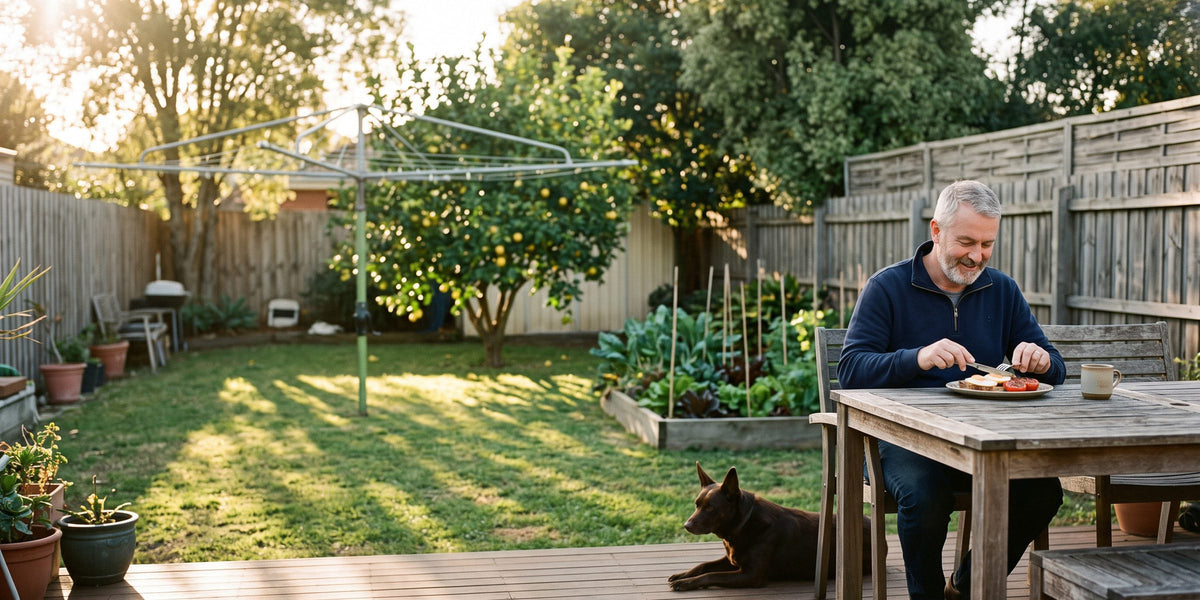
What should an Australian man over 50 eat each day?
The direct answer is a plate shaped by the Australian Dietary Guidelines and sized to the Nutrient Reference Values for men aged 51 and over. On an average weekday that reads as vegetables at two meals, a protein food at every main meal, wholegrains more often than refined choices, two to three serves of dairy or a calcium-fortified alternative, two serves of fruit, and plain water as the default drink. The protein, dietary fibre and specific micronutrients below are what each day is checked against; the five food groups are the plate it is built on.
Over 90% of Australian adults do not meet dietary guidelines, per the Australian Institute of Health and Welfare. Over 50, the gaps often compound because appetite and energy requirements drift down while the daily nutrient targets stay firm.
This page walks the daily totals from the published Nutrient Reference Values, the Dietary Guidelines serves for men 51-70 and 70+, and a workable weekday that reaches them from food. HLTH+ Men's 50+ appears later as the Formulated Supplementary Food that sits beside those meals, in its own section.
Prefer a dietitian-formulated top-up alongside your meals? Learn more about the HLTH+ Men's 50+ Starter Kit.
How many calories should a 50-year-old man eat each day?
Energy needs change with age, body size and activity level. The Nutrient Reference Values for Australia and New Zealand publish reference energy requirements in megajoules per day, calculated against a man's weight and his physical activity level (PAL). At light activity (PAL 1.6), a man aged 51-70 at a mid-range weight sits roughly inside the 9 to 10 MJ/day band (around 2,150 to 2,400 calories); a sedentary pattern sits lower, and a physically active day runs higher.
Those are reference numbers rather than daily targets. The NRV tables depend on age, sex and activity, so treat the figure as a sanity check against what is actually eaten, not as a kilojoule budget to tally.
Appetite often eases down in the fifties and sixties, while the protein and micronutrient targets below do not fall at the same rate. For a food-first read on which nutrients deserve the most attention in Australia, nutrient-dense foods covers the priority nutrient list from the current evidence.
How does the protein target shift after 50?
The protein NRV page publishes an Australian RDI of 64g protein per day for men aged 51-70 and 81g per day for men over 70. healthdirect's protein page states the same figures as a 52-64g range for men 19 to 70 and 65-81g for men over 70. Those are population averages set against deficiency, not performance targets.
The per-meal number is where older adults most often fall short. The PROT-AGE Study Group's position paper proposes 1.0 to 1.2 g/kg body weight per day for people over 65 for muscle maintenance; it sets a higher band of 1.2 to 1.5 g/kg per day for those managing an acute or chronic condition, with a per-meal threshold around 25 to 30g (Bauer and colleagues, Journal of the American Medical Directors Association, 2013). For an 80 kg man that works out to roughly 80 to 96g a day, only reachable if each meal pulls its weight.
Where that number lives on an Australian table: 100g of grilled chicken breast carries about 32g protein; a 150g tin of salmon carries about 29g; a cup of cooked lentils about 18g; two eggs about 12g; a 200g pot of plain Greek yoghurt about 17g. For worked meal examples, the high-protein meal prep guide builds a week around the per-meal number, and the muscle-building protein article covers resistance-training ranges.
Which nutrients get harder to hit after 50, and from which foods?
Six nutrients earn attention after 50 because the gap between what the plate delivers and what the Nutrient Reference Values recommend tends to widen. The table pairs each daily intake with the ordinary food sources that reliably carry it in an Australian kitchen.
| Nutrient | Daily intake (men 51-70, per NRV) | Everyday food sources |
|---|---|---|
| Protein | 64g RDI (rises to 81g at 70+) | Chicken breast 100g, canned salmon 150g, cup of cooked lentils, eggs, plain Greek yoghurt |
| Dietary fibre | 30g AI | Wholegrains, legumes, nuts and seeds, fruit eaten with the skin, cooked and raw vegetables |
| Vitamin D | 10.0 µg AI (rises to 15.0 µg at 70+) | Salmon and sardines, egg yolks, UV-exposed mushrooms, fortified margarine, sensible sun |
| Vitamin B12 | 2.4 µg RDI | Beef, lamb, chicken thigh, fish, eggs and dairy; fortified plant milks when animal foods are limited |
| Magnesium | 420 mg RDI | Pumpkin and sunflower seeds, almonds, cooked spinach, legumes, brown rice, wholemeal bread |
| Calcium | 1,000 mg RDI (rises to 1,300 mg at 70+) | Milk, plain yoghurt, hard cheese, calcium-set firm tofu, tinned sardines with the bones in, fortified soy or oat milk |
Intake values come from the NRV pages for protein, dietary fibre, vitamin D, vitamin B12, magnesium and calcium, each retrieved 3 November 2026. Food portions follow the Australian Food Composition Database (AUSNUT 2011-13, Food Standards Australia New Zealand). The totals describe daily adequacy rather than a treatment dose, and a diagnosed deficiency is a reason for personal advice from your doctor.
The two biggest step-ups after the sixties sit in vitamin D and calcium: the vitamin D adequate intake lifts from 10.0 µg/day to 15.0 µg/day at 70+, and the calcium RDI lifts from 1,000 mg/day to 1,300 mg/day. For deeper reads, magnesium-rich foods covers portions and reference values in detail, fibre-rich foods covers soluble and insoluble sources, and the vitamin B12 deficiency article covers the absorption changes that become more common after 50.
What are the five main food groups, and what are the serves for men over 50?
The Australian Dietary Guidelines name the five food groups as vegetables and legumes/beans; fruit; grain foods, mostly wholegrain; lean meats and alternatives (including fish, eggs, tofu, nuts and seeds, and legumes); and milk, yoghurt, cheese or their alternatives. Eat for Health's serves table for adults lists the daily serves per age band and sex.
For a man 51-70 that reads as 5½ serves of vegetables (counting legumes and beans), 2 fruit serves, 6 serves of grain foods (mostly wholegrain), 2½ serves of lean meats and alternatives, and 2½ serves of dairy or alternatives, plus 0 to 2½ discretionary choices and an allowance for unsaturated spreads, oils, nuts or seeds. For a man 70+ the pattern shifts: 5 serves of vegetables, 2 of fruit, 4½ of grain foods, 2½ of lean meats and alternatives, and 3½ of dairy or alternatives. The grain figure drops; the dairy figure rises; the vegetable, fruit and protein-food figures hold steady.
Those serves are what the daily plate delivers in food-group currency. The NRV numbers above are what each serve adds up to in nutrient currency. Both read the same week from different angles.
What does a food-first weekday look like for a man over 50?
A workable weekday hits the per-meal protein number, carries a vegetable or fruit at every eating occasion, and uses wholegrains more often than refined choices. The example below reaches roughly 90 to 100g of protein and 30 to 35g of dietary fibre on an 80 kg frame, without a scale or tracking app.
- Breakfast. Rolled oats cooked in milk or a calcium-fortified plant milk, a tablespoon of chia or pumpkin seeds, a serve of berries, plus two eggs or a 200g pot of plain Greek yoghurt on the side. Protein near 25g; dietary fibre near 8g; adds calcium, magnesium and the first wholegrain serve.
- Mid-morning. A piece of fruit with a small handful of almonds. Keeps the vegetable and fruit count moving; adds magnesium.
- Lunch. Grilled salmon or a 150g tin of salmon with brown rice and a mixed salad, plus a slice of wholegrain bread. Protein near 30g; vitamin D from the fish; dietary fibre from the salad, rice and bread.
- Afternoon. Plain yoghurt topped with fruit, or wholegrain crackers with hummus and a glass of milk. Another dairy serve lands here on most days.
- Dinner. Lean beef, chicken thigh or firm tofu with roasted vegetables and a cup of cooked lentils or beans. Protein near 30g; dietary fibre near 10g; the second vegetable serve.
- Fluids. Water as the default; tea, coffee and milk count towards hydration (Better Health Channel water page).
That day lands close to the Men's 51-70 serves for every food group except the full vegetable count, which usually needs a second vegetable at dinner to clear. For a mornings-only overhaul, the high-protein breakfast article covers the easiest meal to reshape, and the protein powder buyer guide for men over 50 covers the label questions.
What changes when the appetite is reduced?
Appetite can drift down after 50 for ordinary reasons: a quieter work pattern, dental changes, medications that reduce appetite (the GLP-1 class is one example), chronic conditions, or recovery from an illness. Smaller portions mean each sitting carries more of the day's nutrient work, and protein is usually the first number to slip. The practical move is to keep three main meals and anchor a protein food in each one, even on a day when total intake is lower than usual. Any sudden drop in appetite, unintentional weight loss, or difficulty eating belongs with your doctor; two or three days of plain notes about what was actually eaten give a GP a better starting point than a planned menu does.
For days when solids are a stretch, protein shakes for a low appetite covers the role a shake can play without replacing the food routine, and the protein powder article for seniors over 70 covers the step-up when appetite has fallen sharply. The GLP-1 nutrition pillar page covers eating well while on a reduced appetite in more detail.
Where does a Formulated Supplementary Food like HLTH+ Men's 50+ fit?
HLTH+ sits inside the Formulated Supplementary Food category under the Australian Food Standards Code. The category exists so a product can supplement the day's intake where food alone leaves a gap. HLTH+ is not designed as a meal replacement because it complements a food-first approach, but it works fine as a healthy snack or to tie you over.
HLTH+ Men's 50+ is formulated to the Nutrient Reference Values set by the National Health and Medical Research Council, the Australian Government Department of Health and Ageing, and the New Zealand Ministry of Health, scaled to men aged 50 and over. A single sachet is 60g (62g for Chocolate). The panel reads 30g protein per sachet; dietary fibre lands at 7g, collagen appears as a 5g content line inside the total protein number, and DHA shows at 60mg. The sachet also lists Lactobacillus Plantarum Postbiotic to a count of 10 billion CFU per serve. Sugars print at 1.7g with no added sugar; calories print at 248. Across the pack the formulation covers 30 essential daily nutrients spanning the macro-, micro- and functional-nutrient set.
The 30g of protein contributes to the maintenance of muscle mass, as part of a healthy diet involving a variety of foods. The ingredient list is dairy-free and gluten-free; it does include soy, so read the panel if that matters for you. HLTH+ is produced at Australian facilities that comply with Good Manufacturing Practice (GMP). The pack scores 5 stars under the Australian Health Star Rating system.
A single sachet is RRP $6.00. On subscription, the 28-serve pack reads at $5.10 a day; the 14-serve pack at $5.40 a day. Subscriptions can be paused, skipped or cancelled at any point, and shipping is free over $100. HLTH+ Men's 50+ is available at hlthplus.com, through the HLTH+ store on Amazon AU and at Chemist Warehouse online.
For a daily routine beside your meals, learn more about the HLTH+ Men's 50+ Subscription Pack.
Not sure which nutrients your current food routine most often skips? The Find My Formula quiz is a short diagnostic that reads a daily stack against the gaps.
This article is general information, not medical advice. Decisions about any medication belong with your doctor.

Frequently Asked Questions
Does a man over 50 need more protein than a younger man?
The Nutrient Reference Values set an RDI of 64g a day for men 51-70, the same as men 19-50; it rises to 81g a day for men over 70. The PROT-AGE Study Group's position paper proposes 1.0 to 1.2 g/kg body weight per day for people over 65 for muscle maintenance; it sets a higher band of 1.2 to 1.5 g/kg per day for those managing an acute or chronic condition, with a per-meal threshold around 25 to 30g.
Is a daily multivitamin necessary for men over 50?
A daily multivitamin is not a requirement in the Nutrient Reference Values, which are set to be met by a varied food intake. In practice, over 90% of Australian adults do not meet dietary guidelines, so the food-first routine often leaves gaps worth checking against a food diary. A confirmed deficiency, a chronic condition or a restricted diet is a conversation for your GP, not the supplement shelf.
What are the best breakfast foods for men over 50?
Honest breakfasts carry a protein food, a wholegrain and a serve of fruit or dairy. Rolled oats with milk, chia or pumpkin seeds, and a serve of berries plus two eggs or Greek yoghurt lands near 25g of protein and 8g of dietary fibre, with calcium and magnesium alongside. Oily fish on wholegrain toast adds vitamin D on fish days.
Can a protein shake fit into a food-first routine for men over 50?
A shake sits comfortably at an eating occasion when food is not going to arrive, such as a skipped breakfast, a packed workday or an afternoon when the appetite is quiet. It is a top-up alongside the food routine, not a swap for a plated meal. HLTH+ Men's 50+ is a Formulated Supplementary Food in this category, not a meal replacement.
When should a man over 50 see a dietitian or GP?
A sudden loss of appetite, unexplained weight change, difficulty swallowing, a diagnosed condition, a new medication that changes eating, or persistent fatigue is a reason to see your GP. A dietitian accredited with Dietitians Australia can tailor a daily routine to your prescription, blood work and schedule. Two or three days of plain notes about what you actually ate helps the first conversation.

Leave a comment
This site is protected by hCaptcha and the hCaptcha Privacy Policy and Terms of Service apply.