

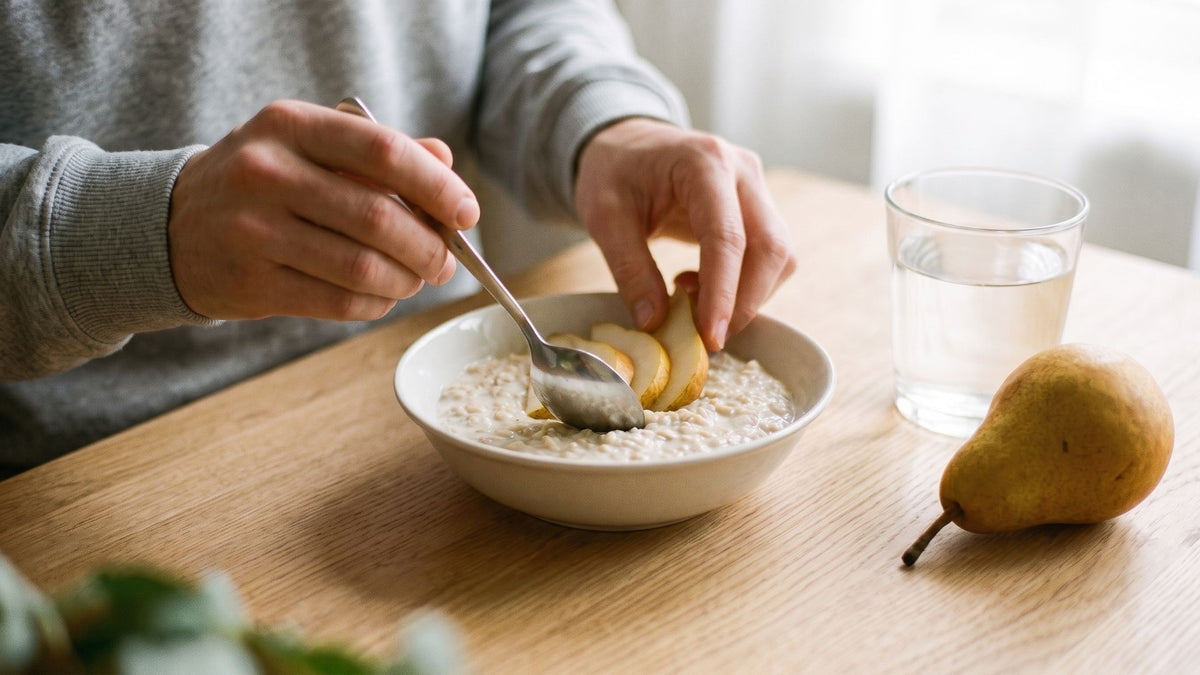
How much dietary fibre do Australian adults need?
Australia's adequate intake for dietary fibre is 25g daily for adult women and 30g for adult men; separate suggested dietary targets are 28g and 38g respectively, for long-term health. Pregnancy, breastfeeding and individual medical advice change the context. Count the portions you eat, build variety and increase gradually with adequate fluids.
Finding several different numbers online can make a straightforward food question unnecessarily confusing. The first step is identifying what each number represents, before deciding how breakfast, lunch and dinner contribute to it.
This article explains the Australian references, then shows how to calculate food portions without turning a guideline into a personal diagnosis.
On this page:
- Adequate intake versus suggested dietary target.
- Pregnancy, breastfeeding and older age.
- A worked food example with transparent arithmetic.
- Reading packets and adjusting your own portions.
- Gradual changes and situations needing advice.
For a longer ingredient list, dietary fibre-rich foods covers food options. This page explains which daily reference to use and how the amounts add together.
Why are there two different Australian targets?
The Nutrient Reference Values were developed by the National Health and Medical Research Council, the Australian Government Department of Health and Ageing, and the New Zealand Ministry of Health. Their different reference types answer different nutrition questions.
The official NRV definitions describe an adequate intake, or AI, as an estimate used when there is not enough evidence to establish a recommended dietary intake. It draws on observed or experimental intakes in apparently healthy groups that are assumed adequate.
A suggested dietary target, or SDT, relates to average intake from food and drinks that may help reduce chronic disease risk. It is therefore a different benchmark, not a correction to the AI or an instruction to take the difference as a supplement.
| Adult reference | Women | Men | What it means |
|---|---|---|---|
| Adequate intake | 25g/day | 30g/day | General adequacy reference |
| Suggested dietary target | 28g/day | 38g/day | Higher reference for long-term health |
Sources: the dietary fibre NRV table and chronic disease SDT summary. The latter places its fibre figures in the context of coronary heart disease risk and encourages a food pattern with vegetables, fruit and wholegrain cereals.
Read the table as two named reference levels. Neither tells you the cause of a bowel symptom, and an intake below the AI does not by itself establish a deficiency in an individual.
A dietitian can help interpret the figures if your appetite, food restrictions or medical care make a general target difficult to apply. A personal plan can require more context than choosing whichever online number is highest.
Do pregnancy, breastfeeding or older age change the number?
The primary Australian fibre table lists 28g daily during pregnancy and 30g during breastfeeding for the adult age bands 19 to 50. These are adequate intakes, even though the pregnancy number happens to match the SDT for women.
For adults outside pregnancy or breastfeeding, the AI stays at 25g for women and 30g for men across the adult age bands, including over 70. A smaller appetite does not automatically lower that published reference.
Children and adolescents have their own age-specific entries. Do not use this adult table to plan a young child's diet, or substitute the adult pregnancy figure for adolescent pregnancy advice.
If you have a medical diet, follow that plan and ask how dietary fibre fits into it. Population guidance does not replace instructions following bowel surgery or advice for an active digestive condition.
For a medicine-related eating context, dietary fibre with a reduced appetite covers a separate question. Medicine decisions and persistent digestive changes belong with your doctor.
What does about 26g look like in actual food portions?
The table below uses Food Standards Australia New Zealand's Australian Food Composition Database, Release 3.0, checked on 21 October 2026. Amounts are calculated from its per-100g entries and rounded to one decimal place for display.
These portions are illustrative amounts selected for the calculation, not government serving recommendations. The foods can form parts of meals across a day; the table is not a complete menu or a claim to meet all nutritional needs.
| Food and preparation | Portion weighed | Fibre per 100g | Fibre in that portion |
|---|---|---|---|
| Uncooked rolled oats | 40g | 9.5g | 3.8g |
| Pear, green skin, unpeeled and raw | 150g edible portion | 3.0g | 4.5g |
| Bread made from wholemeal flour, untoasted | 70g | 6.9g | 4.8g |
| Chickpeas, canned and drained | 100g | 5.7g | 5.7g |
| Broccoli, fresh, boiled and drained | 150g | 2.5g | 3.8g |
| Almonds, raw, unsalted, with skin | 30g | 11.0g | 3.3g |
| Combined illustrative portions | The portions above | Not applicable to a mixed set | 25.9g |
The primary data are available in the FSANZ nutrient profiles download. Database entries describe particular foods; a branded product's current nutrition panel is more specific to that product.
Using unrounded calculations, the total is 3.80 + 4.50 + 4.83 + 5.70 + 3.75 + 3.30 = 25.88g, displayed as 25.9g. That precision explains the arithmetic, rather than promising the same measured amount in every pear or loaf.
If the day also includes 100g fresh green peas, boiled and drained, the database adds 5.2g. The resulting total is 31.08g, displayed as 31.1g; those peas are an addition in this example, so no other food has been subtracted.
Use the figures as a demonstration of counting. Choose quantities that suit your meals instead of forcing every item into one sitting to reach a number.
How do you calculate the portion you actually eat?
The basic calculation is: fibre per 100g × portion weight in grams ÷ 100. It works only when the food description and the weight refer to the same preparation.
For the canned, drained chickpeas above, a 60g portion would provide 5.7 × 60 ÷ 100 = 3.42g, or about 3.4g. That is an illustration of a smaller serving, not a clinical recommendation to eat exactly that amount.
If a recipe is shared, work out the fibre in all measured ingredients, then divide by the actual number of equal portions. Do not give every diner the nutrition of the whole saucepan, and do not assume all portions are equal if they are not.
Preparation makes a practical difference:
- Weigh the oats dry when using the uncooked entry.
- Use drained bean weight for a drained entry.
- Match cooked vegetables with the stated cooked entry.
- Count the edible part of fruit, excluding what you discard.
- Keep bread weight and preparation consistent with the database description.
A useful food record only needs enough detail to be interpretable. “Chickpea salad” is less informative than the drained chickpea amount plus the ingredients you actually added.
The breakfast ideas article can help turn ingredients into an eating occasion. Keep protein and fibre as separate totals rather than assuming a food high in one is automatically high in both.
What should you check on a packaged food label?
Read the serving size and the fibre figure together. According to FSANZ's nutrition-panel guidance, serving sizes are set by the food business, so two packets can describe different amounts as one serve.
Per-100g information helps compare similar products on the same basis. Per-serving information helps estimate what you consume, provided the declared serving matches yours.
Use a short label checklist:
| Check | What to do with it |
|---|---|
| Serving weight | Compare it with the portion you eat |
| Fibre per serve | Adjust if your portion differs |
| Fibre per 100g | Compare similar foods using equal weights |
| Preparation instructions | Establish whether figures describe dry food or a prepared serving |
| Missing fibre entry | Do not automatically count it as none |
FSANZ explains that dietary fibre is not always required in a nutrition panel; certain nutrition claims trigger its inclusion. An absent line can therefore mean the value is undeclared, rather than that the food contains no dietary fibre.
When accuracy matters, use the manufacturer's information or a well-matched food-composition entry. Avoid substituting a visually similar food whose grain, recipe or preparation differs.
How can you make an increase comfortable and sustainable?
Work from your current routine. A person who rarely eats legumes may find a modest addition easier to evaluate than simultaneously changing cereal, bread, snacks and dinner.
The Better Health Channel advises introducing dietary fibre slowly and drinking enough water. It notes that a sudden increase can bring abdominal pain and more wind.
Try this planning sequence:
- Record a few ordinary days, including rushed meals and drinks.
- Identify one eating occasion with a practical wholegrain, fruit, vegetable or legume option.
- Make the change in a portion you find comfortable.
- Notice tolerance and repeat it before adding another change.
- Review the overall pattern rather than chasing an exact daily decimal.
This sequence is a planning suggestion, not a tested treatment protocol or a promise about how quickly your bowel will respond. There is no need to compensate for a lower-fibre day by eating a large concentrated amount the following evening.
Keep fluids accessible with meals and through the day. If a clinician has set a fluid restriction, use that advice rather than following a generic instruction to drink more.
For shopping and snack choices, the high-protein snacks page considers a different nutrient alongside food convenience. Check the actual fibre amount independently when building your own day.
When does the general target need individual advice?
More fibre is not a universal answer to constipation or other digestive symptoms. The US National Institute of Diabetes and Digestive and Kidney Diseases lists several possible causes of constipation, including medicines, pelvic-floor problems and digestive conditions.
It advises seeing a doctor when symptoms persist despite self-care. With constipation, seek medical care promptly for rectal bleeding, blood in the stool, constant abdominal pain, inability to pass gas, vomiting, fever or unintended weight loss.
Follow an existing prescribed low-fibre diet or other eating plan until your treating team advises otherwise. The same principle applies when symptoms are active: choosing the right type and amount may need an assessment, not simply a larger daily total.
If you are considering a concentrated fibre product, psyllium husk has its own discussion. Product directions, medicine interactions and individual suitability belong in a conversation with a pharmacist or clinician.
This article is general information, not medical advice. Decisions about any medication belong with your doctor.
Where does HLTH+ belong in the arithmetic?
HLTH+ is a Formulated Supplementary Food, with 7g dietary fibre in a serving and 30g protein per serve. Count that serving within what you consume across the day, alongside the fibre from your other foods.
For a purely numerical example, food providing 18g plus a serving providing 7g totals 25g. That does not establish the adequacy of the whole diet or say that the product addresses a digestive symptom.
Retain food variety as well as the number. Nutrition planning for smaller portions considers the wider intake question, and the Find My Formula quiz helps you examine gaps in your existing supplement stack.
Frequently Asked Questions
Is 25g or 30g the Australian daily fibre target?
Both are Australian adequate intakes: 25g daily for adult women and 30g for adult men. The separate suggested dietary targets are 28g and 38g respectively. Check which reference an article is using, then consider pregnancy, breastfeeding, medical advice and the portions in your usual eating pattern.
Do women need 28g of fibre every day?
The Australian adult female adequate intake is 25g daily, while the suggested dietary target is 28g. Pregnancy at ages 19 to 50 also has an adequate intake of 28g, for a different reason. These references should not be merged into a single rule for every woman or circumstance.
Is more dietary fibre always better?
The Australian reference values do not set an upper intake level for dietary fibre, but that does not mean unlimited amounts suit everyone. Increase gradually, consider fluids and follow any prescribed dietary restrictions. Persistent or concerning digestive symptoms need assessment rather than repeated increases in fibre foods or products.
Should I count fibre from food and a nutrition drink together?
Yes, count dietary fibre from everything you actually consume when estimating the daily total, including a nutrition drink with a declared fibre amount. Use your real portion and avoid counting an ingredient twice. The resulting total describes intake; it does not demonstrate that every nutritional need has been met.

Leave a comment
This site is protected by hCaptcha and the hCaptcha Privacy Policy and Terms of Service apply.