

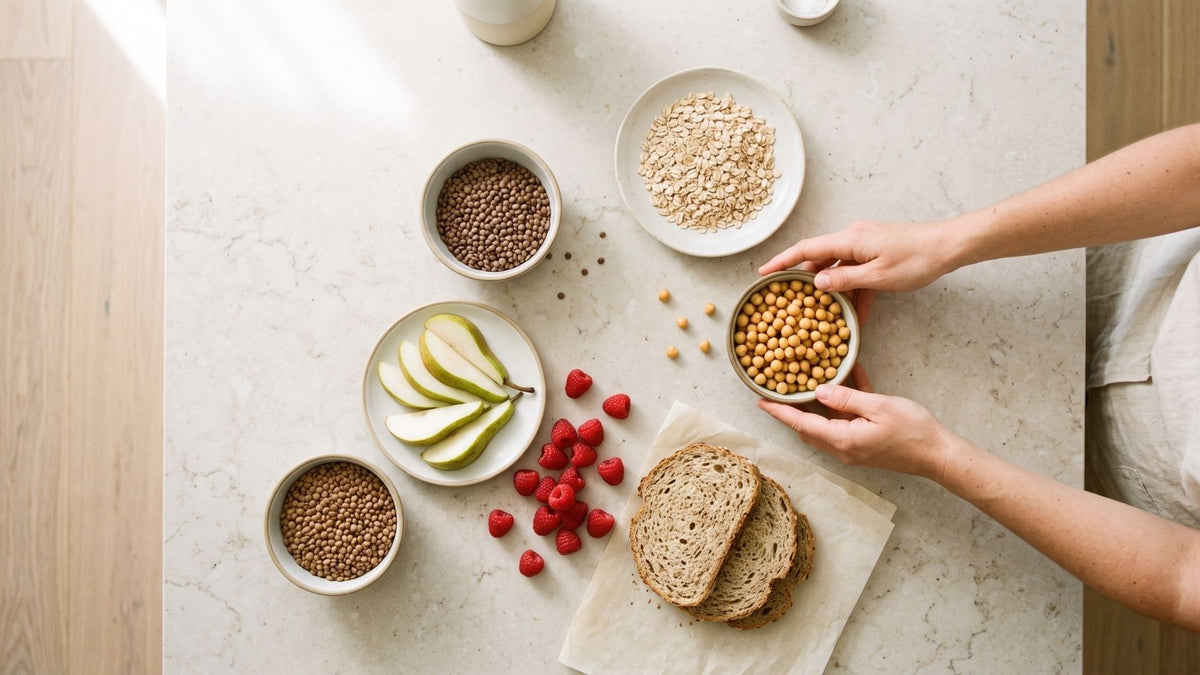
What counts as a high-fibre snack?
A snack is high in dietary fibre when one realistic portion carries 4g or more; it clears the top label descriptor at 7g or more. On Australian Food Composition Database figures, 130g of drained canned chickpeas delivers 7.4g together with 8.2g protein, 20g of chia seeds 6.6g together with 4.8g protein, and 125g of raspberries 6.0g together with 1.4g protein.
Most online "high-fibre snacks" lists skip the number altogether. The table below gives it for 18 Australian snacks, pairs it with the protein that lands on the plate with it, and shows how three snack portions can close most of a daily dietary fibre gap on their own.
One 55g sachet, 7g dietary fibre and 30g protein. The HLTH+ Women's Starter Kit is a convenience option on days a food-first snack is not practical. As part of a healthy diet involving a variety of foods, dietary fibre contributes to regular laxation.
What makes a snack "high-fibre" by the Australian label rules?
The Australian Food Standards Code sets two per-serve descriptors in Schedule 4, section S4-3: a product requires at least 4g per serve to carry "good source of dietary fibre", and at least 7g per serve to carry "excellent source of dietary fibre". Those thresholds hold whether the snack is a tin of beans, a scoop of seeds or a drinkable formula.
Those thresholds are label rules, not daily targets. A single snack carrying 4g is a sensible floor for the word "high-fibre"; nothing stops two or three different snacks across a day stacking to a larger total. Fibre-rich foods runs the same arithmetic across a full day of meals, and high-protein snacks ranks 30 small portions by protein per 100 kJ when the gap on the plate is protein instead.
Context matters. The Better Health Channel (reviewed 11 December 2025, Victorian Department of Health) says most Australians consume 20g to 25g of dietary fibre a day, below the adequate intakes of 25g for women and 30g for men set in the Nutrient Reference Values. A snack is a lever on that gap only when the number on the row is weighed, not guessed.
Which snacks carry the most dietary fibre per serve?
Each row below draws its per-100g dietary fibre and protein from Release 3.0 of the Australian Food Composition Database (Food Standards Australia New Zealand), downloaded on 28 October 2026. The serve column multiplies the per-100g figure by the serve weight shown and rounds to one decimal place. Edible portions only. On a packaged snack, the pack panel beats a database row because recipes and canned preparations vary brand to brand.
| Snack (serve) | Dietary fibre | Protein |
|---|---|---|
| Chickpeas, canned, drained (130g) | 7.4g | 8.2g |
| Soy beans, boiled from dried (100g) | 7.2g | 13.5g |
| Chia seeds, dried (20g) | 6.6g | 4.8g |
| Linseed, ground (20g) | 6.6g | 4.3g |
| Lentils, dried, boiled, drained (150g) | 6.2g | 10.9g |
| Baked beans in tomato sauce, canned (130g side bowl) | 6.2g | 6.2g |
| Raspberries, raw (125g punnet) | 6.0g | 1.4g |
| Rye crispbread (30g, two to three crackers) | 5.0g | 2.6g |
| Pear, unpeeled, raw (150g, one medium) | 4.5g | 0.6g |
| Kiwifruit, green, peeled (150g, two medium) | 4.5g | 1.8g |
| Avocado, Hass, raw (70g, half-small) | 4.1g | 1.1g |
| Sunflower seeds (30g) | 3.9g | 7.4g |
| Apple, unpeeled, raw (150g, one medium) | 3.8g | 0.5g |
| Almonds, raw, with skin (30g) | 3.3g | 5.9g |
| Hummus, commercial, with vegetable sticks (80g) | 3.1g | 5.5g |
| Peanut butter, no added sugar (40g, two tablespoons) | 2.6g | 9.7g |
| Popcorn, commercial, salted (30g, roughly four cups popped) | 2.6g | 2.7g |
| Pistachios, raw (30g, about thirty nuts) | 2.3g | 5.1g |
Six of the 18 rows carry at least 6g dietary fibre in a single snack portion, four of them clear the Schedule 4 7g excellent-source threshold on their own, and 11 clear the 4g good-source threshold. The pattern is where the plant grew. Legumes and the dried seeds built for storage sit at the top; whole fruits sit in the middle; nuts, nut butters and crackers sit near the floor on dietary fibre, though several of them lift the protein column.
Three of the snacks also carry more than 10g protein alongside their dietary fibre, clearing the Code's "good source of protein" per-serve threshold at section S4-4: a 100g serve of boiled soy beans, 150g of boiled lentils and, at a 60g rather than a 40g serve, two heaped tablespoons of peanut butter. The others pair usefully with the combinations below.
How can you combine dietary fibre and useful protein in a single snack?
Three snack-sized pairings. Each adds up from the rows above and lands near or past the daily adequate-intake share a single snack can realistically carry; the numbers are additive, so swapping one row for another in the table recalculates the plate without changing the method.
Apple with peanut butter
| Ingredient | Dietary fibre | Protein |
|---|---|---|
| Apple, unpeeled, raw (150g) | 3.8g | 0.5g |
| Peanut butter, no added sugar (40g) | 2.6g | 9.7g |
| Combined serve | 6.4g | 10.2g |
A fridge-free pairing that moves straight into a backpack. Brands that add sugar read the same for dietary fibre but add sweetness that counts toward the day's sugars.
Natural yoghurt with chia and raspberries
| Ingredient | Dietary fibre | Protein |
|---|---|---|
| Natural yoghurt, regular fat (170g tub) | 0.2g | 8.7g |
| Chia seeds, dried (20g) | 6.6g | 4.8g |
| Raspberries, raw (125g) | 6.0g | 1.4g |
| Combined bowl | 12.8g | 14.9g |
A fridge snack that doubles as a small dessert. The chia will thicken if the bowl sits for ten minutes; the yoghurt row is dietary-fibre-light, so dairy and plant beverages lift the protein column rather than the dietary fibre column.
Hummus with wholemeal pita and vegetable sticks
| Ingredient | Dietary fibre | Protein |
|---|---|---|
| Hummus, commercial (80g, two heaped tablespoons) | 3.1g | 5.5g |
| Wholemeal pita, half round (35g) | 2.4g | 3.6g |
| Carrot sticks, raw (70g, one medium carrot) | 1.9g | 0.6g |
| Combined plate | 7.4g | 9.7g |
The pita row scales from the Food Standards database's wholemeal flour bread entry; some pita brands label higher dietary fibre again. Carrot sticks lift the dietary fibre further without adding much energy.
How can snacks close a day's dietary fibre gap?
The adequate intakes for dietary fibre, from the Nutrient Reference Values published in 2006 by the National Health and Medical Research Council, the Australian Government Department of Health and Ageing and the New Zealand Ministry of Health, are 25g a day for an adult woman and 30g for an adult man. Pregnancy raises the figure for women to 28g; breastfeeding raises it to 30g. These are population references, not individual prescriptions.
Over 90% of Australian adults do not meet dietary guidelines on the Australian Institute of Health and Welfare's poor-diet measure. A 2024 priority-nutrient review in Frontiers in Nutrition by Starck and colleagues ranked dietary fibre among six highest-priority nutrients for Australia and New Zealand, judged against both inadequacy of intake and association with national health priorities. The authors looked at national nutrition-survey data: it is population-intake evidence, not product-efficacy evidence.
The straightforward way to close a 10g to 15g gap is a day of snacks that each clear 5g. Three snack portions, drawn from the sections above, worked below:
| Snack moment | Snack | Dietary fibre | Protein |
|---|---|---|---|
| Morning tea | Pear, unpeeled (150g) and almonds (30g) | 7.1g | 6.4g |
| Afternoon | Hummus with wholemeal pita and carrot sticks | 7.4g | 9.7g |
| After dinner | Natural yoghurt with chia and raspberries | 12.8g | 14.9g |
| Three snacks | 27.3g | 31.0g |
That is more than the 25g adequate intake for adult women, and nearly the 30g for adult men, from the three snack moments alone. Meals sit on top of that total. Snacks are often where the shortfall is unknowingly built, and the same choices built differently are the easiest place to close it.
The Better Health Channel advises raising dietary fibre gradually and drinking enough water alongside, noting that a sudden increase can bring abdominal pain and more wind. Practically, lift a snack-based total by around 3g to 5g a day across a week, not in a single afternoon.
How much dietary fibre does one HLTH+ serve carry?
A HLTH+ sachet sits in the Formulated Supplementary Food category, defined by the Food Standards Code for a product intended to supplement a diet when an individual's intake of energy and nutrients does not reach their requirements. A single Women's sachet weighs 55g and holds 7g dietary fibre alongside 30g protein. The 7g dietary fibre figure clears the per-serve excellent-source threshold at Schedule 4 S4-3: as part of a healthy diet involving a variety of foods, dietary fibre contributes to regular laxation.
Four formulations cover the range: the Women's, the Women's 50+, the Men's and the Men's 50+. A balanced multivitamin profile prints on every panel beside the protein, the dietary fibre, the collagen and the DHA. Totalled across those macronutrients, micronutrients and functional ingredients, each 55g sachet delivers 30 essential daily nutrients. The same panel lists 5g collagen and 10 billion CFU of the Lactobacillus Plantarum Postbiotic strain as content statements. A postbiotic is the inactivated bacterial material and metabolites left after a fermentation; it is not a probiotic, so cell counts are not a like-for-like comparison with a live-strain product. Every formulation is formulated to the Nutrient Reference Values set by the National Health and Medical Research Council, the Australian Government Department of Health and Ageing and the New Zealand Ministry of Health, released in 2006.
HLTH+ is not designed as a meal replacement, because it complements a food-first approach; it works fine as a healthy snack or to tie you over, alongside the foods in the table above. A single serve lists at RRP $6.00. On subscription, $142.80 across 28 serves is $5.10 a day; $75.60 across 14 is $5.40 a day. The product is available at hlthplus.com, on the HLTH+ brand store at Amazon AU and through Chemist Warehouse online. For a wider view of eating patterns when portions shrink, see nutrition when the appetite drops and the dietary fibre page for a reduced appetite.

A sachet-sized boost of dietary fibre and 30g protein. The HLTH+ Women's Starter Kit lands 7g dietary fibre with 30g protein in a 55g serve; no added sugar, dairy-free, gluten-free. As part of a healthy diet involving a variety of foods, dietary fibre contributes to regular laxation.
Which part of a daily routine is light on dietary fibre, protein or a key micronutrient? The ✦ Find My Formula quiz is diagnostic. In roughly thirty seconds it walks through what already sits in a reader's stack and reports where the panel reads thin, so the purchase that follows is a response to a gap rather than a guess.
Which snacks travel without a fridge, and which stay chilled?
Portable snacks keep a day's dietary fibre honest when meals happen away from a kitchen. From the main table, shelf-stable options include a tin of drained chickpeas carried in its tin, chia seeds, linseed, the pear, the kiwifruit, the apple, almonds, pistachios, peanut butter, popcorn and dried crispbread. A sachet of HLTH+ is a dry powder, so it travels alongside them.
Perishable snacks stay chilled. Yoghurt, cottage cheese, cooked lentils, cooked soy beans and pre-dressed vegetables belong in that group. The Food Standards Australia New Zealand 2-hour and 4-hour rule sets the window for food held in the risk zone between 5°C and 60°C: under two hours it may be chilled again; from two to four hours it is eaten but not re-refrigerated; past four it goes in the bin. For a day away from a kitchen, a small insulated bag with an ice brick is the practical answer, or a snack list drawn from the shelf-stable rows above.
This article is general information, not medical advice. Decisions about any medication belong with your doctor. Persistent changes in bowel habit, blood in the stool or unintended weight changes belong with a general practitioner, not a snack plan.
Frequently Asked Questions
Which single snack has the most dietary fibre?
Among the 18 snack rows above, a 130g drained tin of canned chickpeas sits first at 7.4g dietary fibre, with 8.2g protein alongside; 100g of boiled soy beans follows at 7.2g dietary fibre and 13.5g protein. Both clear the Schedule 4 "excellent source of dietary fibre" threshold for a per-serve claim on their own.
What is a high-fibre snack under Australian labelling rules?
The Food Standards Code (Schedule 4) lists two per-serve descriptors a product can carry. "Good source of dietary fibre" needs a serve of 4g or more; "excellent source of dietary fibre" needs a serve of 7g or more. The thresholds anchor each row on the panel, never the per-100g column.
How much dietary fibre do adults need each day?
Australia's adequate intakes for dietary fibre are 25g a day for an adult woman and 30g for an adult man, set in the 2006 Nutrient Reference Values. Pregnancy raises the figure for women to 28g, and breastfeeding to 30g. The Better Health Channel reports most Australians eat 20g to 25g a day, below the 25g adequate intake for adult women.
How can three snacks reach 25g of dietary fibre in a day?
A pear with 30g almonds in the morning carries 7.1g; hummus with half a wholemeal pita and carrot sticks in the afternoon carries 7.4g; natural yoghurt with 20g chia and 125g raspberries after dinner carries 12.8g. The three snacks total 27.3g on Australian Food Composition Database figures, before any meal is counted alongside them.
Can one shake be a high-fibre snack?
A single 55g HLTH+ sachet carries 7g dietary fibre, which meets the Schedule 4 excellent-source threshold for a per-serve claim. As part of a healthy diet involving a variety of foods, dietary fibre contributes to regular laxation. Chia or berries stirred in add further dietary fibre; count what the finished glass actually contains.


Leave a comment
This site is protected by hCaptcha and the hCaptcha Privacy Policy and Terms of Service apply.