

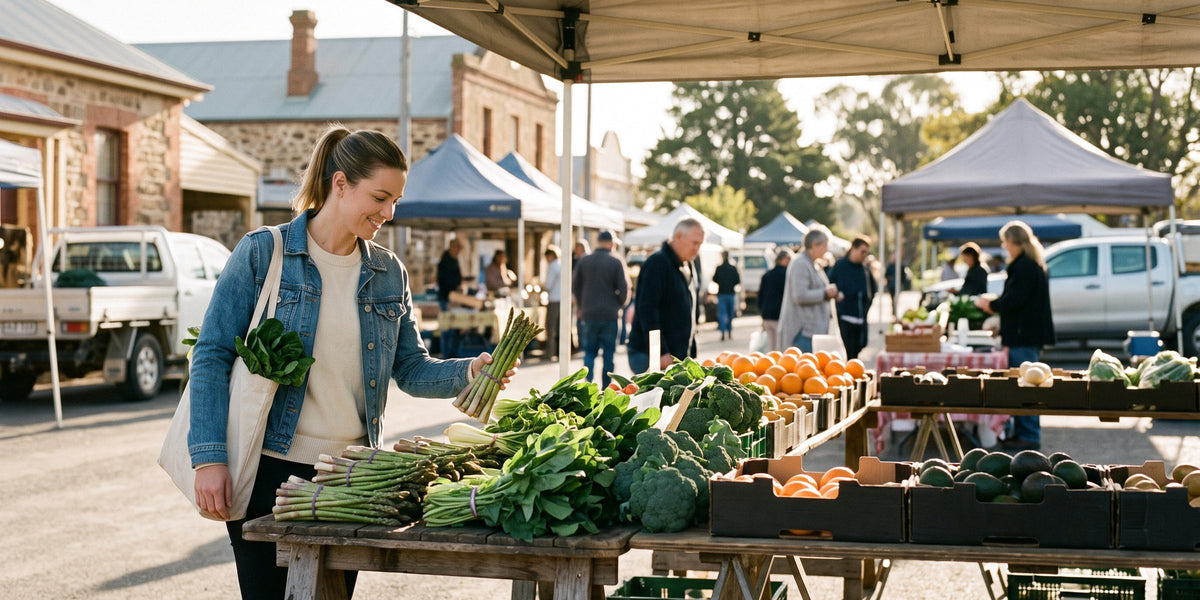
What makes a food folate-rich in Australia?
Folate-rich Australian foods include leafy greens, legumes, oranges, eggs and bread made with fortified wheat flour. On Australian Food Composition Database figures, 100g of baby spinach carries 158μg of folate, 100g of canned chickpeas 63μg and two slices of wholemeal bread 219μg DFE. Spread the sources across the day rather than relying on one hero food.
Folate is a water-soluble B vitamin involved in cell division, red blood cell formation and amino acid metabolism. "Folate" is the general term; "folic acid" is the synthetic form used in supplements and in Australia's mandatory bread-flour fortification. Food values are now commonly reported as dietary folate equivalents (DFE) so that the different bioavailability of the two forms is already in the number.
This page walks through adult reference intakes, Australian foods with the highest folate per 100g from current composition tables, a worked day of meals and the label-check that handles fortified bread. Pregnancy, a diagnosis, or any treatment plan belongs with your doctor.
Want one sachet alongside those folate-rich meals, not in place of them? Browse the HLTH+ Women's collection.
How much folate do Australian adults need?
Published reference values for the two countries put the adult folate recommended dietary intake at 400 micrograms (μg) of dietary folate equivalents (DFE) per day, for women and men aged 19 or over. These were agreed in 2006 by the National Health and Medical Research Council, the Australian Government Department of Health and Ageing and the New Zealand Ministry of Health; the folate chapter was re-fetched this week. The adult upper level of intake, from fortified foods and supplements combined, is 1,000μg per day expressed as folic acid.
Pregnancy and lactation have their own higher reference values on the same page; the recommendation and the folic acid supplement advice around conception are decisions to work through with your doctor rather than from a food article. For most non-pregnant adults, the 400μg DFE/day figure is the number to plan a plate against.
Everyday context from the national health data: over 90% of Australian adults do not meet dietary guidelines, the Australian Institute of Health and Welfare's measure of overall diet quality. Folate is one of several nutrients those guidelines sit on; it rarely sits as the one most at-risk nutrient for an average adult, but a monotonous diet with little green vegetable or legume can leave it low.
| Life stage (adults) | RDI (dietary folate equivalents) | Upper level from supplements/fortified food |
|---|---|---|
| Men 19 years and older | 400 μg/day | 1,000 μg/day |
| Women 19 years and older | 400 μg/day | 1,000 μg/day |
| Women pregnant (19 to 50) | 600 μg/day | 1,000 μg/day |
| Women lactating (19 to 50) | 500 μg/day | 1,000 μg/day |
Those are reference values for the healthy population, not individual prescriptions. A diagnosis of coeliac disease, inflammatory bowel disease, a methyl-group metabolism concern, or any prescribed folate therapy is a reason for a tailored plan.
For an everyday nutrient-planning companion, the nutrient-dense foods guide sits beside this page and shares the same shopping-and-cooking lens.
Which Australian everyday foods carry the most folate per 100g?
Each row below was looked up in the Australian Food Composition Database Release 3 nutrient profiles file, retrieved on 3 November 2026 from Food Standards Australia New Zealand. "Nat" is naturally occurring food folate; "FA" is folic acid added through fortification; "DFE" totals the two using the standard 1:1.7 conversion for folic acid in fortified food.
| Food (per 100g) | Nat folate (μg) | Added folic acid (μg) | Dietary folate equivalents (μg) |
|---|---|---|---|
| Chicken liver, raw | 1,450 | 0 | 1,450 |
| Peanut, with skin, raw, unsalted | 240 | 0 | 240 |
| Spinach, baby, fresh, raw | 158 | 0 | 158 |
| Broccoli, fresh, raw | 152 | 0 | 152 |
| Kale, raw | 125 | 0 | 125 |
| Avocado, Hass, raw | 120 | 0 | 120 |
| Spinach, Mature English, boiled, drained | 78 | 0 | 78 |
| Egg, chicken, whole, poached | 86 | 0 | 86 |
| Chickpea, canned, drained | 63 | 0 | 63 |
| Lentil, red, hulled, dry | 70 | 0 | 70 |
| Baked beans, canned in tomato sauce | 50 | 0 | 50 |
| Bean, red kidney, canned, drained | 40 | 0 | 40 |
| Orange, navel, peeled, raw | 60 | 0 | 60 |
| Strawberry, raw | 65 | 0 | 65 |
| Juice, orange, commercial | 45 | 0 | 45 |
| Bread, from wholemeal flour | 18 | 177 | 313 |
| Bread, from white flour | 10 | 208 | 357 |
| Bread, mixed grain | 14 | 155 | 272 |
| Breakfast cereal, whole wheat biscuit, added vitamins & minerals (Sanitarium Weet-Bix) | 45 | 246 | 456 |
| Tofu, firm, as purchased | 41 | 0 | 41 |
A few readings fall out of that column. Raw leafy greens sit near the top of the natural column; boiling halves spinach's folate because folate is water-soluble and heat-sensitive. Fortified bread and fortified breakfast biscuits sit near the top of the DFE column because of the added folic acid rather than high natural levels. Peanut leads the natural number among everyday pantry staples; chicken liver sits well above everything else but is not an everyday food for most Australians.
For dry pulses, the dry number is high but the cooked number is what you eat. Dried red lentils drop from 70μg per 100g dry to roughly 14μg per 100g boiled on the same database, so the canned or cooked line is the one to plan against.
What does a day of folate-rich meals look like?
The totals below scale per-100g values to an Australian serve weight and add them up. Combinations are planning examples rather than tested recipes, and brand-specific products with their own fortification levels can shift the bread and cereal rows.
A breakfast built on fortified wheat
| Food (serve) | Folate (DFE) |
|---|---|
| Two Weet-Bix style whole wheat biscuits (30g) | 137 μg |
| 250 mL skim cow's milk (negligible folate; included as the base) | 0 μg |
| One Hass avocado portion (70g) on wholemeal toast (70g, two slices) | 84 + 219 |
| Subtotal | 440 μg |
That is already above the 400μg adult RDI from one plate. The fortified biscuit and the two slices of wholemeal bread do most of the lift; the avocado adds a natural food folate serve that is not reliant on fortification.
A lunch built on legumes
| Food (serve) | Folate (DFE) |
|---|---|
| Half a 400g can of chickpeas, drained (120g) | 76 μg |
| 70g baby spinach, raw (added last) | 111 μg |
| One wholemeal wrap, white flour, commercial (60g) | 159 μg |
| Subtotal | 346 μg |
A chickpea-and-spinach wrap on its own carries roughly a day's worth of folate; the folate in baby spinach drops if you wilt it, so adding the leaves at the end preserves more of the number.
A dinner built on green vegetables and bread
| Food (serve) | Folate (DFE) |
|---|---|
| 100g broccoli, boiled | 87 μg |
| One grilled fish fillet (negligible folate) | ~0 μg |
| 70g wholemeal bread (two slices) | 219 μg |
| Half a navel orange (65g, raw) | 39 μg |
| Subtotal | 345 μg |
Across those three worked meals the folate total is well above the 400μg adult reference. A real day eats less of the sources listed and more of the base foods you already repeat (rice, pasta, meat, fruit), which is why one meal lifting past the RDI matters less than three meals carrying a share.
For a wider everyday-plate companion that pairs with these numbers, the magnesium-rich foods guide handles the mineral alongside; both pages use the same serve-first approach.
How does Australia's mandatory bread-flour fortification change the picture?
Since 2009, Food Standards Australia New Zealand has required folic acid to be added to wheat flour used for bread-making across Australia and New Zealand. Plain, fancy and sweet breads, rolls and buns, bagels, focaccia, English muffins and yeast-based flat breads are covered, as are flour mixes and flour sold for home bread-making.
The effect shows up in AFCD figures: fortified wholemeal bread carries about 177μg added folic acid per 100g (around 313μg DFE), so two 35g slices sit near 219μg DFE before anything is spread on top.
Organic bread is exempt from the rule, breads made entirely from non-wheat flours are not required to carry added folic acid, and gluten-free bread based on alternative flours lands near 63μg DFE per 100g. For a coeliac diet, that is a cue to plan folate in from the leafy greens, legumes and fortified alternatives rather than from the loaf.
Breakfast cereals vary widely. Australian whole-wheat biscuits and bran cereals land anywhere from 300 to 580μg DFE per 100g; an unfortified corn flake can sit at only 6μg DFE, so the panel on the box is the reliable guide.
For a breakfast that is already fibre-focused, the high-fibre breakfast page builds on the same approach; one of its worked bowls doubles as a folate plan when wholemeal bread or a fortified biscuit sits at the base.
What should you check on a food label for folate?
Not every panel declares folate. FSANZ's labelling guidance names the mandatory nutrition information panel lines as energy, protein, fat (total and saturated), carbohydrate (and sugars), sodium and dietary fibre. A folate line is voluntary unless the pack carries a specific folate claim.
Three practical checks sit around that:
- Look for "source of folate" or "good source of folate" descriptors. Those are regulated nutrition-content thresholds in Schedule 4 of the Code: "source" asks for at least 10% of the folate RDI in one serve, "good source" at least 25%. For an adult, 10% equals 40μg DFE per serve.
- Compare per 100g, not per serve, between brands of a similar product. Manufacturers set their own serving sizes, so two cereal boxes can declare different serve weights for similar bowls.
- On gluten-free or non-wheat breads, read the ingredient list for added folic acid. The product may be fortified voluntarily, or not; only the label is reliable.
A plant-food folate figure assumes a reasonable cooking method. Prolonged boiling of spinach halves the number on your plate; steaming or microwaving briefly retains more.
For an everyday consumer read, healthdirect's folate page names the food groups without quoting amounts and gives a plain "when to see a doctor" line. Persistent tiredness alongside other symptoms is a reason for a general practitioner visit and blood tests rather than a self-dosed supplement.
Where does a Formulated Supplementary Food fit alongside folate-rich foods?
HLTH+ is a Formulated Supplementary Food, the Code's category for foods that supplement an ordinary diet where routine intake may not fully cover the day's nutrient needs (Food Standards Code, Standard 2.9.3). HLTH+ is not designed as a meal replacement because it complements a food-first approach, but it works fine as a healthy snack or to tie you over.
A 55g Women's sachet declares 30g protein per serve plus 7g of dietary fibre, with 5g of collagen counted inside that protein total and 60mg of DHA. The postbiotic strain is Lactobacillus Plantarum Postbiotic, delivered at 10 billion CFU in every serve. Vitamin C on the Women's Vanilla panel reads 14.8mg per serve, verified against the manufacturer's panel in September 2026; across macro, micro and functional lines, the formulation covers 30 essential daily nutrients.
Each life-stage panel (Women's, then Women's 50+, Men's, Men's 50+) is designed to the Nutrient Reference Values set by the National Health and Medical Research Council, the Australian Government Department of Health and Ageing, and the New Zealand Ministry of Health. The age bands exist because adult nutrient needs shift with the decade; a sachet sits alongside a food-first plate rather than ahead of it.
The HLTH+ panel does not publish a folate figure, so this guide does not include a folate number against the sachet. The AFCD foods above stay as the folate planners; a sachet rounds out protein and dietary fibre on short days.

Want one 55g sachet of 30g protein plus 7g dietary fibre alongside those folate foods? One box of ten sachets across every flavour is HLTH+ Women's starter kit.
RRP for a single sachet is $6.00; subscription packs work out cheaper per serve. Direct ordering is at hlthplus.com; the sachets are also available on Amazon AU and from Chemist Warehouse online.
Not sure which nutrients your current routine is already covering well? The ✦ Find My Formula quiz works as a diagnostic. In half a minute it reads what the current stack is doing and names the parts the panel is leaving light, so a buying decision follows what is actually missing rather than a guess.
This article is general information, not medical advice. Decisions about any medication, a pregnancy, or a diagnosed condition belong with your doctor. For a plan matched to your own history, an Accredited Practising Dietitian is the professional to see.
Frequently Asked Questions
What foods are highest in folate per serve?
Chicken liver sits at 1,450μg per 100g on the Australian Food Composition Database, well above every other everyday food. Among more routine Australian foods, raw baby spinach carries 158μg per 100g, raw broccoli 152μg, raw kale 125μg and Hass avocado 120μg. Fortified wholemeal bread carries about 313μg DFE per 100g.
What are five easy Australian sources of folate?
Baby spinach, canned chickpeas, a wholemeal sandwich, a Weet-Bix style whole wheat biscuit and a navel orange cover five everyday sources that fit a normal shopping list. Each sits above 40μg per serve on current database figures, so a day that lands on two or three of them already clears the adult reference intake of 400μg.
Does Australian bread contain added folic acid?
Yes, in most cases. Since 2009 Australia and New Zealand require millers to add folic acid to wheat flour used for bread-making, so plain, fancy and sweet breads, rolls, buns, bagels, focaccia, English muffins and yeast-based flat breads are fortified. Organic bread, breads made entirely from non-wheat flours and some gluten-free lines are not covered.
Can you get enough folate from food alone?
For most non-pregnant adults, yes. The adult folate reference intake is 400μg DFE per day. A worked day drawing on fortified bread, legumes, leafy greens and an orange or two can clear that number before the evening meal; a monotonous diet with little green vegetable or legume is the common pattern that leaves it low.
Does cooking destroy folate in vegetables?
Prolonged boiling halves folate in leafy greens on the Australian Food Composition Database figures (raw mature spinach 110μg per 100g versus 78μg boiled), because folate is water-soluble and heat-sensitive. Steaming, microwaving briefly or adding leaves at the end of cooking tends to retain more; using the cooking water in a soup or sauce keeps some of the loss on the plate.


Leave a comment
This site is protected by hCaptcha and the hCaptcha Privacy Policy and Terms of Service apply.