

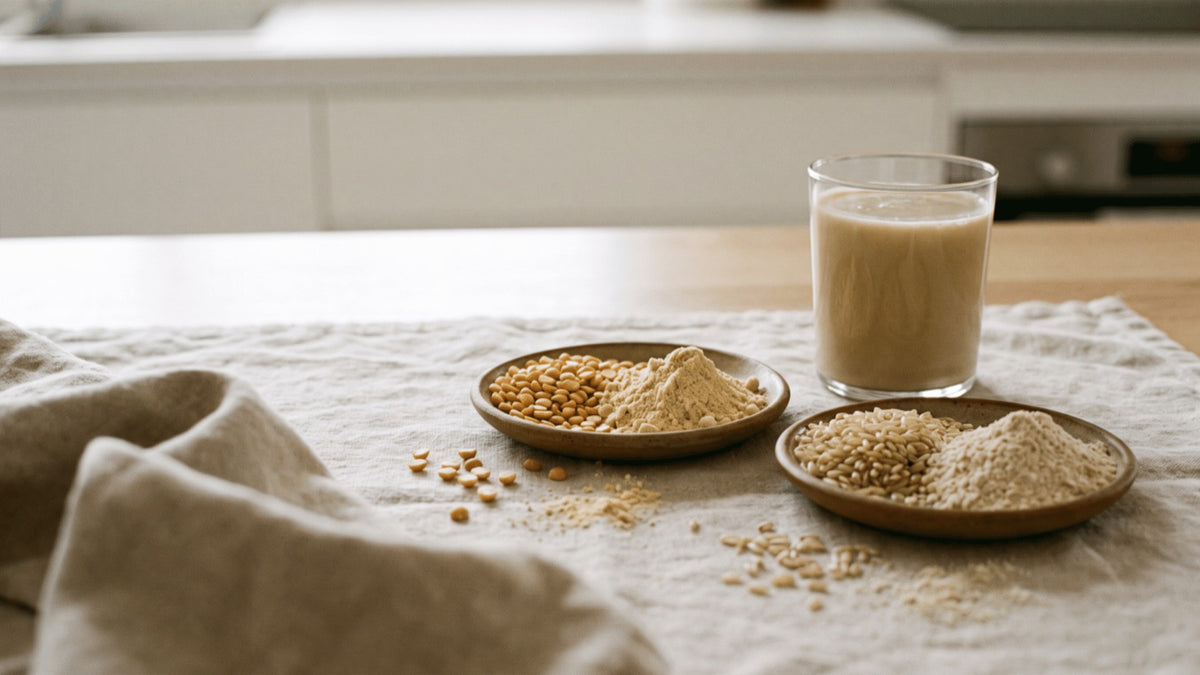
What does a protein powder with fibre actually mean?
A protein powder with fibre is a single tub that declares both nutrients on the Nutrition Information Panel, not a protein tub plus a separate psyllium husk sachet you remember on a good day. The label question is simple. What does one scoop deliver, in what quantities.
Many of the biggest-selling whey tubs in Australia show no fibre row at all; many greens powders show 1 to 2 grams of protein. The product that answers both questions in one serve is a narrower shelf than the category suggests. This guide walks the panel row by row so you can tell, before adding to cart, what the tub is really selling.
Why pair protein and fibre in the same shake?
Protein and fibre answer different questions, and most Australian adults are short on both. AIHW reports that over 90% of Australian adults do not meet dietary guidelines, with vegetable, legume and whole-grain intakes the usual gaps. Pairing the two in one food is a simpler ask than remembering two.
Fibre also behaves differently from protein. Better Health Channel describes two broad types: soluble fibre, which dissolves in water and gives the thicker texture many shakes carry, and insoluble fibre, which adds bulk to the stool. The gram total alone will not tell you which type is in the tub, so reading the ingredient list is as important as reading the panel.
A common direct-use case is a drop in overall intake. When appetite is reduced for any reason (illness, surgery recovery, pregnancy nausea, medication side effects), a serve carrying both nutrients is one less thing to assemble.
What should the label show on a protein powder with fibre?
Six lines on the panel, in this order, decide whether a tub is really a protein-with-fibre product or a straight protein with a sprinkle on top.
- Serving size, in grams. Not scoops. A 30g scoop and a 55g sachet are different foods even if the headline protein is similar.
- Protein grams per serve. FSANZ labelling rules require per-serving and per-100g columns. Compare on the per-serving figure.
- Dietary fibre grams per serve. The thresholds live in Schedule 4 of the FSANZ Food Standards Code: 2g per serve for any fibre content claim, 4g for "good source of fibre", 7g for "excellent source of fibre".
- Fibre source, named in the ingredient list. Common ones are inulin, chicory root, acacia, psyllium husk, oat beta-glucan, resistant tapioca starch. Each behaves differently in the gut and on the spoon.
- Sugars per serve, alongside the fibre. A shake with 7g of fibre and 7g of sugars is a different food to one with 7g of fibre and 1g of sugars.
- Allergen and additive statement. Milk, soy, almond, gluten, specific sweeteners. Food Standards requires them to be declared; the claim box above the panel is not the place to look.
Photograph the back of pack. A category search by ingredient is far more useful once you can lay panels alongside each other at the kitchen table.
Can you just add fibre to a protein shake instead?
You can, and some people do, but three practical questions decide whether that is simpler than one tub.
Gram arithmetic. A whey tub with no fibre row plus a daily sachet of psyllium husk adds a line to the shopping list; the combined cost per serve is often close to a single tub that carries both, so check it with current prices rather than from memory.
Texture change. Many standalone fibre powders are designed for water; adding them to a milk-based shake can thicken the result past what you were used to. If the shaker ends up in the sink half-full, the panel number is academic.
Ingredient match. A separate fibre product may bring a sweetener or a flavour the protein did not have, so a two-product routine means reading two labels, not one.
Combining them is a reasonable answer when a specific prescribed protein and a specific prescribed fibre are the two decisions. For the everyday-food question of "I want both in one drinkable shake", a single tub that declares both lines is usually the simpler path.
How do the Australian options actually declare their fibre?
The table below is label to label, read off each brand's own current product page. Each row shows published panel data retrieved between 2 and 29 September 2026, so check the current label on the back of the pack before you buy. No brand is linked; this comparison stays on this page.
| Product (category) | Serve | Protein | Dietary fibre | Sugars | Energy | Price |
|---|---|---|---|---|---|---|
| HLTH+ Women's (sits in the Formulated Supplementary Food category, not a protein powder) | 55g sachet | 30g | 7g | 1.5g | 223 cal | RRP $6.00 per serve (28-serve subscription $142.80, which works out to $5.10 daily) |
| Macro Mike Premium Almond Protein, Deluxe Chocolate (plant protein) | 40g | 23.7g | 4.6g | 3.1g | 142.9 cal | $52.95 for 10 serves |
| Amazonia Raw Protein Isolate, Vanilla (plant protein) | 30g | 21.6g | 2.7g | 1.1g | 121 cal | $47.00 for 16 serves (confirm pack size at purchase) |
| True Protein Plant Protein, Rich Chocolate (plant protein) | 30g | 19.3g | 2.0g | 0.4g | 122 cal | $78.00 for 25 serves |
| Bulk Nutrients Whey Protein Isolate, Chocolate (dairy protein) | 30g | 25.5g | not declared | 0.4g | about 115 cal | $79.00 for 33 serves |
Four of the five publish a dietary fibre row on the captured panel. Bulk Nutrients' Chocolate Whey Protein Isolate does not; neither the per-serve nor the per-100g column lists one. That is a legitimate design choice for an isolate, which is engineered to be lean protein per gram, but it is also the point: a protein powder is not automatically a protein-with-fibre powder.
Macro Mike's 4.6g per serve clears Schedule 4's "good source of fibre" threshold; HLTH+'s 7g clears "excellent source"; Amazonia and True Protein's plant option meet the general content-claim threshold (at least 2g) but not "good source". The rough shelf pattern: whey isolates and concentrates near zero fibre, plant blends in the 1 to 5g range, and a dedicated food-category product designed to supplement a day's intake going past 7g.
For context: a meal-replacement shake like The Man Shake declares 7.4g dietary fibre per 56g serve on its 2026 panel (verified 22 September 2026); The Lady Shake runs 3.2g to 8.9g depending on flavour. Both are meal replacements, which is why they sit in prose rather than the table.
What fibre types are usually on an Australian protein tub?
The ingredient list, not the gram total, tells you what you are drinking.
Inulin and chicory root turn up most often on plant protein tubs. They are soluble, prebiotic-type fibres that give a shake its thicker mouthfeel; a high dose on a first-time user commonly causes gas or bloating, so starting at a smaller serve is reasonable.
Psyllium husk is a soluble fibre, more common in standalone fibre products than in protein tubs. It thickens a drink quickly and keeps thickening in the glass, which is why it has a reputation for sinking in a shaker left to stand.
Acacia (gum arabic) is a soluble prebiotic that mixes into water with little texture change.
Oat beta-glucan carries the clearest cholesterol-reduction evidence as a regulated claim; few protein tubs carry enough per serve to make it.
Resistant tapioca starch and pea fibre appear on plant blends as the "pulp" of the raw material. Whether a brand strains out the pea fibre or keeps it in explains why two pea-protein tubs can declare very different fibre numbers.
If your reason for buying is a specific digestive concern, that question belongs with a pharmacist, dietitian or GP rather than the back of a pack.
How do you prepare one serve well?
Protein-with-fibre powders behave differently in liquid to a straight whey isolate, and a few habits save re-shaking a lumpy drink.
Use the liquid volume printed on the pack as a starting point, not an upper bound. A tub formulated for 300ml of water usually drinks well in 350 to 400ml; milk changes mouthfeel more than macros, but it does add its own protein, sugars and fat.
Add powder to the shaker before the liquid, close the lid, invert, and shake for about 10 seconds. Soluble fibre thickens on standing. In a smoothie, add the powder near the end and run the blender in a short burst; a long blend turns the drink to foam.
Store the pack dry and sealed. A damp scoop returning to a soluble-fibre tub is the usual cause of clumping.
A split serve is often more comfortable than one large one, particularly for someone new to inulin: half in the morning, half later.
How does HLTH+ compare?
A single HLTH+ sachet is 55g, declaring 30g protein and 7g dietary fibre on the panel. The category is Formulated Supplementary Food, built around 30 essential daily nutrients. A balanced multivitamin profile is part of that set. The fibre figure meets Schedule 4's "excellent source of fibre" threshold, which requires at least 7g per serve.
On that same panel sit the overlay ingredients: Lactobacillus Plantarum Postbiotic at 10 billion CFU (plus prebiotics), 5g of collagen and 60mg DHA. The Women's and Women's 50+ formulas use the Nutrient Reference Values set by the National Health and Medical Research Council, the Australian Government Department of Health and Ageing, and the New Zealand Ministry of Health; Men's and Men's 50+ sit beside them for men. Dairy-free, gluten-free, no added sugar; the allergen line names soy.
As part of a healthy diet involving a variety of foods, every serve's 30g protein contributes to the maintenance of muscle mass; 7g dietary fibre per serve, an excellent source of dietary fibre, contributes to regular laxation as part of a healthy diet involving a variety of foods.
If the main job is a dedicated single-ingredient protein with a strict amino-acid composition, a whey isolate is a sharper tool for that job. If the question is "I want both protein and fibre in one everyday drink, with the rest of my daily nutrition carried too", HLTH+ is formulated for that. The Find My Formula quiz narrows the pack choice to one of Women's, Women's 50+, Men's or Men's 50+ in about half a minute, with the result pre-filled in the cart.

When would a dedicated fibre product still make sense?
A standalone fibre has its place. Someone on a prescribed fibre regime is almost certainly using a specific product at a specific dose selected with their clinician; a protein tub does not replace that.
Someone who already likes their current whey or casein and does not want to change the amino-acid profile is another good case for a two-product routine. Changing the protein changes other label lines; a separate fibre keeps the protein decision stable.
Short-term travel sometimes makes a single-nutrient sachet easier to carry than a 1kg bag.
For daily use at home, the practical test is simple: how many tubs end up in the cupboard, how often do you remember each one, and is each panel answering a real question.
What else matters when a protein-with-fibre powder is a daily food?
A few label-level habits make daily use simpler over time.
Read the back of the second product you buy, not just the first. The reason to switch tubs is almost always a label change, a flavour decision or a price change; keeping the comparison on paper beats reconstructing it from memory.
Keep the eating around the shake in view. A shake is one food. Fibre also comes from vegetables, legumes, whole grains and fruit, and most adults get there faster by changing the plate than by stacking supplements.
Give a new product two weeks before judging it, if the ingredients are well tolerated. Some fibre sources settle in the first week, some take longer.
For anyone sharing their routine with a clinician, pharmacist or Accredited Practising Dietitian, "a protein-with-fibre powder" is a vague description; a photo of the ingredient panel and the price is a precise one.
This article is general information, not medical advice. Decisions about any medication belong with your doctor.
Frequently Asked Questions
Which protein powder has the most fibre in Australia?
The answer depends on category. Among dedicated protein tubs, Macro Mike's Premium Almond Protein declares 4.6g per 40g serve, which clears Schedule 4's "good source of fibre" threshold; most whey isolates sit near zero. HLTH+'s 7g sits inside a Formulated Supplementary Food, a different shelf from a straight protein powder.
How much fibre should a daily shake supply?
A single shake is not meant to supply a day's fibre; most Australians need foods across the day. On the label, 2g per serve meets the general content threshold, 4g meets "good source" and 7g meets "excellent source". The right amount for you is a dietitian question if you need a target.
Is organic protein powder with fibre better for you?
"Organic" describes how an ingredient was grown, not what the finished shake contains. A certified-organic plant protein with 2g of fibre is still a 2g-of-fibre product. Read the panel first for protein, fibre and sugars, then use the certification as a tie-breaker.
What is the cleanest protein powder with fibre in Australia?
"Clean" is a marketing word, not a food standard. Read the ingredient list: how many items, which sweeteners, which emulsifiers, and whether the fibre source is one you want. Different buyers will reasonably call different products "clean"; check the back of pack, not the slogan.
Can plant-based protein powders carry enough fibre to count?
Yes, but not automatically. Many plant blends list 1 to 2g of fibre per serve; almond and faba blends often go higher. The panel number is a food fact, not a daily recommendation. If plant-based is the brief and fibre is the goal, Macro Mike at 4.6g and HLTH+ at 7g stand out in the table above.


Leave a comment
This site is protected by hCaptcha and the hCaptcha Privacy Policy and Terms of Service apply.